IBM computer, Jeopardy! champ tied after first day
February 15, 2011 by Chris Lefkow
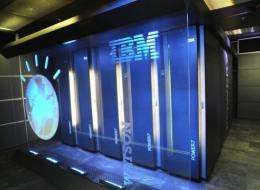
The IBM supercomputer, named "Watson" seen here, is playing two games of Jeopardy! over the next three days against Ken Jennings, who holds the show record of 74 straight wins, and Brad Rutter, winner of $3.25 million in prize money.
An IBM computer displayed a few quirks but played to a draw on the opening day of a man vs. machine showdown with two human champions of the popular US television game show Jeopardy!.
"Watson," a supercomputer named after the founder of the US technology giant Thomas Watson, and human contestant Brad Rutter each had $5,000 after the first day of the three-day match.
The other human player, Ken Jennings, was trailing the pair with $2,000.
Watson, represented on stage by a large computer monitor, was frequently quicker to the buzzer than Rutter and Jennings, correctly answering questions in its artificial voice.
Jeopardy!, which first aired on US television in 1964, tests a player's knowledge in a range of categories, from geography to politics to history to sports and entertainment.
A dollar amount is attached to each question and the player with the most money at the end of the game is the winner. Players have money deducted for wrong answers.
In a twist on traditional game play, contestants are provided with clues and need to supply the questions.
Watson receives the clues electronically by text message at the same time as they are revealed to the human contestants. The first player to hit the buzzer gets to answer the question.
Watson showed an impressive grasp of the Beatles songbook.
"What is Maxwell's silver hammer?" replied Watson to the clue "Bang, bang, his silver hammer came down upon her head," a reference to the Beatles song.
"What is Eleanor Rigby?" Watson answered correctly to the clue "She died in the church and was buried along with her name, nobody came."
Watson at one point built up a commanding lead with $4,000 to $200 each for Rutter and Jennings.
But the machine then began to slip up, oddly repeating a wrong answer to a question Jennings had already answered incorrectly.
Jennings wrongly identified the 1920s as the decade during which the crossword puzzle and the Oreo cookie were introduced.
Given its chance, Watson also said in the 1920s.
"No, Ken said that," Jeopardy! host Alex Trebek admonished Watson.
Rutter then answered correctly -- the 1910s.
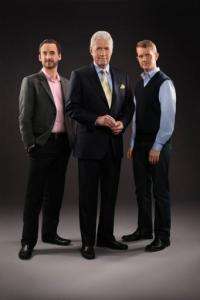
L-R: Contestant Brad Rutter, Jeopardy host Alex Trebek and contestant Ken Jennings. An IBM computer displayed a few quirks but played to a draw on the opening day of a man vs. machine showdown with two human champions of the popular US television game show Jeopardy!.
On another question, about a one-legged US Olympic champion, the clue was "It was the anatomical oddity of US gymnast George Eyser who won a gold medal on the parallel bars in 1904."Watson replied "What is a leg?" instead of "What is missing a leg?"
"Watson's very bright, very fast but he has some weird little moments once in a while," Trebek said.
Watson, which is not connected to the Internet, plays the game by crunching through multiple algorithms at dizzying speed and attaching a percentage score to what it believes is the correct response.
Watson, which has been under development at IBM Research labs in New York since 2006, is the latest machine developed by IBM to challenge mankind -- in 1997, an IBM computer named "Deep Blue" defeated world chess champion Garry Kasparov in a six-game match.
Developing a supercomputer that can compete with the best human Jeopardy! players, however, involves challenges more complex than those faced by the scientists behind "Deep Blue," according to IBM researchers.
Watson uses what IBM calls Question Answering technology to tackle Jeopardy! clues, gathering evidence, analyzing it and then scoring and ranking the most likely answer.
"You are about to witness what may prove to be an historic competition -- an exhibition match pitting an IBM computer system against the two most celebrated and successful players in Jeopardy! history," Trebek said to kick off the show.
Jennings holds the Jeopardy! record of 74 straight wins while Rutter won a record $3.25 million on the show.
The winner of the Jeopardy! showdown is to receive $1 million. Second place is worth $300,000 and the third place finisher pockets $200,000.
IBM plans to donate 100 percent of its winnings to charity. Jennings and Rutter plan to give 50 percent of their prize money to charity.
(c) 2011 AFP
-
From lemons to lemonade: Reaction uses carbon dioxide to make carbon-based semiconductor,
28 comments
-
Thioridazine kills cancer stem cells in human while avoiding toxic side-effects of conventional cancer treatments,
3 comments
-
SpaceX private rocket blasts off for space station (Update),
42 comments
-
Climate scientists say they have solved riddle of rising sea,
30 comments
-
Scotland passes turbine test to harness tidal power,
41 comments
-
Ideas to mitigate risk of 911 calls being misdirected
May 24, 2012
-
Live scribe pen?
May 10, 2012
-
Shallow water flow simulation
May 07, 2012
-
Tablet for taking notes?
May 05, 2012
-
Best fit tablet for me?
May 05, 2012
-
Measure of Informaton
May 04, 2012
- More from Physics Forums - Computing & Technology
More news stories
SpotterRF debuts Radar Backpack Kit (w/ Video)
(Phys.org) -- SpotterRF has announced a special radar backpack kit designed to enhance situational awareness for soldiers on the ground. The company says its special radar is designed for warfighters as part ...
Probability of contamination from severe nuclear reactor accidents is higher than expected: study
Catastrophic nuclear accidents such as the core meltdowns in Chernobyl and Fukushima are more likely to happen than previously assumed. Based on the operating hours of all civil nuclear reactors and the number ...
Technology / Energy & Green Tech
May 22, 2012 |
3.5 / 5 (18) |
49
|
Delphi gasoline-injection engine technique rivals hybrid's edge
(Phys.org) -- Running a diesel like engine on gasoline is something Delphi is doing in notable fashion. They claim they are on to a promising way to enjoy an engine that gives the vehicle owner high efficiency ...
HyperSolar shows dirty water no barrier to power world
(Phys.org) -- The Santa Barbara, California, company, HyperSolar, is set to transparently share the ups and downs of its research experiences toward the companys ultimate vision, successfully producing ...
Tesla to launch electric sedan in US on June 22
Tesla Motors said Tuesday it would begin deliveries of "the world's first premium electric sedan" on June 22, slightly ahead of schedule.
Technology / Energy & Green Tech
May 22, 2012 |
4.5 / 5 (11) |
18
Australia hails surprise super-telescope decision
Australia has hailed a surprise decision giving it a role in a radio telescope project aimed at revolutionising astronomy, vowing to draw on its decades of experience in space science.
Astronomers seize last chance in lifetime for Venus Transit
Astronomers are gearing for one the rarest events in the Solar System: an alignment of Earth, Venus and the Sun that will not be seen for another 105 years.
Thousands of shellfish found dead in Peru
Thousands of crustaceans were found dead off the coast of Lima following the mystery mass death of dolphins and pelicans, the Peruvian Navy said Friday.
SpaceX capsule has 'new car' smell, astronauts say
SpaceX's Dragon cargo vessel smells like a new car, said astronauts at the International Space Station after opening the hatches Saturday following the spacecraft's landmark mission to the orbiting lab.
Family history of Alzheimer's affects functional connectivity
(HealthDay) -- Cognitively normal individuals with a family history of late-onset Alzheimer's disease (AD) may display lower resting state functional connectivity in the default mode network (DMN) of the brain, ...
Astronauts enter world's 1st private supply ship
(AP) -- Space station astronauts floated into the Dragon on Saturday, a day after its heralded arrival as the world's first commercial supply ship.

Feb 15, 2011
Rank: not rated yet
Feb 15, 2011
Rank: not rated yet
Feb 15, 2011
Rank: 1 / 5 (1)
Feb 15, 2011
Rank: 1 / 5 (1)
Feb 15, 2011
Rank: not rated yet
Also, Watson goofed up when Ken answered 20's, then Watson buzzed in and said 1920's. Apparently Watson didn't have any record of Oreos or Crossword puzzles in the 1910's.
Feb 15, 2011
Rank: 1.5 / 5 (2)
Feb 15, 2011
Rank: not rated yet
Wouldn't that add another variable for failure for Watson? If Trebek pronounces something strangely at least the human competitors can read what's on the board. I would think the text message system would be most accurate and ensure they all get the clue at the same time.
Feb 15, 2011
Rank: 1 / 5 (1)
Feb 16, 2011
Rank: not rated yet
That is just something that is missing from the program: Parsing the incorrect input from answers by other contestants to narrow down its search.
The added complexity of providing Watson with these clues is enormous, while the number of occurrences (where a false answer by another actually helps you decide upon your answer) are few.