Computer crushes human 'Jeopardy!' champs (Update)
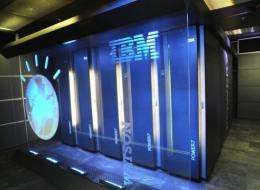
The IBM supercomputer, named "Watson" seen here, is playing two games of Jeopardy! over the next three days against Ken Jennings, who holds the show record of 74 straight wins, and Brad Rutter, winner of $3.25 million in prize money.
An IBM computer crushed two human champions Tuesday in the second round of a man vs. machine showdown on the popular US television game show "Jeopardy!"
Most of the banter and gentle humor that usually pepper the popular quiz show was gone as the supercomputer dominated the game by beating his human opponents to the buzzer again and again.
Ken Jennings -- who holds the "Jeopardy!" record of 74 straight wins -- shook his buzzer in silent frustration as the computer's artificial voice answered the first dozen challenges without pause, getting all but one right.
"Watson" - named after Thomas Watson, the founder of the US technology giant -- receives the clues electronically by text message at the same time as they are revealed to the human contestants.
The first player to hit the buzzer gets to answer the question. The others only get a chance if the first player gets the answer wrong.
Watson, which is not connected to the Internet, plays the game by crunching through multiple algorithms at dizzying speed and attaching a percentage score to what it believes is the correct response.
It beat Jennings and Brad Rutter -- who won a record $3.25 million on the show -- to the buzzer on 24 of 30 questions.
Five-time "Jeopardy!" champion Jeffrey Spoeri sympathized with Jennings and Rutter, and said the computer's speed to the buzzer seemed like an unfair advantage.
"I gotta root for the humans," said Spoeri, who won 105,000 dollars on the show in November 2006.
But he was deeply impressed with the computer's skills.
"The actual game play was just amazing, that it would know the answers and discern which one is the correct one," Spoeri told AFP after viewing the first show.
"It's a terrific experiment."
Watson, which has been under development at IBM Research labs in New York since 2006, is the latest machine developed by IBM to challenge mankind.
In 1997, an IBM computer named "Deep Blue" defeated world chess champion Garry Kasparov in a six-game match.
"Jeopardy!", which first aired on US television in 1964, tests a player's knowledge in a range of categories, from geography to politics to history to sports and entertainment.
A dollar amount is attached to each question and the player with the most money at the end of the game is the winner. Players have money deducted for wrong answers.
In a twist on traditional game play, contestants are provided with clues and need to supply the questions.
Watson showed an impressive knowledge of pop culture, answering "Who is the Church Lady" to the challenge "A Dana Carvey character on 'Saturday Night Live.'"
Watson was quick to the punch on history, geography, medicine and art -- jumping in with the second largest city in New Zealand, the founder of Cambridge's Trinity College, the names of stolen artwork, and types of diseases.
Most impressive was his ability to interpret the challenges, answering "What is narcolepsy?" to the question "You just need a nap. You don't have this sleep disorder that can make sufferers nod off while standing up."
Jennings managed to get three correct answers in while Rutter won two.
None were able to identify a portrait of Spanish King Phillip II as that which was stolen at gunpoint from an Argentina gallery in 1987.
The computer stumbled badly in the usually critical final "Jeopardy!" round.
The audience groaned when Watson answered "What is Toronto????" to the question: "Its largest airport is named for a WWII hero. Its second largest, for a WWII battle" under the category "US Cities."
Jennings and Rutter both gave Chicago as the correct answer.
But even though they wagered nearly all their winnings on the challenge, they couldn't catch up to Watson's lead.
Watson ended the second day of the three day challenge with $35,734 while Rutter had $10,400 and Jennings had $4,800.
The final round airs Wednesday.
(c) 2011 AFP
-
From lemons to lemonade: Reaction uses carbon dioxide to make carbon-based semiconductor,
28 comments
-
Thioridazine kills cancer stem cells in human while avoiding toxic side-effects of conventional cancer treatments,
3 comments
-
SpaceX private rocket blasts off for space station (Update),
42 comments
-
Climate scientists say they have solved riddle of rising sea,
30 comments
-
Scotland passes turbine test to harness tidal power,
41 comments
-
Ideas to mitigate risk of 911 calls being misdirected
May 24, 2012
-
Live scribe pen?
May 10, 2012
-
Shallow water flow simulation
May 07, 2012
-
Tablet for taking notes?
May 05, 2012
-
Best fit tablet for me?
May 05, 2012
-
Measure of Informaton
May 04, 2012
- More from Physics Forums - Computing & Technology
More news stories
SpotterRF debuts Radar Backpack Kit (w/ Video)
(Phys.org) -- SpotterRF has announced a special radar backpack kit designed to enhance situational awareness for soldiers on the ground. The company says its special radar is designed for warfighters as part ...
Probability of contamination from severe nuclear reactor accidents is higher than expected: study
Catastrophic nuclear accidents such as the core meltdowns in Chernobyl and Fukushima are more likely to happen than previously assumed. Based on the operating hours of all civil nuclear reactors and the number ...
Technology / Energy & Green Tech
May 22, 2012 |
3.5 / 5 (18) |
49
|
Delphi gasoline-injection engine technique rivals hybrid's edge
(Phys.org) -- Running a diesel like engine on gasoline is something Delphi is doing in notable fashion. They claim they are on to a promising way to enjoy an engine that gives the vehicle owner high efficiency ...
HyperSolar shows dirty water no barrier to power world
(Phys.org) -- The Santa Barbara, California, company, HyperSolar, is set to transparently share the ups and downs of its research experiences toward the companys ultimate vision, successfully producing ...
Tesla to launch electric sedan in US on June 22
Tesla Motors said Tuesday it would begin deliveries of "the world's first premium electric sedan" on June 22, slightly ahead of schedule.
Technology / Energy & Green Tech
May 22, 2012 |
4.5 / 5 (11) |
18
Australia hails surprise super-telescope decision
Australia has hailed a surprise decision giving it a role in a radio telescope project aimed at revolutionising astronomy, vowing to draw on its decades of experience in space science.
Astronomers seize last chance in lifetime for Venus Transit
Astronomers are gearing for one the rarest events in the Solar System: an alignment of Earth, Venus and the Sun that will not be seen for another 105 years.
Thousands of shellfish found dead in Peru
Thousands of crustaceans were found dead off the coast of Lima following the mystery mass death of dolphins and pelicans, the Peruvian Navy said Friday.
SpaceX capsule has 'new car' smell, astronauts say
SpaceX's Dragon cargo vessel smells like a new car, said astronauts at the International Space Station after opening the hatches Saturday following the spacecraft's landmark mission to the orbiting lab.
Family history of Alzheimer's affects functional connectivity
(HealthDay) -- Cognitively normal individuals with a family history of late-onset Alzheimer's disease (AD) may display lower resting state functional connectivity in the default mode network (DMN) of the brain, ...
Astronauts enter world's 1st private supply ship
(AP) -- Space station astronauts floated into the Dragon on Saturday, a day after its heralded arrival as the world's first commercial supply ship.
Feb 15, 2011
Rank: 1.3 / 5 (16)
If the comp could see ,hear, taste, feel,smell, would the validity of its prowess be more, humm...'acceptable?
In a future, near or far, we give comps the ability to sleep/dream/feel-and have emotions- to hunger and thirst and make their own offspring: I can see; it would be MUCH easier to defeat them after undergoing a socialization! Watson is a brilliant tool BUT if he were 'smart' he would have NOT beat the humans to every buzzer so that no one would site his electronic or mechanical speed as an advantage...Watson needs to, in fact, 'grow up' to really win!
Feb 15, 2011
Rank: 4.6 / 5 (9)
That Watson comes up with the answer faster than they do is part of the point. He also has to physically buzz in the same way the players do.
Feb 15, 2011
Rank: 5 / 5 (3)
Feb 15, 2011
Rank: 1 / 5 (6)
Feb 15, 2011
Rank: 4 / 5 (9)
Eh, why? Teaching isn't (or shouldn't be) just about regurgitating facts, otherwise you might as well read an encyclopedia.
Feb 16, 2011
Rank: 2.2 / 5 (13)
Not sure why this is supposed to be exciting... I eagerly await the day when a computer actually UNDERSTANDS the answer it is giving.
Feb 16, 2011
Rank: 4.6 / 5 (9)
It's exciting because Watson needs to understand the question (which is in natural language) before it can answer.
Computers have always been good at regurgitating data, provided it is input in a structured form. Watson is the first, really good algorithm, for parsing natural language.
Feb 16, 2011
Rank: 4 / 5 (5)
So what if it's an advanced indexing system? That's pretty much what our brains are. You have stored data which you need to access. If someone asks you who plays a certain song, you access your data based on the input query.
It made me think of the computer on the Enterprise. It will be awesome to ask a computer a question in the future and have a single answer returned instead of 10 million pages to sift through.
Feb 16, 2011
Rank: 3.7 / 5 (3)
But it doesn't really "understand" it or even parse it. To my understanding, it works a bit like Google's translator - a big database of keywords and phrases linked up with scores of possible answers. It's a statistical analysis machine that is "smart" because it basically knows the questions and answers beforehand, even though they may not necessarily be written down in exactly the same way in its memory. It pieces together the question out of pieces that seem to match the input.
That's why it answered "Toronto" when the topic was US cities, and why Google sometimes gets simple things wrong like the difference between "is" and "is not"
Feb 16, 2011
Rank: 3 / 5 (2)
I guess it's a good thing because IBM programmers have more work to do. This is a great start.
Feb 16, 2011
Rank: 5 / 5 (2)
The difference is that your brain indexes the data based on what it means. If you ask it the question, "There's a white castle where a big man lives, controls the united tribes of the great land of the eagle.", Watson would probably be completely clueless because it has no keywords to match that exact phrase with "Washington D.C." unless programmed to do so. But then, it may just as well trip over "white castle" and "big man", and answer "What are hamburgers?" - a mistake that no thinking person would do.
It has syntax, but no semantics.
Feb 16, 2011
Rank: 5 / 5 (1)
I suppose that's because there are several Torontos in the United States.
Feb 16, 2011
Rank: 5 / 5 (9)
"Its largest airport is named for a WWII hero. Its second largest, for a WWII battle"
"Toronto is the 2nd largest city in Jefferson County, Ohio, United States" - Wikipedia.
Then there's the Goodyear Aircraft Corporation which was based in Ohio, and many war heroes came from Ohio. Doing a related keywords search on WW2 hero, WW2 battle, airport, "second largest", US cities etc. easily produces a stronger signal on Toronto, Ohio, because the machine doesn't understand what part of the question is essential and what should be taken literally.
Feb 16, 2011
Rank: 5 / 5 (7)
Yet that seems enough to beat the human champions in this particular game (which has always been associated with contestants of above average intelligence). And pretty decisively at that.
That a computer would make different mistakes than humans (i.e. some that seem obvious to humans) isn't particularly startling. Conversely, if the humans had given more answers, we would certainly have seen things that are 'obvious' to Watson but aren't obvious to humans. So this isn't really an argument for human superiority.
Pretty exciting stuff.
Feb 16, 2011
Rank: 4 / 5 (1)
Feb 16, 2011
Rank: 4.5 / 5 (4)
I'm with you 100% in your enthusiasm and the significance of Watson's achievement, but I don't think this is a major step in AGI. It's an achievement in natural language processing, information indexing and relevance evaluation, but not general intelligence.
Feb 16, 2011
Rank: 1 / 5 (1)
But that isn't really amazing. Throw in enough data and processors, and it was bound to do so by sheer brute force.
That's like pitching Usain Bolt against a motorcycle on a track. It isn't a running competition anymore.
Feb 16, 2011
Rank: 5 / 5 (5)
What is still missing is the creativity aspect of intelligence by combining seemingly unrelated issues and noticing their common ground and the more elusive aspect of 'raw' creativity.
..and, of course, self awareness.
But as with all scientific endeavours: it's a process. Start with the (seemingly) easy things of parsing language and work from there on up.
It is if you have ever worked in language processing. Searching for data is not the problem. Deciding WHAT you are searching for is tricky. A large database will not help you with that.
Feb 16, 2011
Rank: 1 / 5 (1)
But the computer doesn't have to be intelligent to pass off as a person. It only needs someone to program it with a huge number of logical permutations of conversations so that it would simply overwhelm the ability of the human to poke holes in its programming.
And that's the way these machines are built, because it's easier to just deliver the result than replicate the process. If you just want to beat Usain Bolt in a race, you don't build a running robot, you launch a friggin rocket and that's that.
Feb 16, 2011
Rank: not rated yet
Seems to work just fine for Google Translator. They operate on a huge dataset of written language where the translation is known, and then match pieces of phrases and individual words with the best match in the database. In the best case, they already have the entire sentence translated and all they have to do is query it.
It's a very very similiar problem.
Feb 16, 2011
Rank: not rated yet
In my understanding, these machines aren't really trying to parse language, rather than simply trying to see if they already have a similiar string of data stored in memory.
To the machine, the input is "doo dah dah", and it finds it has "doo dah doh" stored in memory, so it determines that it's close enough and follows the link to the desired output result. Or perhaps it also has "doh dah dah" which is an equally good match, so it combines the results or tries to determine which of the results is more important based on some rules like "nouns before adjectives" etc.
Add a few more levels of complexity and some statistical analysis, and you have a Watson. It's not trying to find the relationships between "doo" and "dah" and "doh" because they're meaningless to the machine.
Feb 16, 2011
Rank: 4 / 5 (1)
Yes, indeed.
Yes, but I doubt that that is the intended purpose here, ie to design a general intelligence. A different project is much more likely to achieve that then Watson, namely, the Blue Brain project.
Feb 16, 2011
Rank: not rated yet
Feb 16, 2011
Rank: 5 / 5 (2)
Blue Brain - despite its name - is not a project aimed at AI. It only models a cortex (e.g. it is used to figure out how lesions or chemical imbalances will affect the reaction of neurons). It's a neural simulator, not an evolving network. Even so, it's an awesome project.
I doubt it's that simple. Look at the narcolepsy question. There are no obvious keywords (besides 'disorder') in there.
I would agree that to us 'easier' questions are harder for Watson because the generality of the clues would make it harder for it to narrow down the search. Though then even a human would need more clues. There are plenty of sites where within 20 questions the database will figure out what you are thinking of with high accuracy.
Feb 16, 2011
Rank: 5 / 5 (1)
Yes, I understand that, but I think it's eminently placed to spawn spin-off projects which do focus on AGI.
Only? That's a pretty darn big chunk of what makes us smart.
In fact, it's much more than what most people might think of as a 'simulation'. It reproduces all the physical functionality of neurons and how they interconnect, down to the minutest detail. These aren't simple abstractions that have been used in traditional neural network AI research.
If you can accurately simulate the brain's electro-chemical function enough to be clinically useful (which is the aim of Blue Brain), then you really aren't that far away from AI application.
Feb 16, 2011
Rank: not rated yet
Feb 16, 2011
Rank: not rated yet
Feb 16, 2011
Rank: not rated yet
Feb 16, 2011
Rank: 4 / 5 (1)
When I was working as a project manager in a translation company I found the opposite. Automated single word translations tend to be awful, since the translator lacks context (human translators are pretty bad under those circumstances, too, but they can improve if you give them even minimal context). It's hard to provide an automated translation system with context.
Intelligence requires making and breaking of connections. If you don't model that (which Blue Brain doesn't) then the best you can get is information retrieval and stimulus response. And even that is tricky since we can't yet interpret what a certain mindstate means (Blue Brain has no real sensors/actors).
Feb 16, 2011
Rank: 5 / 5 (2)
No, it isn't. You could say it's intelligent within a restricted domain of expertise, but venture outside it, and it will fall in a heap. Another words, it doesn't exhibit general intelligence.
No, it will take much more than that.
Sure. People become emotionally attached to all kinds of things, even pet rocks. :)
I don't think I'd fancy being assimilated (unless it was by 7 of 9).
Feb 16, 2011
Rank: not rated yet
It doesn't, but it could, or rather, a different project that's based on similar principles (I know BB is funded purely for medical applications).
Again, a different project could have these. But granted, that would add another level of complexity into the mix, but I think a true AGI will need at least audio and visual inputs, as well as autonomous mobility, otherwise it will probably go crazy, being trapped inside a blue box!
Feb 16, 2011
Rank: not rated yet
Rather Google Translator is an excellent tool for the human (semi-/professional) translator who needs a quick list of target words in order to optimize the phrasing in the target language. It's more like using a synonym dictionary for the target language.
Feb 16, 2011
Rank: 4 / 5 (1)
I think for an AI you don't need all the specifics of Blue Brain. You need abstractions thereof. E.g. Blue Brain models a lot of stuff with ion channels, hormones and whatnot which aren't really relevant to the AI subject. In many respects it is overpowered (and in many more it is underpowered) when comparing it to an AI model. I'd say the two approaches share little with one another.
Biological brains (and Blue Brain) exist within a 3D setup. In this setup access to nutrients and possibly reachable neighboring neurons is restricted by the 3D topology.
In an nD setup (as could be easily modeled in a computer for AI models) those restrictions need not apply.
Feb 16, 2011
Rank: 5 / 5 (1)
natural language processing is hard. no question. Is watson something to get excited about- YES. IT was asked questions in various abstract fashions and still arrived at the correct answer many times. The fact it wasn't perfect means nothing actually. It performed better than a human doing the same task -- that is one of the definitions of AI.
Google translate - this massive beast of a program uses A LOT of human processing power. Google created games and put them in the public space where a human matched a word to a picture -- this was done across a few languages and relationships were created based on confidence levels -- how many people agreed with what this person responded with.
this is all very abstract and challenging to program -- but it very closely mimicks how we percieve words - whether written or spoken.
No computer on the planet except Watson has shown capacity to do this.
Feb 16, 2011
Rank: not rated yet
1) The ability of a machine - machine meaning hardware or software or both - to perform a task that previously was done exclusivly by a human and performing better than that human.
2) a machine - same definition as above - that can pass a turing test. the test is if a human were to ask it a set of questions - by the end the human would not be able to determine that what gave the answers was a machine.
Google translate: i was not implying that humans are translating things on the fly but just introducing that Google stored a lot of data using very abstract ways to create translation software -- and picture identification software that many people are not aware of.
Feb 16, 2011
Rank: not rated yet
are humans intelligent -- well only compared to the other animals on the planet -- and then only in context - we have all seen videos of humans doing unintelligent actions.
is a dog intelligent -- is a cat -- is a pig ???
All three of those animals recognize themsleves in a mirror. And they all can do rudimentary counting. - they know if they are missing an offspring from a litter and will go look for it. which means the concept of less and more is understood by the animal. does this mean that they can do arithmetic - NO - but it shows that animals can attain a level of abstract thought.
is Watson intelligent -- well it all depends on context -- can it problem solve - appearently
-- can it do basic and complex math, well theres an app for that.
will it understand what it is doing -- well do you understand what you are doing at all times and do you think through all actions?? -
no you do not
but watson does.
Feb 16, 2011
Rank: not rated yet
Here, I wil quote from the article:
"Five-time "Jeopardy!" champion Jeffrey Spoeri sympathized with Jennings and Rutter, and said the computer's speed to the buzzer seemed like an unfair advantage."
You say Watson had to answer"...the same way.." I ask, did you see Watson's hand come down on the buzzer? If Watson were 'smart' that is contextually and socially he would have told his inventors, "you really should give me a hand with which to ring the buzzer." DO I blame the machine? NO! Is it a great tool? YES!
Feb 16, 2011
Rank: 5 / 5 (1)
It is too bad we can't let all these critics play a game or two of Jeopardy and then analyze the answers that they give.
Did any of you people ever see Jennings or Rutters play? They are both amazing Jeopardy players. The fact that Watson beat them is just incredible. Its sad that people can't recognize what a monumental accomplishment this is.
Feb 16, 2011
Rank: not rated yet
Yes its cool - yes it will advance knowledge sharing - but its not as fantastic as people are being led to believe. Nice IBM job on PR.
Feb 16, 2011
Rank: not rated yet
Feb 16, 2011
Rank: 5 / 5 (1)
Feb 16, 2011
Rank: 5 / 5 (1)
Feb 16, 2011
Rank: not rated yet
Software side this is a truly major accomplishment and this is just a show of new abilities we are making computers capable of doing.
As far as being fair I think they did very good considering the mass differences of a machine to a person. I think what people need to be really impressed with is the fact it took so much hardware and resources to match just a very small aspect of what the human mind can do. So by no means are computers even close to becoming human-like robots.
Feb 16, 2011
Rank: 5 / 5 (1)
Feb 16, 2011
Rank: not rated yet
I did exactly the same test and agree with you.
Feb 16, 2011
Rank: not rated yet
Feb 16, 2011
Rank: not rated yet
Feb 16, 2011
Rank: 5 / 5 (1)
Feb 16, 2011
Rank: 3 / 5 (2)
No, that's not quite right. Watson cannot see nor hear. The questions are fed to it electronically, like text messaging.
No, it's much more significant than that. Yes, it seems a little less 'cool' that Watson isn't responding to spoken words, but the feat is no less special than if, say, a deaf person read the questions rather than hearing them.
I'd love to see this tech applied to something like Wolfram Alpha.
Feb 16, 2011
Rank: not rated yet
I disagree. They said that when asked a question, Watson runs simultaneous algorithms for puns, rhymes, geography, etc. When I play Jeopardy, I consider that maybe my "geography" answers is too literal and I misunderstood the question and then I try to determine the answer using puns or word play. You assume our understanding of the meaning of the question is just given. The "meaning" has to be weighed against different factors and then we decide whether it's more probable that it's a joke or if it is not. Sometimes we are wrong, and that demonstrates that we don't always understand the meaning. I've seen players completely miss the point and give a ridiculous answer that didn't make sense.
Feb 16, 2011
Rank: not rated yet
the next step is a computer that understands human idiosyncracies. what would watson do with a question that makes no sense? would it try to rephrase the question so it makes sense? would the next evolution in AI make a joke and insult the erroneous human? Show me an AI that knows how the human mind works. if watson can't hold a conversation, then it really is nothing more than a glorified indexing machine.
Feb 16, 2011
Rank: not rated yet
It's more than an indexing system. It also is able to understand the question (most of the time). That is a fantastic accomplishment. And the way Jeopardy asks the question (or gives the answer) often isn't simple.
Feb 16, 2011
Rank: not rated yet
Feb 16, 2011
Rank: 1 / 5 (1)
Yep sure is. Just shows how some smoke and mirrors can fool the ignorant!
Feb 17, 2011
Rank: 1 / 5 (1)
Feb 17, 2011
Rank: not rated yet
WHat do you mean by "understanding?" if what you mean is what it sees, hears, smells then understanding means not more than electrical signals. Does this sentence sound familiar from a famous movie?
Feb 18, 2011
Rank: 5 / 5 (2)
Google Translator "understands" that it is Indonesian, but Google is wrong.
Some people, however, smile when having read these signals or symbols. Why?
Feb 19, 2011
Rank: 0.3 / 5 (24)
Can you precisely tell us what you mean by "understand" and why the current program doesn't
already "understand".
Feb 19, 2011
Rank: 0.3 / 5 (24)
Or is it a neural network combined with other higher level analysis.
The fact is you don't have a clue to how it works, and you are the one just throwing out random ideas, like a monkey pushing buttons.
Feb 19, 2011
Rank: 0.3 / 5 (24)
Ya, just like a dog or a cat.
Feb 19, 2011
Rank: not rated yet
Feb 19, 2011
Rank: not rated yet
or just like Vendicar_Decarian but with little or nothing to index!
Feb 20, 2011
Rank: not rated yet
Feb 20, 2011
Rank: 5 / 5 (2)
Watson is a comparitive search algorithim that operates based on the usage and context of words processed through a large set of rules and a massive bank of raw definition based data.
Watson cannot innovate, nor could he perform research. It is not comparable to human intellect in any manner, however, in the evolution of computing, Watson is impressive. We're approaching an understanding of the complexity fo the brain from the top down and the bottom up through research like Watson. The more complex a decision matrix becomes, the closer to intelligence it appears to be.
Feb 20, 2011
Rank: 5 / 5 (1)
I would also like to add compared to size the computer doesn't come close to the wonder of a human mind.
Maybe some day dear Watson, maybe some day!
Feb 20, 2011
Rank: 5 / 5 (2)
The NOVA PBS special on Watson was excellently descriptive. Showed the tuning process and structure of the arguments. It's beautifully simple and very similar to how one would teach a child.
For example: The question posed to Watson is "what fruit is also a color?" His answer "red apple". Which is obviously wrong to all of us, but that's because he didn't understand that "sometimes orange is a fruit and not a color". So they'd program that into the rule set and he'd start getting that question correct.
The performance on the Jeopardy test was incredible because of how Jeopardy questions are constructed. It was amazing to watch Watson reorg the rules in his system in order to grasp the correct answer for linguistically tricky queries.
Feb 20, 2011
Rank: 5 / 5 (2)
That maybe true in theory, given unlimited time for developers, but in reality it is impossible to write every possible "if" operator to any given situation. So, the only way to go is to actually write general purpose algorithms, which is pretty much AI.