Seeing the forest through the trees
(PhysOrg.com) -- University of Arizona researcher Brian Enquist and his colleagues have discovered the secret of patterns within individual trees that can be used to describe the structure and functioning of the world's forests.
Imagine you are walking through a forest. All around you are trees of different species, age, size and height. It looks pretty random, right? Wrong.
In research funded by the National Science Foundation, Brian Enquist of the department of ecology and evolutionary biology at the University of Arizona and his team have discovered a secret in the trees: Hidden among and within the architecture of the branches are fundamental rules that link the size, shape, age and in fact everything about a single tree to all the trees in a forest.
"Everyone knows more or less what a tree looks like, or what a root system looks like," said Enquist. "And it turns out that those architectures, even though they look very diverse and different, are being generated by very simple and common rules across all plants. These rules basically govern how plants branch, when they branch and the sizes and shapes of those branches, and the structure and functioning of forests across the globe."
Understanding these rules has allowed Enquist and his team to make accurate predictions about how plants and even whole forests work, in particular how they flux carbon dioxide. "If you know something about the branching network, you can make predictions about the whole plant's functioning. Then you can extend that to understand the ecology of the entire forest."
The rules appear both in the external branching architecture, or how the branches are arranged, and in the internal structure of the tissues that transport nutrients throughout the tree.
"The rule is basically ‘grow so much and then branch, and then grow so much and then branch,'" said Enquist. "The rule governs what the dimensions of the branches have to be. That is, ‘grow until your branch is such and so much length, or so much in width.' Repeating this rule as a plant grows results in a tremendously complicated but beautiful form such as a tree, but it ultimately can stem down to a very efficient code."
This rule or code reoccurs as the tree grows, creating a fractal – a repeating pattern – like a spiral of daughter branches emanating from the mother branch or tree trunk.
These rules hold true across species, so the ratios of lengths and radii of a mother branch to daughter branches are the same for almost all trees. But palm trees don't count: "That's basically one big branch with a bunch of leaves at the end," said Enquist.
But imagine you're standing in a forest again: the trees around you probably all look pretty different. "There're different flavors of the rule, and that's why you have different types of trees," said Enquist.
If you take a pine tree and a maple tree and look at the dimensions of radii and lengths between the nodes, or places where a new branch grows off an old one, "you'll have a very difficult time separating out the differences between species even though the form itself looks very different," said Enquist. The difference in species is part of what creates the apparent diversity of tree forms that you see in a forest.
"There are additional branching rules that can also kick in," said Enquist. "You can still follow these basic branching rules of radii and lengths, but if you change the angles at which you branch that gives you a tremendously different looking tree."
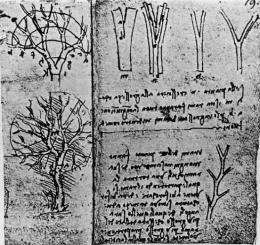
"And you know who actually the first person was to point this out? Leonardo Da Vinci. He discovered that if you have these constant branching ratios you're able to draw a realistic tree," said Enquist. "Some of these rules are known as Leonardo's rules, but few have really explored the functional implication of Leonardo's rules in plants."
Until now.
In a series of recent studies all published in the Proceedings of the National Academy of Sciences, Enquist and his team determined that the same rules that govern when a tree branches and the dimensions of that branch also govern the structure of internal vascular tissues, called xylem and phloem, that transport nutrients throughout the plant. The studies have showed how these branching rules then go on to underlie the structure and function of the world's forests.
So why do these rules exist in the first place?
Enquist and his collaborators predicted that natural selection would select for shapes of trees that, as it grew from seedling to adult plant, solved two important problems: taking in as much resources such as light, water and nutrients as possible but yet transporting resources within the plant with as little work as possible. "There are these two conflicting pressures, and we call these a tradeoff in biology," said Enquist.
It's like when you're hungry and tired, and you want food but don't want to walk far to get it, so you pick the shortest route to the nearest fast-food joint – OK, so maybe you just use the drive-thru. But plants face the same type of scenario without the drive-thru option: how to get food, or resources, with as little work as possible.
For plants, work is transporting nutrients and water through internal tissues called xylem and phloem, and the less energy they have to expend to transport nutrients, the more they have for growth and reproduction.
Ultimately, natural selection has fine-tuned the rules that govern plants' internal and external frameworks to a simple repeating pattern coded for by their DNA.
The internal vascular network governs how water and nutrients are transported within a tree, which influences how much carbon the plant can take in. The external branching network governs a plant's shape, which determines the number of leaves on a tree, which then also influences how much carbon is fluxed within the tree.
"This work is all about the organization and design of biological networks," said Enquist. "They're all around us – we have cardio-vascular systems, we have neural systems, we have plant vascular networks. Biology is basically built around the geometry of vascular networks."
"Vascular networks flux resources, and resources are basically what maintain us," said Enquist. "The speed at which you're able to flux resources will then influence the speed of your physiology: How fast you grow, how long it will take you to reach reproductive maturity, how long ultimately organisms live."
And in the case of trees: "How much carbon dioxide you are able to absorb from the atmosphere."
"Vascular networks are important because ultimately an organism is going to be obtaining resources from the environment and converting that within the body to do work: Make babies or defend territories, all the lovely things that organisms do. That's all fueled ultimately through vascular networks, as vascular networks take resources from one area and shunt them to where they're needed. If you understand the organization of vascular networks you can actually predict an enormous amount about the functioning of organisms."
Because nearly all plants grow by the same network rules, Enquist and his team can scale up to make accurate predictions about the functioning of an entire forest.
In a forest, where resources such as sunlight and water are limited, trees compete with each other to get as much of what they need to live and grow as possible. The result is a fractal-like filling of the forest space, with a few large trees taking up most of the resources and many small trees filling in the cracks. The ratio of big trees to little trees in a forest turns out to be the same as the ratio of big branches to little branches on a single tree from that forest. So Enquist and his team can determine anything they want to about the entire forest by analyzing just one tree.
"If we know something about these rules that govern branching networks, we can start saying something about what may happen in the future," said Enquist. "These branching patterns are so prevalent that they will govern and influence how plants respond in a changing world."
Provided by University of Arizona


