Fingerprints of a gold cluster revealed
February 28, 2011

Fingerprints of a gold cluster revealed

Enlarge

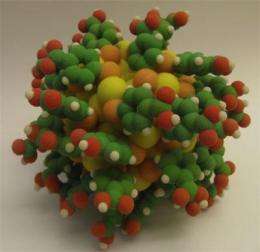
This is an atomistic model of the Au102(p-MBA)44 particle. Gold: yellow, sulfur: orange, carbon: green, oxygen:r ed, hydrogen: white. Credit: Gold:yellow, sulfur:orange, carbon:green, oxygen:red, hydrogen:white.

Nanometre-scale gold particles are currently intensively investigated for possible applications in catalysis, sensing, photonics, biolabelling, drug carriers and molecular electronics. The particles are prepared in a solution from gold salts and their reactive gold cores can be stabilised with various organic ligands. Particularly stable particles can be synthesised by using organothiolate ligands that have a strong chemical interaction to gold. The chemical process of preparing such particles has been known since the mid-1990s and many different stable sizes and compositions are known.

However, the first definite information of their became available only in 2007 when the group of Roger Kornberg (Chemistry Nobel Laureate 2006) at Stanford University succeeded in making single crystals for X-ray diffractometry containing only one type of a particle having 102 and 44 thiolate ligands, the so called Au102(p-MBA)44 particle. The structure was reported in Science in late 2007 [1]. The theoretical analysis of this and other thiolate-protected clusters, led by Professor Hannu Häkkinen at the University of Jyväskylä in Finland, resulted in a theoretical framework that can be used to understand the stability and electronic structure of these . This work was reported in the Proceedings of the National Academy of Sciences in 2008 [2].

Now, researchers in the Department of Chemistry and the Nanoscience Center (NSC) at the University of Jyväskylä, in collaboration with the Kornberg group, report the first full spectroscopic characterisation of the absorption of electromagnetic radiation by the Au102(p-MBA)44 particle in solution and solid phases. The study was published in the Journal of the American Chemical Society on 24 February 2011 [3]. The spectroscopic study was performed in a large range of electromagnetic spectrum from mid-infrared ("heat absorption") to ultraviolet light.

"The study was technically demanding and could only be made now when the Stanford group has succeeded in refining the synthesis to produce pure Au102(p-MBA)44 product in large quantities," explains Adjunct Professor Mika Pettersson, who led the experimental work at the NSC. "We document clear "fingerprint" features in the absorbance spectrum that can be used in the future to benchmark chemical modifications of this particle for various applications. The work also establishes the molecular nature of the clusters by the observation of a band gap of 0.45 eV, in excellent agreement with theory. We were able to analyse these features from large-scale computations using the known structure of Au102(p-MBA)44 and thus fully understand the absorption characteristics of this particle," says Professor Häkkinen.

More information: 1. P.D. Jadzinsky, G. Calero, C.J. Ackerson, D.A. Bushnell and R.D. Kornberg, "Structure of a thiol monolayer-protected gold nanoparticle at 1.1. Ångstrom resolution", Science 318, 430 (2007) (www.sciencemag.org/content/318/5849/430.abstract).

2. M. Walter, J. Akola, O. Lopez-Acevedo, P. D. Jadzinsky, G. Calero, C. J. Ackerson, R. L. Whetten, H. Grönbeck, H. Häkkinen, "A unified view of ligand-protected gold clusters as superatom complexes", Proc. Natl. Acad. Sci. (USA) 105, 9157 (2008) (www.pnas.org/content/105/27/9157). See also http://gtresearchn … lusters.htm.

3. E. Hulkko, O. Lopez-Acevedo, J. Koivisto, Y. Levi-Kalisman, R.D. Kornberg, M. Pettersson and H. Häkkinen, "Electronic and vibrational signatures of the Au102(p-MBA)44 cluster", J. Am. Chem. Soc., online Communication February 24, 2011 : (http://pubs.acs.or … 21/ja111077e)

Provided by Academy of Finland


Rank not rated yet
Relevant PhysicsForums posts
  • Schwartz reagent-- NMR/MS/IR
    created7 hours ago
  • Inversion temp
    created11 hours ago
  • High school chemistry EEI
    created18 hours ago
  • oxidation of I- by KMnO4
    createdMay 25, 2012
  • Invesion temp
    createdMay 25, 2012
  • Hybridization of SnCl3 -
    createdMay 25, 2012
  • More from Physics Forums - Chemistry

More news stories

From lemons to lemonade: Reaction uses carbon dioxide to make carbon-based semiconductor

(Phys.org) -- A materials scientist at Michigan Technological University has discovered a chemical reaction that not only eats up the greenhouse gas carbon dioxide, it also creates something useful. And, by ...

Chemistry / Materials Science

created May 21, 2012 | popularity 4.7 / 5 (88) | comments 28 | with audio podcast

New CO2-removing catalyst can take the heat

(Phys.org) -- The current method of removing the greenhouse gas carbon dioxide (CO2) from the flues of coal-fired power plants uses so much energy that no one bothers to use it. So says Roger Aines, principal ...

Chemistry / Materials Science

created May 24, 2012 | popularity 5 / 5 (7) | comments 7 | with audio podcast

Researchers demonstrate possible primitive mechanism of chemical info self-replication

(Phys.org) -- When scientists think about the replication of information in chemistry, they usually have in mind something akin to what happens in living organisms when DNA gets copied: a double-stranded molecule ...

Chemistry / Materials Science

created May 25, 2012 | popularity 5 / 5 (4) | comments 2 | with audio podcast

High-speed method to aid search for solar energy storage catalysts

Eons ago, nature solved the problem of converting solar energy to fuels by inventing the process of photosynthesis.

Chemistry / Materials Science

created May 25, 2012 | popularity 5 / 5 (3) | comments 3 | with audio podcast

Castor oil: Action mechanism of one of the oldest drugs known to man elucidated

Castor oil is known primarily as an effective laxative; however, it was also used in ancient times with pregnant women to induce labour. Only now have scientists at the Max Planck Institute for Heart and Lung ...

Chemistry / Biochemistry

created May 21, 2012 | popularity 3 / 5 (2) | comments 3 | with audio podcast


SpotterRF debuts Radar Backpack Kit (w/ Video)

(Phys.org) -- SpotterRF has announced a special radar backpack kit designed to enhance situational awareness for soldiers on the ground. The company says its special radar is designed for warfighters as part ...

Australia hails surprise super-telescope decision

Australia has hailed a surprise decision giving it a role in a radio telescope project aimed at revolutionising astronomy, vowing to draw on its decades of experience in space science.

Astronomers seize last chance in lifetime for Venus Transit

Astronomers are gearing for one the rarest events in the Solar System: an alignment of Earth, Venus and the Sun that will not be seen for another 105 years.

Thousands of shellfish found dead in Peru

Thousands of crustaceans were found dead off the coast of Lima following the mystery mass death of dolphins and pelicans, the Peruvian Navy said Friday.

SpaceX capsule has 'new car' smell, astronauts say

SpaceX's Dragon cargo vessel smells like a new car, said astronauts at the International Space Station after opening the hatches Saturday following the spacecraft's landmark mission to the orbiting lab.

Family history of Alzheimer's affects functional connectivity

(HealthDay) -- Cognitively normal individuals with a family history of late-onset Alzheimer's disease (AD) may display lower resting state functional connectivity in the default mode network (DMN) of the brain, ...