Egypt move revives US 'kill switch' debate
February 6, 2011 by Chris Lefkow

Egypt's Internet shutdown has revived debate in the US over how much authority the president should have over the Web

Enlarge

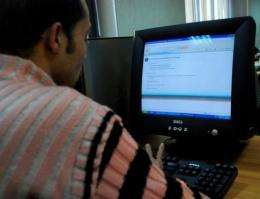
File photo shows an Egyptian man trying to access a website at an internet cafe in Cairo. Egypt's five-day shutdown of the Internet has revived debate in the United States over how much authority the president should have over the Web in the event of a crisis.

Egypt's five-day shutdown of the Internet has revived debate in the United States over how much authority the president should have over the Web in the event of a crisis.

Some opponents of cybersecurity legislation wending its way through the have condemned the bill as a danger to and civil liberties that would equip the White House with an Internet "kill switch."

Supporters deny it would confer any such power on the .

As Hosni Mubarak cut his 80 million people off from the Web, the US senators behind the legislation denounced the move by the Egyptian president as "totally wrong" and leapt to the defense of their bill.

"(Mubarak's) actions were clearly designed to limit internal criticisms of his government," said Joe Lieberman, an independent from Connecticut, Susan Collins, a Republican from Maine, and Tom Carper, a Democrat from Delaware.

"Our cybersecurity legislation is intended to protect the US from external cyberattacks," Lieberman, chairman of the Homeland Security and Governmental Affairs Committee, Collins and Carper said in a joint statement.

"We would never sign on to legislation that authorized the president, or anyone else, to shut down the Internet," they said. "Emergency or no, the exercise of such broad authority would be an affront to our Constitution."

At the same time, the senators continued, "our current laws do give us reason to be concerned" and their bill, which has yet to reach the Senate floor, was designed to replace "broad and ambiguous" presidential authority with "precise and targeted" powers to be used only in a national emergency.

In June, the Electronic Frontier Foundation, American Civil Liberties Union and some two dozen other privacy, civil liberties and civil rights groups wrote a letter to Lieberman, Collins and Carper to express concern about the bill.

"Changes are needed to ensure that cybersecurity measures do not unnecessarily infringe on free speech, privacy, and other civil liberties interests," they said.

"The Internet is vital to free speech and free inquiry, and Americans rely on it every day to access and to convey information," the groups said. "It is imperative that cybersecurity legislation not erode our rights."

Taking note of the concerns, Lieberman, Collins and Carper said "we will ensure that any legislation that moves in this Congress contains explicit language prohibiting the president from doing what President Mubarak did."

"Our bill already contains protections to prevent the president from denying Americans access to the Internet -- even as it provides ample authority to ensure that those most critical services that rely on the Internet are protected," they said.

Cindy Cohn, the EFF's legal director and general counsel, said the latest version of the cybersecurity legislation was an improvement on its "draconian predecessors" but remained wary.

"The Egyptian regime's shutdown of the Internet in an attempt to preserve its political power highlights the dangers of any government having unchecked power over our Internet infrastructure," Cohn said in a blog post.

"The lesson of Egypt is that no one, not even the President of the United States, should be given the power to turn off the Internet.

"(Egypt's move) puts a fine point on the risks to democracy posed by recent Congressional proposals to give the president a broad mandate to dictate how our Internet service providers respond to cyber-emergencies," she said.

"Any proposal to give the president the ability to interfere with Internet access of Americans -- whether to address cyberattacks or for any other reason -- must be tightly circumscribed," she said.

"It must be limited to situations where there are serious and demonstrable external security threats and must be strongly checked by both Congressional and court review."

James Lewis, a cybersecurity expert at the Washington-based Center for Strategic and International Studies, said the cybersecurity bill sets the threshold for invoking the presidential powers "very, very high."

"It's not some arbitrary power to turn off the Internet," Lewis told AFP. "It's an authority consistent with other wartime authorities to act in an emergency.

"It's not an Internet kill switch," he said. "That's just insane. How do you kill a globally distributed network with millions of devices?

"The answer is you don't," Lewis continued. "But you can think about isolating certain domains or certain enterprises.

"Say a big power company gets infected," Lewis said. "You say to them 'Disconnect yourself before you infect other power companies.' It's like an avian flu quarantine for the Internet.

"It's not like where the dictator wakes up in a bad mood and does it," he said. "It would be a legitimate process. It would have to be the threshold of an act of war or a major terrorist event."

(c) 2011 AFP

Filter


Move the slider to adjust rank threshold, so that you can hide some of the comments.


Display comments: newest first

Claudius
Feb 06, 2011

Rank: 5 / 5 (3)

"Our cybersecurity legislation is intended to protect the US from external cyberattacks," Lieberman, chairman of the Homeland Security and Governmental Affairs Committee, Collins and Carper said in a joint statement.
"We would never sign on to legislation that authorized the president, or anyone else, to shut down the Internet," they said. "Emergency or no, the exercise of such broad authority would be an affront to our Constitution."

Doesn't this sound familiar? Remember FISA? Supposed to only allow eavesdropping on "foreign" communications, but bypassed by Pres. Bush, unchallenged?

What is to stop a future President from doing the same with this legislation? Unchallenged.
rwinners
Feb 06, 2011

Rank: 5 / 5 (1)
Has anyone ever heard of Presidential directives? The President can do just about anything he wants during a time of 'declared emergency' without the consent or even knowledge of Congress. This power has been used and the 'orders' can be classified secret.
Good luck, internet.
Eikka
Feb 07, 2011

Rank: not rated yet
"It's not an Internet kill switch," he said. "That's just insane. How do you kill a globally distributed network with millions of devices?


Disrupt the function of the American owned/controlled ICANN and IANA, and the whole internet will be in chaos until others figure out how to assign the numbers again. Without this central authority, the current internet wouldn't function due to the petty arguments over who gets to have what IP address range.

The US is a pretty big deal on the internet. If they decide to shuffle the deck, they can cause some real havoc on international IP routing.
Dinosaw
Mar 17, 2011

Rank: not rated yet
Most people seem to be turning to the internet as their default news source. Curtailing or shutting down the internet, during a crisis, might prove more harmful than good. Nothing gets people more worked up than infectious rumor, as history has shown us repeatedly. Furthermore, checks and balances in our political system were installed for numerous reasons, something history has also shown us more than once.
Rank 5 /5 (1 vote)
Relevant PhysicsForums posts

More news stories

SpotterRF debuts Radar Backpack Kit (w/ Video)

(Phys.org) -- SpotterRF has announced a special radar backpack kit designed to enhance situational awareness for soldiers on the ground. The company says its special radar is designed for warfighters as part ...

Technology / Hi Tech & Innovation

created 10 hours ago | popularity 5 / 5 (2) | comments 10 | with audio podcast report

Probability of contamination from severe nuclear reactor accidents is higher than expected: study

Catastrophic nuclear accidents such as the core meltdowns in Chernobyl and Fukushima are more likely to happen than previously assumed. Based on the operating hours of all civil nuclear reactors and the number ...

Technology / Energy & Green Tech

created May 22, 2012 | popularity 3.5 / 5 (18) | comments 49 | with audio podcast

Delphi gasoline-injection engine technique rivals hybrid's edge

(Phys.org) -- Running a diesel like engine on gasoline is something Delphi is doing in notable fashion. They claim they are on to a promising way to enjoy an engine that gives the vehicle owner high efficiency ...

Technology / Energy & Green Tech

created May 21, 2012 | popularity 4.6 / 5 (17) | comments 33 | with audio podcast report

HyperSolar shows dirty water no barrier to power world

(Phys.org) -- The Santa Barbara, California, company, HyperSolar, is set to transparently share the ups and downs of its research experiences toward the company’s ultimate vision, successfully producing ...

Technology / Energy & Green Tech

created May 24, 2012 | popularity 4.8 / 5 (14) | comments 17 | with audio podcast report

Tesla to launch electric sedan in US on June 22

Tesla Motors said Tuesday it would begin deliveries of "the world's first premium electric sedan" on June 22, slightly ahead of schedule.

Technology / Energy & Green Tech

created May 22, 2012 | popularity 4.5 / 5 (11) | comments 18


Dell tablet leak: 10.1-inch display, two-battery choice

(Phys.org) -- Headline after headline talks about vendors’ tablets in the wings as likely number-one contenders for the iPad. Such claims have justifiably been taken with a grain of salt, considering ...

Scientist: Evolution debate will soon be history

(AP) -- Richard Leakey predicts skepticism over evolution will soon be history. Not that the avowed atheist has any doubts himself.

Keep food safety in mind this memorial day weekend

(HealthDay) -- Picnics, parades and cookouts are as much a part of Memorial Day weekend as tributes to the United States' war veterans.

SpaceX capsule has 'new car' smell, astronauts say (Update)

SpaceX's Dragon cargo vessel smells like a new car, said astronauts at the International Space Station after opening the hatches Saturday following the spacecraft's landmark mission to the orbiting lab.

Australia hails surprise super-telescope decision

Australia has hailed a surprise decision giving it a role in a radio telescope project aimed at revolutionising astronomy, vowing to draw on its decades of experience in space science.

Thousands of shellfish found dead in Peru

Thousands of crustaceans were found dead off the coast of Lima following the mystery mass death of dolphins and pelicans, the Peruvian Navy said Friday.