Discovery arrives at space station for last time
February 26, 2011 By MARCIA DUNN , AP Aerospace Writer
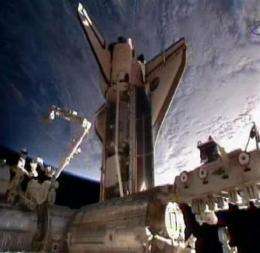
In this frame grab from video taken from NASA television, space shuttle Discovery is seen moments after docking at the International Space Station, its final visit before being parked at a museum, Saturday, Feb. 26, 2011. (AP Photo/NASA)
(AP) -- Space shuttle Discovery arrived at the International Space Station on Saturday, making its final visit before being parked at a museum.
"What took you guys so long?" asked the space station's commander, Scott Kelly.
Discovery should have come and gone last November, but it was grounded by fuel tank cracks. It blasted off Thursday with just two seconds to spare after being held up by a balky ground computer.
"Yeah, I don't know, we kind of waited until like the last two seconds," said shuttle commander Steven Lindsey.
The linkup occurred 220 miles above Australia.
Discovery - flying on its final voyage - will spend at least a week at the orbiting outpost. It's carrying a closet-style chamber full of supplies as well as the first humanoid robot to fly in space.
The compartment will be attached permanently to the space station early next week.
Altogether, there are 12 people aboard the joined spacecraft, representing the United States, Russia and Italy. And in a historic first, four of the five major partners have vessels docked there right now, including cargo ships from Japan and Europe. The entire conglomeration has a mass of 1.2 million pounds, including the shuttle.
It took longer than usual for the hatches to open because of a slight misalignment between the shuttle and station that needed to be corrected. The two skippers shook hands when the doors finally swung open, and there were hugs all around.
It was a quick reunion. The astronauts rushed off to see how far they could get Saturday evening with the installation of a platform holding a spare radiator for the station. The giant shelf was carried up aboard the shuttle.
They worked late, but finally got the platform installed, eight hours after the docking.
Earlier in the day, just before pulling up, Discovery performed a slow 360-degree backflip so space station cameras could capture any signs of launch damage. At least four pieces of debris broke off the fuel tank during liftoff, and one of the strips of insulating foam struck Discovery's belly.
NASA managers do not believe the shuttle was damaged. That's because the foam loss occurred so late in the launch, preventing a hard impact. The hundreds of digital pictures snapped by two space station residents should confirm that; experts on the ground will spend the next day or two poring over all the images.
As a precaution, every shuttle crew since the 2003 Columbia disaster has had to thoroughly check for possible damage to the thermal shielding, which must be robust for re-entering Earth's atmosphere.
Discovery - the first to perform the somersaulting maneuver, back in 2005 - is the first in the fleet to be retired this year. Endeavour and then Atlantis will close out the 30-year shuttle program by midsummer.
Discovery is the oldest of the three and the most traveled, with 143 million miles logged over 39 flights and 26 years.
The robot launched aboard Discovery - Robonaut 2 or R2 for short - will remain at the space station, all boxed up for at least another few months. It's an experimental machine from the waist up that will be tested before attempting simple jobs inside the orbiting complex. The idea is for R2 to eventually serve as an astronaut assistant.
"We're here!" Robonaut said in a Twitter update following Saturday's docking. It actually was posted by a human colleague on the ground. "Home sweet home!"
More information:
NASA: http://www.nasa.gov/mission-pages/shuttle/main/index.html
Robonaut: http://robonaut.jsc.nasa.gov
©2010 The Associated Press. All rights reserved. This material may not be published, broadcast, rewritten or redistributed.
-
From lemons to lemonade: Reaction uses carbon dioxide to make carbon-based semiconductor,
28 comments
-
Thioridazine kills cancer stem cells in human while avoiding toxic side-effects of conventional cancer treatments,
3 comments
-
SpaceX private rocket blasts off for space station (Update),
42 comments
-
Climate scientists say they have solved riddle of rising sea,
30 comments
-
Scotland passes turbine test to harness tidal power,
41 comments
-
revamping general concept and cosmological principle
May 25, 2012
-
Transiting Exoplanet Light Curve
May 25, 2012
-
Math behind Theoretical Physics
May 24, 2012
-
Do we know whats at the center of galaxies yet?
May 23, 2012
-
Structure of the Milky Way?
May 20, 2012
-
What would it take to terraform Pluto and Charon?
May 19, 2012
- More from Physics Forums - General Astronomy
More news stories
SpaceX capsule has 'new car' smell, astronauts say (Update)
SpaceX's Dragon cargo vessel smells like a new car, said astronauts at the International Space Station after opening the hatches Saturday following the spacecraft's landmark mission to the orbiting lab.
Space & Earth / Space Exploration
10 hours ago |
4.5 / 5 (12) |
0
Australia hails surprise super-telescope decision
Australia has hailed a surprise decision giving it a role in a radio telescope project aimed at revolutionising astronomy, vowing to draw on its decades of experience in space science.
10 hours ago |
5 / 5 (2) |
0
Astronomers seize last chance in lifetime for Venus Transit
Astronomers are gearing for one the rarest events in the Solar System: an alignment of Earth, Venus and the Sun that will not be seen for another 105 years.
10 hours ago |
5 / 5 (1) |
0
Astronauts enter world's 1st private supply ship
(AP) -- Space station astronauts floated into the Dragon on Saturday, a day after its heralded arrival as the world's first commercial supply ship.
Space & Earth / Space Exploration
10 hours ago |
5 / 5 (5) |
0
Dragon arrives at space station in historic 1st (Update 2)
The privately bankrolled Dragon capsule made a historic arrival at the International Space Station on Friday, triumphantly captured by astronauts wielding a giant robot arm.
Space & Earth / Space Exploration
May 25, 2012 |
5 / 5 (10) |
16
Dell tablet leak: 10.1-inch display, two-battery choice
(Phys.org) -- Headline after headline talks about vendors tablets in the wings as likely number-one contenders for the iPad. Such claims have justifiably been taken with a grain of salt, considering ...
Scientist: Evolution debate will soon be history
(AP) -- Richard Leakey predicts skepticism over evolution will soon be history. Not that the avowed atheist has any doubts himself.
Keep food safety in mind this memorial day weekend
(HealthDay) -- Picnics, parades and cookouts are as much a part of Memorial Day weekend as tributes to the United States' war veterans.
SpotterRF debuts Radar Backpack Kit (w/ Video)
(Phys.org) -- SpotterRF has announced a special radar backpack kit designed to enhance situational awareness for soldiers on the ground. The company says its special radar is designed for warfighters as part ...
Thousands of shellfish found dead in Peru
Thousands of crustaceans were found dead off the coast of Lima following the mystery mass death of dolphins and pelicans, the Peruvian Navy said Friday.
Family history of Alzheimer's affects functional connectivity
(HealthDay) -- Cognitively normal individuals with a family history of late-onset Alzheimer's disease (AD) may display lower resting state functional connectivity in the default mode network (DMN) of the brain, ...
Feb 27, 2011
Rank: 5 / 5 (1)
Any replacement of similiar form must be bigger and less dense, so it wouldn't need such fragile heat shields to enter the atmosphere. It needs to float down more like a paper plane than a brick with wings, because it's the hard braking with such a small surface area that heats it up.