Climate change causing demise of lodgepole pine in western North America
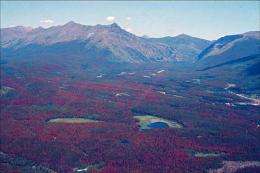
A massive epidemic of bark beetle infestation on these stands of lodgepole pine in British Columbia reflect the impact that changing climate is having on the ability of this tree species to survive, a new study suggests. (Photo courtesy of Richard Waring, Oregon State University)
Lodgepole pine, a hardy tree species that can thrive in cold temperatures and plays a key role in many western ecosystems, is already shrinking in range as a result of climate change and may almost disappear from most of the Pacific Northwest by 2080, a new study concludes.
Including Canada, where it is actually projected to increase in some places, lodgepole pine is expected to be able to survive in only 17 percent of its current range in the western parts of North America.
The research, just published in the journal Climatic Change, was done by scientists from the College of Forestry at Oregon State University and the Department of Forest Resource Management at the University of British Columbia. It was based on an analysis of 12,600 sites across a broad geographic range.
Lodgepole pine ecosystems occupy large areas following major fires where extreme cold temperatures, poor soils and heavy, branch-breaking snows make it difficult for other tree species to compete. This includes large parts of higher elevation sites in Oregon, Washington, the Rocky Mountains and western Canada. Yellowstone National Park is dominated by this tree species.
However, warming temperatures, less winter precipitation, earlier loss of snowpack and more summer drought already appear to be affecting the range of lodgepole pine, at the same time increasing the infestations of bark beetles that attack this tree species.
The researchers concluded that some of these forces have been at work since at least 1980, and by around 2020 will have decreased the Pacific Northwest range of lodgepole pine by 8 percent. After that, continued climatic changes are expected to accelerate the species' demise. By 2080, it is projected to be almost absent from Oregon, Washington and Idaho, some of the areas facing the most dramatic changes.
"For skeptics of climate change, it's worth noting that the increase in vulnerability of lodgepole pine we've seen in recent decades is made from comparisons with real climatic data, and is backed up with satellite-observations showing major changes on the ground," said Richard Waring, an OSU distinguished professor emeritus of forest science.
"This is already happening in some places," Waring said. "Bark beetles in lodgepole pine used to be more selective, leaving the younger and healthier trees alone.
"Now their populations and pheromone levels are getting so high they can more easily reach epidemic levels and kill almost all adult trees," he said. "Less frost, combined with less snow favors heavier levels of bark beetle infestation. We're already seeing more insect attack, and we project that it will get worse."
Some species are adapted to lower elevations, experts say, but lodgepole pine is predominately a sub-alpine tree species. Its new foliage can handle frost down to temperatures below freezing, it easily sheds snow that might break the branches of tree species more common at lower elevations, and it can survive in marginal soils.
But it makes these adaptations by growing more slowly, and as the subalpine environment becomes less harsh, lodgepole pine may increasingly be displaced by other species such as Douglas-fir, grand fir and ponderosa pine, which are also more drought-tolerant.
As lodgepole pine continues to decline, one of the few places on the map where it's still projected to survive by 2080 is Yellowstone National Park a harsh, high-elevation location and a few other sub-alpine locations.
The species historically has played important ecological and cultural roles. It provided long, straight and lightweight poles often sought for tepees by Native American tribes, was later harvested commercially for poles and fence materials, and offers cover and habitat for big game animals.
Provided by
Oregon State University
-
From lemons to lemonade: Reaction uses carbon dioxide to make carbon-based semiconductor,
28 comments
-
Thioridazine kills cancer stem cells in human while avoiding toxic side-effects of conventional cancer treatments,
3 comments
-
SpaceX private rocket blasts off for space station (Update),
42 comments
-
Climate scientists say they have solved riddle of rising sea,
30 comments
-
Scotland passes turbine test to harness tidal power,
41 comments
-
What would stain as translucent on light-coloured fabric?
52 minutes ago
-
How do I identify different bacteria on culture plates?
10 hours ago
-
Why Do Dogs do Strange things...
May 25, 2012
-
What does exophillic and endophillic mean in terms of mosquito and their control?
May 24, 2012
-
Semen stains glows under black lights (uv light)?
May 23, 2012
-
Question on Human Chromosome 2
May 23, 2012
- More from Physics Forums - Biology
More news stories
Thousands of shellfish found dead in Peru
Thousands of crustaceans were found dead off the coast of Lima following the mystery mass death of dolphins and pelicans, the Peruvian Navy said Friday.
9 hours ago |
4.7 / 5 (3) |
4
More plant species responding to global warming than previously thought
(Phys.org) -- Far more wild plant species may be responding to global warming than previous large-scale estimates have suggested.
May 22, 2012 |
4.6 / 5 (14) |
18
|
Totally rad: Scientists create rewritable digital data storage in DNA
(Phys.org) -- Scientists from Stanford's Department of Bioengineering have devised a method for repeatedly encoding, storing and erasing digital data within the DNA of living cells.
May 21, 2012 |
4.9 / 5 (16) |
11
|
For monogamous sparrows, it doesn't pay to stray (but they do it anyway)
It's quite common for a female song sparrow to stray from her breeding partner and mate with the male next door, but a new study shows that sleeping around can be costly.
May 22, 2012 |
5 / 5 (1) |
7
|
Study uncovers secret to speedy burrowing by razor clams
(Phys.org) -- If you look at a razor burrowing clam sitting in a bucket, youd never guess that it could burrow itself down into the soil, much less do it with any speed. Razor clams look like fat straws, ...
SpotterRF debuts Radar Backpack Kit (w/ Video)
(Phys.org) -- SpotterRF has announced a special radar backpack kit designed to enhance situational awareness for soldiers on the ground. The company says its special radar is designed for warfighters as part ...
Australia hails surprise super-telescope decision
Australia has hailed a surprise decision giving it a role in a radio telescope project aimed at revolutionising astronomy, vowing to draw on its decades of experience in space science.
Astronomers seize last chance in lifetime for Venus Transit
Astronomers are gearing for one the rarest events in the Solar System: an alignment of Earth, Venus and the Sun that will not be seen for another 105 years.
SpaceX capsule has 'new car' smell, astronauts say
SpaceX's Dragon cargo vessel smells like a new car, said astronauts at the International Space Station after opening the hatches Saturday following the spacecraft's landmark mission to the orbiting lab.
Family history of Alzheimer's affects functional connectivity
(HealthDay) -- Cognitively normal individuals with a family history of late-onset Alzheimer's disease (AD) may display lower resting state functional connectivity in the default mode network (DMN) of the brain, ...
Astronauts enter world's 1st private supply ship
(AP) -- Space station astronauts floated into the Dragon on Saturday, a day after its heralded arrival as the world's first commercial supply ship.
Feb 28, 2011
Rank: 1.9 / 5 (13)
So, for example is the temperature range is +20C to -40C, why does a range of +20.5C to -39.5C make such a difference. And given that if you move north a few miles it will range +20C to -40C, why would the species not just spread north gradually?
I think you can see why I'm a skeptic. The observations I have no problem with. It's the conclusions you've drawn that cause problems for me.
BTW, why wasn't this wiped out during the last "warming" period? Probably because we didn't call it Global Warming back then? (We called it nature.)
Feb 28, 2011
Rank: 3.6 / 5 (9)
Feb 28, 2011
Rank: 3 / 5 (6)
For example a temp range of 200degrees to -200 and a temp range of 10 degrees to -10 have the same average of zero degrees. Just because the average is the same or similar doesn't mean the numbers used to derive that average are anywhere close.
Feb 28, 2011
Rank: 2.3 / 5 (9)
Rocky Mountain lodgepole pine produces serotinous cones which do not open at maturity because they are sealed shut by a resinous bond between the cone scales. These cones remain on the tree for years and require temperatures between 113 and 140 degrees F (45-60 C) to melt the resin and release the seed. In nature, only forest fires generate temperatures of this magnitude within a tree's crown."
http:/extension.usu.edu/range/woody/lodgepolepine.htm
For the past several decades, the US Forest Service tries to stop forest fires asap.
Feb 28, 2011
Rank: 2.8 / 5 (10)
Feb 28, 2011
Rank: 3.2 / 5 (9)
That's right, mangynowrintintin!
Why didn't you go on to explain this policy? Could it be that the policy is in place because of fears of Ranchers, Developers, Vacation Home Owners, Timber "Growers", Mining, et c., et c. -aka- your much vaunted "free market" have ceaselessly lobbied the DOI to put out fires ASAP, in order to protect their interests?
Your shilldom is showing.
Feb 28, 2011
Rank: 2.2 / 5 (10)
What free market?
Mar 01, 2011
Rank: 4.2 / 5 (5)
I think you'll agree the government does alot of things because of the actions and interests of lobbyists on both sides of the aisle. So what exactly is your point again?
Mar 01, 2011
Rank: 3.7 / 5 (6)
The Citizens of the United States of America own the forests.
Which is just how your freimarket likes it, because that way, taxpayers are on the hook for all the maintenance, roadbuilding and fire control, and all the freimarket has to do is to sign a contract with the gub, and then go in and take what they want, usually at below-market rates, which are, in fact, subsidized by tax dollars. Just the cream, please!
Afterall, why should your corporocrat freemarketeers have to pay to maintain, cull, fire protect, and road build in order to be able to exploit these public resources, when they can have the tab for that part of their operations picked up by the taxpaying public?
Free profit for them, and they've spent many, many long years lobbying for the the selfsame regulatory environment under which they operate, and for that very reason --to make sure that taxpayers pick up the tab.
Mar 01, 2011
Rank: 5 / 5 (2)
Quote editted for contemporary relevance.
"You have meddled with the primal forces of nature, Mr. Swenson, and I won't have it! Is that clear? You think you've merely stopped worker's rights. That is not the case! The Corporations have taken billions of dollars out of this country, and now they must put it back! It is ebb and flow, tidal gravity! It is ecological balance!"
Mar 02, 2011
Rank: 1.7 / 5 (6)
No, it is not.
The Tragedy of the Commons benefits no one.
Mar 02, 2011
Rank: 3.4 / 5 (5)
Now being disengenous, mangy? The Tragedy of the Commons IS that it benefits the exploiter at everyone else's expense. That is how the term came into existence, you moron.
To say that it benefits no one(and especially in the case{s}) being discussed here, is a flat-out lie.
While I appreciate the uniquely rare expression of fellow-feeling from you, since it was in the service of your ongoing corporocratic-apologist dissimulation, I've no other alternative than to blast you for it -which you no less than deserve.
Mar 02, 2011
Rank: 4 / 5 (4)
We've already been over this subject. The tragedy of the commons doesn't occur with a lack of organized effort.
For every individual who cares not, there are more who do care, that is until you involve corporations and other business self interest.
Mar 02, 2011
Rank: 1.8 / 5 (5)
For how long?
The exploiters in this story are the AGWites. The authors either lied about the need for fire for lodge pole pine reproduction or are incompetent for not knowing about this little, important fact.
"serious threat to private land
owners develops when citizens living in urban areas demand that private owners of timberland
(definitionally located in rural areas) produce environmental amenities such as aestheticallypleasing
views, biodiversity, animal habitat, and the like, provided they (the urbanites) don’t
have to pay for it.
Further, they seek to enforce their demands by using the political process to pass regulations that
require land owners disproportionately to bear the cost of producing these environmental
amenities. For example, Oregon law requires private timber land owners to re-plant within 2
years areas" {typical socialism, state control of private property}
http:/www.auburn.edu/academic/forestry_wildlife/forest_policy_ctr/laba
Mar 02, 2011
Rank: 3 / 5 (3)
I don't know what the water and temperature tollerence is for the trees which are replacing the lodge poles, but if they are the same or if they are different could provide evidence of whether this is a climate related effect or not.
Mar 02, 2011
Rank: 1.7 / 5 (6)
It's like blaming climate change for the rabbits kicking the crap out of the marsupials in Australia.
Mar 02, 2011
Rank: 3 / 5 (3)
This could also just be part of the natural progression of land cover change that has occurred since the end of the ice age, after the glaciers retreated and left a barren moon-scape terrain over the whole north american continent. To assume that the environment in North America is stable is a huge misunderstanding a lot of people make. The way it is now is not the same as it was 500 years ago at all. Heck, just the changes in continental altitude cause large scale climate changes on a century time scale.
Mar 02, 2011
Rank: 2 / 5 (4)
Mar 02, 2011
Rank: 2.3 / 5 (6)
http:/www.takepart.com/news/2010/06/24/peak-timber-mountain-pine-beetle-outbreak-threatens-canadian-forests
But of course 'human caused climate change' is blamed but NOT human caused forest management.
Mar 04, 2011
Rank: not rated yet
The issue here is the fact that you didn't even try to post a link. As of 3/1/11, links were allowed on physorg again. This can be evidenced by posts from ryeggsogn2 on that very date.