The brotherhood of speed
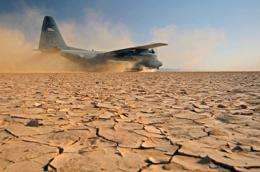
About fifty miles northeast of Los Angeles, the small town of Rosamond slumbers on the edge of the Great American Desert. Here the air is thin and cold, and in the distance the smog in the LA basin is an orange-tinted shroud hung between the high peaks of the Sierra Nevada and the pounding breakers of the Pacific Ocean.
In this blighted place, the sand-blasted landscape stretches to a limitless horizon in every direction. All that breaks the monotony are the tormented silhouettes of Joshua trees, studding the landscape like arthritic corals. Yet there are lakes here – Rosamond Dry Lake and Rogers Dry Lake.
The water in the lakes exists for only a few months of the year, when the small amounts of precipitation that fall during the winter months are washed back and forth, back and forth, until the beds of these lakes become smooth and level. In the summer, the water evaporates and the furnace-like Sun of the California desert bakes the mud until it is as hard and smooth as glass. In this place, nature has created America’s greatest natural landing field.
So it is no surprise that in the years following the end of the Second World War, the US Air Force chose this place to test its new jet and rocket planes. There were thousands of square miles for error and - given the fickle nature of some of the mechanical beasts that were put through their paces here - that was just as well.
In the beginning – before the USAF had been formed from the US Army Air Force - this airfield up in the high desert had been named Muroc. It achieved its first fame on October 14, 1947, when Charles E. “Chuck” Yeager became the first man to fly faster than the speed of sound – breaking the sound barrier in the Bell X-1 rocket plane. It was a singular achievement and made Yeager and Edwards Air Force Base (as it was soon renamed) famous in the world of military aviation.
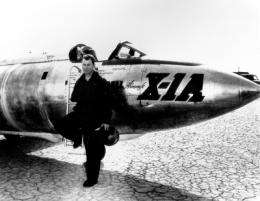
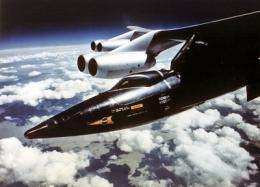
The tradition established by Yeager and the X-1 leads directly to the fabled X-series rocket planes – of which the hypersonic X-15 rocket plane is the most notable example – and thence to the Space Shuttle. The X-15 set speed and altitude records in the early 1960s, reaching the edge of outer space and returning with data that was essential to the development of future high-speed vehicles, particularly those intended to fly back into the atmosphere, such as the Space Shuttle. Today the X-15 still holds the record for the fastest speed ever reached by a piloted rocket-powered airplane.
In the early days of the Space Age, the Air Force and NASA had established a convention that the edge of space was at an altitude of 50 miles (80.47 km, 264,000 ft). Pilots who flew above this altitude were eligible to wear astronaut wings. During the X-15 program, eight pilots reached this altitude, qualifying them for astronaut status.
The lifting bodies were a breed of experimental aircraft that complemented and then succeeded the X-15. They were to explore a third area of aerodynamic engineering beyond the existing winged conventional aircraft (including the X-15) and the ballistic capsules of the Mercury, Gemini and Apollo spacecraft.
The latter programs were an attempt to catch up with the Soviets after the surprise launch in the fall of 1957 of Sputniks 1 and 2. So worried were the Americans by what they perceived as a ‘missile gap’ (for if the Soviets could launch radio transmitters and dogs into orbit, then they could surely deliver nuclear warheads to US cities) that they decided to abandon the orderly progress by which the X-15 would lead to a winged space plane.
Instead they decided to go with the so-called ‘Man-in-Space-Soonest’ concept. This would use a modified ballistic missile to launch a capsule containing a man (Mercury) and eventually men (Gemini and Apollo) into orbit. It was a ‘quick and dirty’ approach that would cut years of development off putting Americans into space. Ultimately this approach would pay off on July 20, 1969, when Neil Armstrong and Buzz Aldrin became the first humans to walk on the Moon.
In the meantime, progress towards a lifting re-entry vehicle such as the Shuttle was not completely shelved but there were still many engineering problems to be overcome. Chief among these was the fact that with a reusable spacecraft, wings are a problem from a heating and structural standpoint -- particularly at launch. But the Shuttle would need them to achieve a useful cross-range – the ability to glide for many miles -- during re-entry and for landing.
For the return to Earth the vehicle's wings also would have to be designed to withstand the extreme dynamic and thermal stresses of both re-entry and hypersonic speeds. Thus, despite the fact that Wernher von Braun’s original concept for a reusable spacecraft (which dated back to the 1950s) was explicitly a rocket with wings, it seemed that his solution on its own would not work. But by the 1960s it was realized that the challenge of lifting flight through the atmosphere might be met by with a hybrid approach combining wings with a lifting body fuselage.
Shuttle was, in fact, a more refined application of an older concept, dating to the work of Eugen Sanger and his wife, mathematician Irene Sanger-Bredt, who had first conceived the classic flat-bottom half-ogival body shape, coupled with wings, for their so-called "Silbervogel" space transportation system first proposed in the late 1930s. Where Shuttle differed was in more careful blending of the wing and body, and use of a large delta wing as opposed to conventional straight wings with a conventional tail, as the Sangers had employed.
Source: Astrobio.net


