New approach to solar cells
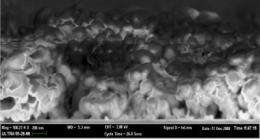
This is a transmission electron microscope image of nanoparticles in an experimental solar cell. Credit: Gergely Zimanyi, UC Davis
An interdisciplinary team of UC Davis and UC Santa Cruz researchers is taking a novel approach to solar power, one that promises to lead to a technological breakthrough. By using nanoparticles of germanium, silicon and other materials, the researchers hope to produce solar cells far more efficient than the current state of the art.
The project was recently awarded $1.5 million over three years from the National Science Foundation.
Conventional solar cells all operate on the same principle of "one photon in, one electron out," said Gergely Zimanyi, professor of physics at UC Davis and principal investigator on the NSF grant. In other words, one particle of light, or photon, hits the solar cell and generates one electron to produce an electrical current.
The efficiency energy out compared to energy in of a solar cell operating according to this principle is capped by a theoretical maximum of 31 percent. But by constructing solar cells from extremely small nanoparticles, the UC researchers aim to generate several electrons for each photon, raising the maximum efficiency to between 42 and 65 percent.
The one-photon-in/multiple-electrons-out paradigm has been demonstrated at the Los Alamos National Laboratory, Zimanyi said but the Los Alamos group did not build a functioning solar cell based on this paradigm. The UC Davis/UC Santa Cruz team includes scientists with experience making solar cells from nanoparticles, giving hope that the group will be able to construct a fully functioning and well-optimized solar cell from germanium and silicon nanoparticles, he said.
The team members are: Zimanyi; UC Davis chemistry professors Susan Kauzlarich and Delmar Larsen; Professor Giulia Galli, who holds a joint appointment in physics and chemistry; Professor Zhaojun Bai, Department of Mathematics and Computer Science; Debashis Paul, professor in the Department of Statistics; and Susan Carter, professor of physics at UC Santa Cruz.
The interdisciplinary nature of the team was crucial to getting the proposal funded, Zimanyi said. "NSF asked for a collaborative effort between materials sciences, chemistry and mathematical sciences," he said.
Zimanyi, Galli and Bai will conduct theoretical and computer-modeling studies, with Paul providing statistical expertise; Kauzlarich's lab will synthesize the new nanoparticles, Larsen's group will characterize them and Carter's lab at UCSC will develop a working device. A prototype cell has been already constructed prior to getting the grant and exhibited an efficiency of about 8 percent, which Zimanyi described as a very encouraging result given the limited resources going into its construction.
The team will collaborate with the California Solar Energy Collaborative, which is based at UC Davis and led by Pieter Stroeve, professor of chemical engineering and materials science. The team also plans an outreach effort, primarily via its public webpage: http://www.solarwi … cdavis.edu/.
Provided by University of California - Davis
-
From lemons to lemonade: Reaction uses carbon dioxide to make carbon-based semiconductor,
30 comments
-
Thioridazine kills cancer stem cells in human while avoiding toxic side-effects of conventional cancer treatments,
3 comments
-
SpaceX private rocket blasts off for space station (Update),
42 comments
-
Climate scientists say they have solved riddle of rising sea,
30 comments
-
Delphi gasoline-injection engine technique rivals hybrid's edge,
37 comments
-
microstructure of titanium
3 hours ago
-
Steam in My Espresso Machine
9 hours ago
-
Density question
May 24, 2012
-
Mass transport originating from a point source at a solid gas interface
May 22, 2012
-
Ammonia dispersion in Air
May 22, 2012
-
Multi Choice Help
May 21, 2012
- More from Physics Forums - Materials & Chemical Engineering
More news stories
Dopant gives graphene solar cells highest efficiency yet
(Phys.org) -- By taking advantage of graphenes favorable electrical and optical properties, and then adding an organic dopant, researchers have achieved the highest power conversion efficiency yet for ...
Nanomedicine: Quantum dots appear safe in pioneering study on primates
A pioneering study to gauge the toxicity of quantum dots in primates has found the tiny crystals to be safe over a one-year period, a hopeful outcome for doctors and scientists seeking new ways to battle diseases ...
Nanotechnology / Bio & Medicine
May 20, 2012 |
4.3 / 5 (3) |
8
|
In nanorod crystal growth, nanoparticles seen as artificial atoms
In the growth of crystals, do nanoparticles act as "artificial atoms" forming molecular-type building blocks that can assemble into complex structures? This is the contention of a major but controversial theory ...
May 24, 2012 |
4.8 / 5 (6) |
0
|
First direct observation of oriented attachment in nanocrystal growth
Berkeley Lab researchers have reported the first direct observation of nanoparticles undergoing oriented attachment, the critical step in biomineralization and the growth of nanocrystals. A better understanding ...
May 24, 2012 |
4.7 / 5 (3) |
0
|
Synthetic nano-waste does not disappear
(Phys.org) -- Tiny particles of cerium oxide do not burn or change in the heat of a waste incineration plant. They remain intact on combustion residues or in the incineration system, as a new study by Swiss ...
Nanotechnology / Bio & Medicine
May 25, 2012 |
5 / 5 (2) |
1
|
Dell tablet leak: 10.1-inch display, two-battery choice
(Phys.org) -- Headline after headline talks about vendors tablets in the wings as likely number-one contenders for the iPad. Such claims have justifiably been taken with a grain of salt, considering ...
Scientist: Evolution debate will soon be history
(AP) -- Richard Leakey predicts skepticism over evolution will soon be history. Not that the avowed atheist has any doubts himself.
Keep food safety in mind this memorial day weekend
(HealthDay) -- Picnics, parades and cookouts are as much a part of Memorial Day weekend as tributes to the United States' war veterans.
SpaceX capsule has 'new car' smell, astronauts say (Update)
SpaceX's Dragon cargo vessel smells like a new car, said astronauts at the International Space Station after opening the hatches Saturday following the spacecraft's landmark mission to the orbiting lab.
SpotterRF debuts Radar Backpack Kit (w/ Video)
(Phys.org) -- SpotterRF has announced a special radar backpack kit designed to enhance situational awareness for soldiers on the ground. The company says its special radar is designed for warfighters as part ...
Australia hails surprise super-telescope decision
Australia has hailed a surprise decision giving it a role in a radio telescope project aimed at revolutionising astronomy, vowing to draw on its decades of experience in space science.
Feb 03, 2011
Rank: 5 / 5 (1)
Feb 03, 2011
Rank: not rated yet
Feb 03, 2011
Rank: not rated yet
Feb 04, 2011
Rank: not rated yet
Both approaches have their merits. Shell bailed because they saw (for the foreseeable future) no way that biofuels could be manufactured cheaper than pumping oil out of the ground. They are not in the business of being green (and have pretty much given up of ever having such an image) so there's no point for them to invest in biofuels (the same money can more easily go into bribing governements into subsidies for oil/oil production and the slowing down of any alternative energy legislature).
Feb 04, 2011
Rank: not rated yet
Feb 04, 2011
Rank: 5 / 5 (1)
So if the 40% efficient panels are less than 4 times as expensive per square meter they are better.
Additionally, using fewer panels means less wires required and less of other components (such as the self-orienting motors used in large farms,) which also lowers the cost of the entire system.
If you need 1/4th as many panels then even if the panels are relatively expensive they may be "better" due to the other costs saving since the entire system is 1/4th the size.
If they actually obtained 65% efficiency in photovoltaics, that would make Solar Towers obsolete, since real turbine based systems cannot exceed about 66% efficiency, at least as far as pure electricity production goes. Which means that a solar tower's maximum theoretical efficiency would be ~66%
This is assuming we are measuring efficiency as "total solar flux per meter^2 in vs electricity out".
Feb 04, 2011
Rank: not rated yet
So the same megawatts class power plant constructed with 40% efficient panels could be 1/4th the area, and would use 1/8th of the total length for power lines.
X = number lines
y = average length
XY = wire used in 10% photovoltaic power plant.
(0.25X)*(0.5Y) = wire used in 40% power plant.
= 0.125XY
considering the current price of copper and other materials used in electrical cables, this is a temendous savings potential. For every ton of copper used in a 10% efficient plant, you'd use only 0.125 tons in the 40% efficient plant. At current prices for copper near $9900 per metric ton, this would save 7/8, or $8662.5.
The savings in copper starts to be a significant fraction of the total cost of the operation.