Antimatter atoms ready for their close-up
Two international teams of physicists, including RIKEN researchers (Japan), have trapped and manipulated atoms made out of antimatter, in milestone experiments that should help to reveal why the substance is so rare in our Universe.
Since its existence was first predicted by physicist Paul Dirac in 1931, antimatter has become an increasingly common sight. The antiparticle of the electron, for example, is routinely used in positron emission tomography, a clinical imaging technique. Yet despite this routine use of isolated antimatter particles, making ‘anti-atoms’ is extremely difficult because matter and antimatter annihilate each other in a flash of energetic photons when they meet.
The simplest and most abundant atom in the universe—hydrogen—consists of a positive proton and an electron. Its opposite number, antihydrogen, contains a negative antiproton and a positron, and teaming the antiparticles without allowing them to touch any ordinary matter is a ticklish business.
In parallel research efforts, known as ALPHA and ASACUSA, the international teams of physicists have shown how to handle antihydrogen atoms in a way that will soon allow their properties to be investigated precisely, and compared with normal hydrogen.
Physicists are keen to make this comparison because one of the foundations of modern quantum physics—the charge, parity and time reversal symmetry theorem—states that hydrogen and antihydrogen should have identical energy levels, producing matching spectra when probed with light. But this also suggests that at the very beginning of the Universe, both matter and antimatter would have been created in equal quantities. So the fact that our Universe is almost entirely made of matter seems to contradict quantum theory, and poses a fundamental question about how the cosmos works.
Trapped in an asymmetric field
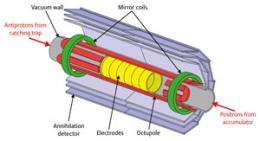
Researchers working on the ATHENA and ATRAP experiments at CERN, the European particle physics facility based in Geneva, Switzerland, first combined positrons and antiprotons to create cold antihydrogen in 2002. The ATHENA project evolved into ALPHA, which relies on electric and magnetic fields—a ‘magnetic bottle’, or Ioffe-Pritchard trap—to control, cool, and mix the particles, and to trap antihydrogen atoms.
“The challenge is the temperature of antihydrogen atoms,” says Yasunori Yamazaki of the RIKEN Advanced Science Institute in Wako, Japan, who is involved with both the ALPHA and ASACUSA experiments. Fast-moving antiprotons as hot as 100,000 kelvin must be chilled to less than 0.5 kelvin to form trappable antihydrogen.
In recent experiments, the ALPHA researchers collided about 30,000 antiprotons with electrons to cool them to roughly 200 kelvin in a cloud about 1.6 millimeters across. They cooled a separate pool of positrons by allowing the hotter particles to ‘evaporate’ away from the rest, leaving a 1.8 millimeter-diameter cloud of about two million particles at roughly 40 kelvin. The strong magnetic field containing the particles was shaped so that the particles collected in the center of the trap (Fig. 1), and the researchers slowly coaxed the antiprotons towards the positrons by changing the electric field. After mixing for just a second, they removed any unreacted antiparticles from the trap.
About 0.2 seconds after the removal of antiprotons and positrons, the researchers opened the magnetic bottle to look for trapped antihydrogen atoms. Since antihydrogen atoms are neutral, any that formed were no longer controlled by the electric field. Those not cold enough to be trapped in the magnetic bottle drifted towards the sides of the trap, where they annihilated and formed exotic particles called pions, which were registered by silicon detectors. Studying the energy and the trajectory of the pions allowed the researchers to weed out any signals that had been produced by cosmic rays—high-energy particles from space. Overall, they found 38 atoms of antihydrogen from 335 experimental runs.
Yamazaki hopes that antihydrogen could be trapped for much longer in future experiments, which would help efforts to study its properties. But “the strong magnetic field gradient of the magnetic bottle would make real high-resolution spectroscopy not straightforward,” he adds.
Synthesized in a symmetrical field
ASACUSA uses a different method of taming antihydrogen. It collects antiprotons and positrons in a cusp trap (Fig. 2), which relies on symmetrical magnetic and electric fields, unlike ALPHA's asymmetrical fields. Recent experiments show that ASACUSA researchers can use the cusp trap to combine antiprotons and positrons to produce a beam of antihydrogen atoms. This approach has unique advantages, says Yamazaki.
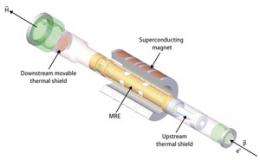
“First of all, we can extract antihydrogen atoms as an intensified beam in a magnetic-field free region, which enables high-resolution spectroscopy. Secondly, the temperature of the antihydrogen atoms can be much higher—say 10 kelvin—which makes it orders of magnitude more efficient to synthesize a usable number of antihydrogen atoms,” explains Yamazaki. “We think we can confirm the beam next year, and if everything goes well, we can also get some spectroscopic results for the first time,” he adds. ALPHA, too, is already making plans for its own laser spectroscopy measurements.
Improving supply
Both experiments could benefit from a new project at CERN, called ELENA, which can deliver lower-energy antiprotons. “We really hope this project will be approved as soon as possible,” says Yamazaki. This could provide a continuous supply of much larger numbers of chilled antiprotons for ALPHA and ASACUSA, which “should have a tremendous impact on both antihydrogen projects,” he notes.
Of both projects’ latest results, he adds: “I feel that these two achievements are really big milestones towards realizing low-energy antimatter physics for the first time.”
More information:
1.Andresen, G.B., et al. Trapped antihydrogen. Nature 468, 673–676 (2010).
2.Enomoto, Y., et al. Synthesis of cold antihydrogen in a cusp trap. Physical Review Letters 105, 243401 (2010).
Provided by RIKEN


