Ancient shells meet high-tech: Researchers study the sound of pre-Incan conches (w/ Video)
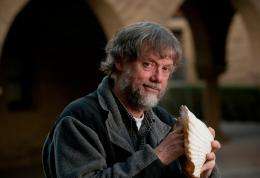
(PhysOrg.com) -- Archaeologists and acousticians strike an unusual partnership to understand the mesmerizing role of conches in the temple culture around Peru's Chavin.
The sound is ancient and eerie. For a palpable sense of time, blow into the sawed-off spire of a conch. Feel the ache in your lungs and hear the oceanic roar as it vibrates the hefty shell in your hand.
In the Sanskrit epic the Mahabharata, the warriors blew conches to announce battle. In Buddhism, the conch's deep and penetrating drone proclaims the far reach of the dharma. Tibetan monks still use them to summon devotees.
But in the Andean sierra of South America, what did it mean when, three millennia ago, the pre-Incan residents of Chavín de Huántar raised those ornately decorated conch shells to their lips in the underground corridors of their temple?
Nobody knows for certain. But a few Stanford researchers are determined to find out. The result has led to an unusual collaboration between archaeologists and acousticians, under the auspices of Peru's Ministry of Culture, leading into the rarified realms of psychoacoustics and archaeo-acoustics.
Seed funding for the project came from the Stanford Institute for Creativity and the Arts, a featured program of The Stanford Challenge, a fundraising campaign launched in 2006 and now in its final year.
"Conches are attention-grabbers," said John Rick, associate professor of anthropology and part of the Chavín team. "They're rarely used trivially. People don't play them for entertainment. They're ceremonial – shiny, noisy, highly labor-intensive things.
"This is something that literally has an effect on the human being, even physiologically."
Conches figured prominently in the iconography of Chavín, a UNESCO World Heritage archaeological site about 150 miles north of Lima. "They were clearly important. They were carried in important processions," said Rick.
In July 2001, Stanford archaeologists working at Chavín's 3,000-year-old ceremonial center came across a conch buried in the dirt in one of the temple's underground galleries. To get a sense of the scale of the discovery, remember that only a couple of decorated conches had ever before been found in Peru.
But that wasn't all: "The first one we hit we knew exactly what it was, but we never had a clue that we'd be lucky enough to find 20 intact ones that were still playable," said Rick. The decorated shells, about 10 inches long and weighing 3 to 5 pounds each, had been used for centuries. Their thick pink shells were worn through.
"Once we started to find them, it was imperative to know more," said Rick.
In the unique acoustic landscape – stone-walled underground architecture, with twisting corridors, hidden alcoves and ventilation shafts – how did the conches sound? What role did they play in the ceremonial culture?
The questions weren't new. In the mid-1970s, Peruvian archaeologist Luís Lumbreras, director of the National Institute of Culture (now subsumed into the Ministry of Culture), described the interior structures at Chavín as a set of connected, resonant chambers. He called one of the structures an "acoustic canal" that would produce a loud applause or thunder-like sound when a barrel of water was poured into it.
In other places, conch shells might have created the disorienting impression of sounds coming from several different directions at once.
"We have evidence of the manipulation of light; we have acoustic spaces where it seems that they were playing around with sound. We've got evidence of the use of psycho-active drugs," said Rick. But what other effects were they using in this very early multimedia show, and why? Was it a kind of mind control using sensory manipulation exercised by the priestly elite?
Time for the acousticians to enter the picture, beginning with John Chowning, music professor emeritus, one of the fathers of computer music and the founding director of the renowned Center for Computer Research in Music and Acoustics (CCRMA).
The CCRMA team included consulting Professor Jonathan Abel and former CCRMA director Perry Cook.
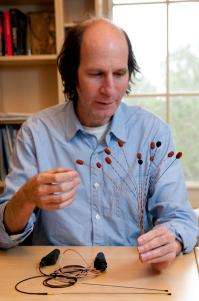
"My chest was rattled, and I was nauseated for the rest of the day," said Abel, who first heard Rick play a conch as he was standing in a stairwell at CCRMA. "Serious subharmonics were involved." But he also was hooked.
As a result, "I was exposed to this incredible culture that seemed to be able to control the senses in a way through the architecture, through the features of Chavín, and, in particular, these Strombus shell trumpets," he said.
Since the archaeo-acoustic team's visit to Peru in 2008, CCRMA graduate student and Stanford Interdisciplinary Graduate Fellowship recipient Miriam Kolar, whose dissertation studies the psychoacoustics of Chavín, has been making on-site measurements in the temple complex. She is hoping to recreate "the aural experience of an ancient ceremonial center."
Using sprays of flexible microphones, amplifiers, low distortion speakers, analog-to-digital converters and computer audio interfaces, she measures "how the architecture of these spaces affects auditory perception, which can provide clues about the site's purpose."
In her experiments, "participants listen, in the real acoustic context, to sounds that could have been authentic in Chavín times," and then respond to questions about what they hear.
Supplying the support research back at Stanford, Abel explores the "auditory texture of the place" and tries to "quantify the gallery acoustics." He and the rest of the team are in a race against time: Chavín needs conservation work that will forever alter the mysterious acoustics in the sharply twisting passages and underground alcoves.
Were the priests using these techniques to draw people into the cult? Rick said that this period marks the emergence of an elite in the Andes, a class that could issue orders and command labor and fealty.
"We don't see the public here; this is for the elite. You don't see anything like, 'Thank you, St. Chavín, for saving my leg,'" said Rick. "If you're not an aspirant or not a member, you're probably not there."
Perhaps it marks an early kind of capitalism, as well: "The Chavín priests are in a business. This isn't a free cult, any more than the Mediterranean cults or anything else."
The conches were engraved with elaborate patterns. "But whose patterns were those?" Rick asked. "At first we thought those were all Chavín designs. We started to study those and realized that they were contemporary designs to Chavín culture, but they weren't of Chavín themselves."
Apparently, the shells had stopped at other sites in the central Andes, in their journey from the seas off what are now Panama, Costa Rica and Ecuador, and were converted to trumpets en route. The Chavín touch was the characteristic V-shaped notch carved into the opening of the shell, which allows for bendable notes. It also possibly enabled priests in the procession to see where they were walking as they blew into the shells.
So far, Abel said, the conches haven't lost their charm; one can make the shell sound like an animal, or the wind, or a whisper. "Let me make it sound like a jet engine," he said. "It's completely fun."
Abel praises the interdisciplinary side of the project as "the only way we can make certain kinds of advances."
"Archaeology, anthropology, electrical engineering, signal processing, acoustics, mechanical engineering, physics, music, art – it all comes together," he said. "It's completely fascinating. I'm learning a little bit about culture, and a lot about acoustics, actually."
Rick, in turn, praises the "acoustic magicians" of CCRMA: "The most important thing I've learned is that acoustics is not some sort of soft science. Acoustics is real science. I've had my eyes opened time and time again by the analytical work that I've watched.
"You could say the acoustics people are the new priests of Chavín," he said.
More information: ccrma.stanford.edu/groups/chavin/
Provided by Stanford University


