Wildflower colors tell butterflies how to do their jobs
(PhysOrg.com) -- The recipe for making one species into two requires time and some kind of separation, like being on different islands or something else that discourages gene flow between the two budding species.
In the case of common Texas wildflowers that share meadows and roadside ditches, color-coding apparently does the trick.
Duke University graduate student Robin Hopkins has found the first evidence of a specific genetic change that helps two closely related wildflowers avoid creating costly hybrids. It results in one of the normally light blue flowers being tagged with a reddish color to appear less appetizing to the pollinating butterflies which prefer blue.
"There are big questions about evolution that are addressed by flower color," said Hopkins, who successfully defended her doctoral dissertation just weeks before seeing the same work appear in the prestigious journal Nature.
What Hopkins found, with her thesis adviser, Duke biology professor Mark Rausher, is the first clear genetic evidence for something called reinforcement in plants. Reinforcement keeps two similar proto-species moving apart by discouraging hybrid matings. Flower color had been expected to aid reinforcement, but the genes had not been found.
In animals or insects, reinforcement might be accomplished by a small difference in scent, plumage or mating rituals. But plants don't dance or choose their mates. So they apparently exert some choice by using color to discourage the butterflies from mingling their pollen, Hopkins said.
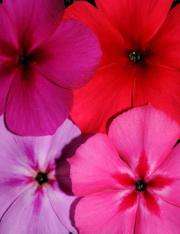
Where Phlox drummondii lives by itself, it has a periwinkle blue blossom. But where its range overlaps with Phlox cuspidata, which is also light blue, drummondii flowers appear darker and more red. Some individual butterflies prefer light blue blossoms and will go from blue to blue, avoiding the dark reds. Other individual butterflies prefer the reds and will stick with those. This "constancy" prevents hybrid crosses.
Hybrid offspring between drummondii and cuspidata turn out to be nearly sterile, making the next generation a genetic dead-end. The persistent force of natural selection tends to push the plants toward avoiding those less fruitful crosses, and encourages breeding true to type. In this case, selection apparently worked upon floral color.
Hopkins was able to find the genes involved in the color change by crossing a light blue drummondii with the red in greenhouse experiments. She found the offspring occurred in four different colors in the exact 9-to-3-to-3-to-1 ratios of classical Mendelian inheritance. "It was 2 in the morning when I figured this out," she said. "I almost woke up my adviser."
From there, she did standard genetics to find the exact genes. The change to red is caused by a recessive gene that knocks out the production of the plant's one blue pigment while allowing for the continued production of two red pigments.
Even where the red flowers are present, about 11 percent of each generation will be the nearly-sterile hybrids. But without color-coding, that figure would be more like 28 percent, Hopkins said. Why and how the butterflies make the distinction has yet to be discovered.
Hopkins will be continuing her research as a visiting scientist at the University of Texas, and the clear message from all of her advisers is "follow the butterflies. Everyone wants to know more about the butterflies!"
More information: "Identification of two genes causing reinforcement in the Texas wildflower Phlox drummondii," Robin Hopkins and Mark D. Rausher. Nature, Advance Online Publication, Jan. 9, 2011 DOI:10.1038/nature09641
Provided by Duke University


