Which-way detector unlocks some mystery of the double-slit experiment
January 21, 2011 By Lisa Zyga
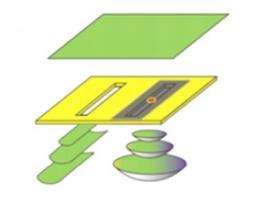
With a filter over the right slit, electrons are more likely to undergo inelastic scattering and act like a spherical wave. Electrons passing through an uncovered slit are more likely to undergo elastic scattering and act like a cylindrical wave. The two different waves do not have a phase correlation and so, even if an electron passed through both slits, it could not create an interference pattern. Image credit: Frabboni, et al. ©2011 American Institute of Physics.
(PhysOrg.com) -- One of the greatest puzzles of the double-slit experiment and quantum physics in general is why electrons seem to act differently when being observed. While electrons traveling through a barrier with two slits create interference patterns when unobserved, these interference patterns disappear when scientists detect which slit each electron travels through. By designing a modified version of the double-slit experiment with a new "which-way" electron detector at one of the slits, a team of scientists from Italy has found a clue as to why electron behavior appears to change when being observed.
As one of the most famous experiments in quantum physics, the double-slit experiment demonstrates how the quantum world is very different from the classical world. When macroscale objects are shot at a barrier with two slits, the objects travel straight through the slits and leave two straight lines on the wall behind the barrier. But when electrons are used instead of macroscale objects, they do not leave two straight lines on the wall but an interference pattern of many lines. Because the interference pattern remains even when the electrons are shot one at a time, the experiment seems to suggest that each electron somehow travels through both slits at the same time and interferes with itself, like a wave instead of a particle.
The second unusual part of the double-slit experiment is that the electrons stop creating an interference pattern when scientists set up a detector near one of the slits to determine which slit(s) an electron is passing through. Under these circumstances, the electrons simply create two straight lines, the same as classical particles.
Throughout the years, scientists have demonstrated different versions of the two-slit experiment. In the new study, physicists Stefano Frabboni from the University of Modena and Reggio Emilia and the CNR-Institute of Nanoscience in Modena, Italy; Gian Carlo Gazzadi from the CNR-Institute of Nanoscience; and Giulio Pozzi from the University of Bologna have presented another version of the two-slit experiment using a transmission electron microscope.
Over the last few years, we tried to use our expertise in transmission electron microscopy and focused ion beam specimen preparation to realize some basic experiments related to some of the mysteries of quantum mechanics, as pointed out by Feynman in his celebrated lectures and books, Frabboni told PhysOrg.com.
First, the scientists used focused ion beam milling to make two nanoslits on a barrier. Then they modified one of the slits by covering it with a filter made of several layers of low atomic number material to create a which-way detector for the electrons passing through.
Although the electrons (which were shot one by one) could still pass through the filtered slit, the filter caused more of the electrons to undergo inelastic scattering rather than elastic scattering. As the physicists explained, an electron undergoing inelastic scattering is localized at the covered slit, and acts like a spherical wave after passing through the slit. In contrast, an electron passing through the unfiltered slit is more likely to undergo elastic scattering, and act like a cylindrical wave after passing through that slit. The spherical wave and cylindrical wave do not have any phase correlation, and so even if an electron passed through both slits, the two different waves that come out cannot create an interference pattern on the wall behind them.
The physicists also found that the thickness of the filter determined the interference effects: the thicker the filter, the greater the probability for inelastic scattering rather than elastic scattering, and so the fewer the interference effects. They could make the filter thick enough so that the interference effects canceled out almost completely.
When the electron suffers inelastic scattering, it is localized; this means that its wavefunction collapses and after the measurement act, it propagates roughly as a spherical wave from the region of interaction, with no phase relation at all with other elastically or inelastically scattered electrons, Frabboni said. The experimental results show electrons through two slits (so two bright lines in the image when elastic and inelastic scattered electrons are collected) with negligible interference effects in the one-slit Fraunhofer diffraction pattern formed with elastic electrons.
In a separate study, the physicists covered both slits to see if two spherical waves would create an interference pattern. They found that, in the very faint inelastic intensity, no fringes seem present, whereas interference fringes are recovered, at a very low intensity, when the elastic image is taken.
Overall, the results suggest that the type of scattering an electron undergoes determines the mark it leaves on the back wall, and that a detector at one of the slits can change the type of scattering. The physicists concluded that, while elastically scattered electrons can cause an interference pattern, the inelastically scattered electrons do not contribute to the interference process.
More information: Stefano Frabboni, Gian Carlo Gazzadi, and Giulio Pozzi. Ion and electron beam nanofabrication of the which-way double-slit experiment in a transmission electron microscope. Applied Physics Letters 97, 263101 (2010). DOI:10.1063/1.3529947
Copyright 2010 PhysOrg.com.
All rights reserved. This material may not be published, broadcast, rewritten or redistributed in whole or part without the express written permission of PhysOrg.com.
-
From lemons to lemonade: Reaction uses carbon dioxide to make carbon-based semiconductor,
29 comments
-
Thioridazine kills cancer stem cells in human while avoiding toxic side-effects of conventional cancer treatments,
3 comments
-
SpaceX private rocket blasts off for space station (Update),
42 comments
-
Climate scientists say they have solved riddle of rising sea,
30 comments
-
Scotland passes turbine test to harness tidal power,
41 comments
-
why do trucks have bigger brakes?
3 hours ago
-
Solar Sail Physics - Do they work on a large scale?
4 hours ago
-
How should I switch an air conditioner off?
4 hours ago
-
Question about current decay in R-L circuit
5 hours ago
-
Elementary time - how does it work?
7 hours ago
-
How can squinting be used by both a myopic & hyperopic eye?
10 hours ago
- More from Physics Forums - General Physics
More news stories
Landmark calculation clears the way to answering how matter is formed
(Phys.org) -- An international collaboration of scientists, including Thomas Blum, associate professor of physics, is reporting in landmark detail the decay process of a subatomic particle called a kaon ...
May 25, 2012 |
4.6 / 5 (17) |
46
|
Is a classical electrodynamics law incompatible with special relativity?
(Phys.org) -- The laws of classical electromagnetism that were developed in the 19th century are the same laws that scientists use today. They include Maxwell’s four equations along with the Lorentz la ...
Lying in wait for WIMPs: Researchers seek to dramatically increase sensitivity of Large Underground Xenon detector
Although it's invisible, dark matter accounts for at least 80 percent of the matter in the universe. No one knows what it is, but most scientists would bet on weakly interacting massive particles, or WIMPs.
May 23, 2012 |
4.2 / 5 (6) |
15
|
Hall effect at the speed of light: How can you demonstrate relativistic effects with your mobile phone?
The relativistic Hall effect describing objects rotating at speeds comparable with the speed of light has been reported.
May 21, 2012 |
4.3 / 5 (3) |
8
Cloak of invisibility: Engineers use plasmonics to create an invisible photodetector
A team of engineers at Stanford and the University of Pennsylvania has for the first time used "plasmonic cloaking" to create a device that can see without being seen - an invisible machine that detects light. It is the first ...
May 21, 2012 |
4.8 / 5 (16) |
7
|
Dell tablet leak: 10.1-inch display, two-battery choice
(Phys.org) -- Headline after headline talks about vendors tablets in the wings as likely number-one contenders for the iPad. Such claims have justifiably been taken with a grain of salt, considering ...
Scientist: Evolution debate will soon be history
(AP) -- Richard Leakey predicts skepticism over evolution will soon be history. Not that the avowed atheist has any doubts himself.
Keep food safety in mind this memorial day weekend
(HealthDay) -- Picnics, parades and cookouts are as much a part of Memorial Day weekend as tributes to the United States' war veterans.
SpaceX capsule has 'new car' smell, astronauts say (Update)
SpaceX's Dragon cargo vessel smells like a new car, said astronauts at the International Space Station after opening the hatches Saturday following the spacecraft's landmark mission to the orbiting lab.
SpotterRF debuts Radar Backpack Kit (w/ Video)
(Phys.org) -- SpotterRF has announced a special radar backpack kit designed to enhance situational awareness for soldiers on the ground. The company says its special radar is designed for warfighters as part ...
Australia hails surprise super-telescope decision
Australia has hailed a surprise decision giving it a role in a radio telescope project aimed at revolutionising astronomy, vowing to draw on its decades of experience in space science.
Jan 21, 2011
Rank: 5 / 5 (5)
If you want to hear a very good explanation of quantum strangeness, you should search the google tech talks for "quantum conspiracy" (the title is meant to be ironic). The speaker does a very good job of making much of the counter-intuitive nature of quantum mechanics seem intuitive.
Jan 21, 2011
Rank: 4.9 / 5 (8)
The filter acts in place of a photon detector and forces wave function collapse through expected interaction.
I'm not understanding what the goal of this was. I'm fairly sure that we already knew that inelastic scattering did not provide wave action.
Jan 21, 2011
Rank: 3.7 / 5 (3)
I think it was Bohr himself who once said that if you think quantum mechanics makes sense, you haven't really understood it. Something like that, anyway.
Jan 21, 2011
Rank: 5 / 5 (2)
Way overused quote. We know much more about quantum interactions now then we did then.
Anyway, the thesis of the presentation i refered to is this: entanglement is mathematically identical to measurement which is why you cant communicate faster then light speed with a quantum setup -- because the entanglement "collapses" (although that term is not really accurate) the interference.
Jan 21, 2011
Rank: 4.4 / 5 (7)
Rather than considering the electron as a point or a wave then consider it to be in the shape of a cone of probability.
I.M.O.
Jan 21, 2011
Rank: 3.5 / 5 (2)
This also seems to me to be a misunderstanding in physics. Of course observing something changes it at the molecular level, observing it affects it physically. It's like the difference between passive and active sonar. There is no analogy to passive sonar in the quantum realm, it is all active and it affects what is being observed physically, not magically. This seems to me what this experiment is showing.
Jan 21, 2011
Rank: 4.5 / 5 (13)
What this experiment shows is that if you use a 'soft' filter (i.e. one that only forces your electron into a certain type of behaviour with a probaility lower than one) then you will only get gradual interference. It also shows which type of filter is more effective at localizing the electrons (i.e. which type takes more information out of the flight path and hence reduces the interference pattern most): those that force elastic or those that force inelastic scattering.
I'd say this is a good step forward.
Jan 21, 2011
Rank: 2 / 5 (2)
Jan 21, 2011
Rank: 2.6 / 5 (7)
I think the double slit experiment is the easiest one that shows us nobody understands this properly. (And inventing the wave function and its collapse doesnt count as understanding -- that's just observing and inventing math to match it.)
Jan 21, 2011
Rank: 4.7 / 5 (25)
The absence of global warming contrarians and creationist propagandists probably contributes to that.
Jan 21, 2011
Rank: 4.3 / 5 (3)
Err, isn't that what physics is all about. Observing somthing then developing an abstract(maybe mathmatical) model to predict future events?
You can never truley say you know somthing to 100% accurracy and therefore understand it absolutely.
That's not to say we aren't extremely accurate though. From memory Feynman's analogy was. When someone asks, how far away is the moon from me; the question arrises do you mean from your neck, or the top of your head. That was from at least 30yrs ago.
I think @antialias_physorg has the right idea about this experiment.
Jan 21, 2011
Rank: 1.4 / 5 (9)
Jan 21, 2011
Rank: 4.5 / 5 (2)
Someone is new the site. :) get used to it. If you really want to really know about almost anything on here, you are going to have to do some google searches.
Jan 21, 2011
Rank: 3 / 5 (4)
Jan 22, 2011
Rank: 1 / 5 (1)
Jan 22, 2011
Rank: 5 / 5 (5)
So if it was done by americans you would have said the americans are as clueless as everyone else? I hate all generalizations.
Jan 22, 2011
Rank: 3 / 5 (2)
But the mystery of quantum machanics is not better understood, how can a qantum system be in many states in the same time (millions or billions of places at the same times for diffracting particles like photons, electrons and molecules) being both a wave and a particle and collapse at only a single place when loosing energy and coherence, among such a trillions of places over all our universe on a sphere of 10 billions years for a photon emitted by an atom in a galaxy 10 billions years ago !! !!
Jan 22, 2011
Rank: 5 / 5 (8)
The mystery is why people continue to cling to the notion that there are such things as idealized particles and idealized waves at all.
Jan 22, 2011
Rank: 5 / 5 (2)
Jan 23, 2011
Rank: 4.7 / 5 (30)
This is correct. There is no reason to suppose that realty should conform to our a-priori notions or epistemological means of ordering experience, on a scale far removed from that which the mind has evolved. Therefore any understand, in the classical intuitive sense, is out of the question from the start. Heisenberg's matrix mechanics is equivalent to Schrodinger's visualizable wave picture, but doesn't imply the false hope.
Jan 23, 2011
Rank: 4.4 / 5 (31)
This is correct. There is no reason to suppose that realty should conform to our a-priori notions or epistemological means of ordering experience, on a scale far removed from that which the mind has evolved. Therefore any understand, in the classical intuitive sense, is out of the question from the start. Heisenberg's matrix mechanics is equivalent to Schrodinger's visualizable wave picture, but doesn't imply false hope.
P.S.,.. AGW is non-sense.
Jan 24, 2011
Rank: 2.7 / 5 (3)
Ethelred
Jan 24, 2011
Rank: 3 / 5 (4)
It shows the idea that a sentient observer is needed is nonsense. There was no actual detector. Just a quantum filter that effected the wave's path probabilistically. The greater the filtering the less the interference.
What intrigues me is something that the experiment might not have the sensitivity to show. Does a SINGLE electron show a BOTH some interference and some direct path effects? In the terms of the experiment and quantum mechanics there should be BOTH spherical and columnar waves from the filtered side with EACH electron tested.
Ethelred
Jan 24, 2011
Rank: 3 / 5 (1)
this experiment is also used for quantum phy, in place of a normal screen, a different screen is used to detetect the electrons.
In this experiment, when a slit is a line, cylindrical wavefronts are formed and in the case where filter has been used, the eectrons undergo inelastic collision and the eletron which go through the filter now has a point shaped slit which forms spherical wavefront.
i hope m correct abut what m saying, if not plz correct me.
Vikash
Jan 24, 2011
Rank: 4 / 5 (1)
Jan 24, 2011
Rank: 4.2 / 5 (31)
Jan 24, 2011
Rank: 4.3 / 5 (7)
Ethelred
Jan 24, 2011
Rank: 4.3 / 5 (31)
Jan 24, 2011
Rank: 4.5 / 5 (30)
Jan 24, 2011
Rank: 4.5 / 5 (31)
Jan 24, 2011
Rank: 4.7 / 5 (29)
Jan 24, 2011
Rank: 3.7 / 5 (3)
More
Jan 24, 2011
Rank: 3 / 5 (2)
Ethelred
Jan 24, 2011
Rank: 4.4 / 5 (31)
Right, to paraphrase a famous physicist, 'if you're not bewildered and astonished by qm, you don't understand it'. You think that a mind evolved to function on the macro scale can rationally apply it's a-priori intuition to all reality?
The Copenhagen, epistemological, Kant, interpretation is several orders of magnitude more rational than "many-worlds".
Jan 24, 2011
Rank: 3.5 / 5 (2)
"With a filter over the right slit, electrons are more likely to undergo inelastic scattering and act like a spherical wave. Electrons passing through an uncovered slit are more likely to undergo elastic scattering and act like a cylindrical wave. The two different waves do not have a phase correlation and so, even if an electron passed through both slits, it could not create an interference pattern."
This is interesting, because with coherent light, a slit producing a cylindrical wave and a tiny hole producing a spherical wave will produce an interference pattern.
Do the experiment yourselves with a small laser pointer.
So why do electrons behave differently?
A.J.
Jan 24, 2011
Rank: 4.7 / 5 (28)
There is no tiny hole, both slits are rectangular. If the electron interacts with the filter, a measurement is in effect performed, which causes the electrons wavefuction to collapse (state reduction), to a observable value. From there the wavefuncion evolution starts over, but since it's already at the slit the wave is spherical (not conformed to the slit geometry).
The case you mention does not apply because they are only firing one electron (or photon) at a time. It won't interfere with itself for the above reasons.
Jan 25, 2011
Rank: 2.3 / 5 (3)
More
Jan 25, 2011
Rank: 5 / 5 (2)
AND FOURTH I was going on the Wave model the other day. Not the Many Worlds but both the get the same results. I use them both at will.
As Dr. Feynman said about his brother and algebra 'the idea is to get the answer'.
Yes the Many-Worlds Model disturbs people. So did the Copenhagen Model. People just got used to it even though it didn't explain anything the math didn't. The Many Worlds Model DOES.
If you have two models of the Universe and both produce the same numbers with the same equations then the one that tells you MORE is the better model.
Try getting out of that Norwegian rut.
Ethelred
Jan 25, 2011
Rank: 4.8 / 5 (28)
Second, the role of science is no longer to "explain" things. THAT is out dated. It is to formulate a model that will allow for predictions. That is all. This is the point my associating Kant with Bohr ideas on the interpretations, it is a rational reason why we can't have an intuitive (classical) understanding of qm.
To deny wavefunction collapse is to associate a independent reality to it as some existent entity, that maintains a temporal existence even after a state reduction to an observable state.,...
Jan 25, 2011
Rank: 4.7 / 5 (27)
Jan 25, 2011
Rank: 5 / 5 (2)
He's not denying it. He's denying the CI stance on it.
Jan 25, 2011
Rank: 4.8 / 5 (29)
A qm system is a singular wavefucntion and may include whatever set of atoms you like as a system,.. the point is it is NOT observable until it is forced to take on a known form,.. I.e. a measurement designed and interpreted by a mind. There is no mystical magic here, it is purely logical.
Jan 25, 2011
Rank: 4.8 / 5 (27)
Jan 25, 2011
Rank: 5 / 5 (2)
No. The MWI states that at wave form collapse all possibilities occur, resulting in the split, this includes a potential for the wave form to not collapse, so technically it never does, but it does, in every possible configuration as well.
Basically the MWI removes the superposition and satisfies it with the equivalent of brute force.
I see the CI as being artificially limited based on presupposition.
Jan 25, 2011
Rank: 4.8 / 5 (26)
Jan 25, 2011
Rank: 4.8 / 5 (28)
Jan 25, 2011
Rank: 5 / 5 (2)
Jan 25, 2011
Rank: 4.8 / 5 (28)
Again I never said that an object has all possibilities. An object exists in Noumenal reality until it is conceptualized by being observed, upon which it is conformed by the intellectual faculties necessary for a thing to be known by a mind. I'll have to try to explain better later.
I can see how this seems like word salad, but Kant is the epitome of reason.
Jan 25, 2011
Rank: 3.7 / 5 (3)
More
Jan 25, 2011
Rank: 5 / 5 (1)
More
Jan 25, 2011
Rank: 5 / 5 (1)
SHActually I am denying a collapse. The math is wave based and the Many Worlds has no collapse either. In the MW model ALL possibilities are real and the math fits that.Yep.No. The cartoon stuff is a collapse. See Maroon Cartoons.
SHWhich is not collapsing as the concept behind a collapse is that only ONE state is real.It means you and the Grammar Check in MS Word agree. This is not a good sign as competent writers think MS's Grammar Check is deranged. I sell the thing and few people that can write like the Grammar Check.
Definition of being able to write. It flows and you don't have to open a vein.
Ethelred
Jan 25, 2011
Rank: not rated yet
Irrelevant, pushing for the CI engages this line of reasoning.
And this is why Kant is not the epitome of reason.
Jan 25, 2011
Rank: 4.8 / 5 (26)
I still fail to get your point here. Could you give an example? I write on my iPhone, posting on an forum, and have limited time to convey a difficult philosophy to people who believe in alternate universes, and must wirte in a condensed fashion. Maybe I understand you now.
I'll have to respond later to the several misunderstandings you put on display, above, but in short, I never denied an objective reality, and 'intuitive understanding' and 'classical' should be familiar to anyone who knows modern physics history.
Anyway are you not the one who said 'the only difference between me and the cranks was that I was a better writer'?
Jan 25, 2011
Rank: 5 / 5 (2)
Jan 25, 2011
Rank: 4.8 / 5 (26)
Jan 25, 2011
Rank: 4 / 5 (1)
You don't need to understand the ins and outs of hunting with spears to know it is an outdated practice when it comes to hunting deer.
Such is the application of Kant to science.
Jan 25, 2011
Rank: 4.7 / 5 (27)
Jan 25, 2011
Rank: 5 / 5 (2)
You still know how to hunt. And this back and forth shows the problem. Kant is subtly prone to the same fault of Plato. The requirement to redress shortcommings in explanation sans metaphysics, which are unreasonable.
It always requires a predefining mechanism of unobservation, but that's the problem. Nothing that exists is unobservable. We may have a limited refernce frame, but our myopic existence doesn't have a defining metric upon reality.
Jan 25, 2011
Rank: 4.7 / 5 (28)
Jan 25, 2011
Rank: 5 / 5 (2)
Jan 25, 2011
Rank: 4.8 / 5 (26)
Jan 25, 2011
Rank: 4.7 / 5 (28)
I can’t agree. The ‘defining metric’ are the conditions for *understanding to be possible in the first place,.. that a-priori intellectual intuitions determine the form of the experience and so understanding, i.e time, space, and causality are such conditions the mind conforms reality to. There is no time entity out there, this is added by the mind, …it is a condition for understanding to be possible.
Reality as it is in itself, unconceptualized, must differ from phenomenal reality because phenomenal reality contains the subjective component, i.e. conditions required for knowledge to be possible.
*I mean here intuitive understanding (i.e.
Jan 25, 2011
Rank: 4.7 / 5 (28)
Jan 25, 2011
Rank: 4.8 / 5 (26)
Jan 25, 2011
Rank: not rated yet
Jan 26, 2011
Rank: 3 / 5 (2)
You keep pumping Kant and stating he seperated the physical from the metaphysical. If that was the case, Kant wouldn't have fallen so hard on his face when he tried to create an objective moral framework.
Jan 26, 2011
Rank: 4.9 / 5 (27)
Kant was not correct about several things. All that I'm taking from him is that there cannot be a one-to-one correspondence between reality as it-is-in-itself, and reality as Conceptualzed. The latter is necessarily limited by a-priori faculties of the mind. These intuitions are necessary for ordering experience given the way the mind functions, but results in conceptual artifacts that are not discoverable in themselves apart from there application.
Jan 26, 2011
Rank: 4.9 / 5 (27)
Jan 26, 2011
Rank: 4.9 / 5 (27)
Jan 26, 2011
Rank: not rated yet
and...
Which would be intuitively satisfying. It's a lot easier to say "if we can't see it, it's not real" as opposed to casual reproduction being the norm.
Bohr found CI intuitively satisfying. You're defeating your own arguments here.
Jan 26, 2011
Rank: 4.8 / 5 (26)
Jan 26, 2011
Rank: 4.8 / 5 (26)
...I mean by a-priori Intuitions not common usage, but those elements of thought necessary for ordering experience,... space, time, causality,.. which cannot be used to rationalize qm, which is why the gulf between 'classical' physics and qm. Einstein still expected some underlying classical understanding but this subsequently was shown to not exist.
Jan 27, 2011
Rank: 5 / 5 (1)
I'm not sure why you're even trying to argue this. Noumenal reality is metaphysics within Kant's framework. It's magic sky fairy crap that was relevant considering Kant was raised in an age when everyone believed in a magic sky fairy. Kant is not the pinnacle of reason and rationale.
That title belongs with Diogenes.
Jan 27, 2011
Rank: 4.8 / 5 (26)
Kant is the most influential philosopher of modern times. The existence of Noumenal reality is just logic if you believe in objective reality as it is apart from being conceptualized.
And again CI is NOT intuitively satisfying,.. THAT's WHY IT WAS CONTROVERSIAL.
Jan 27, 2011
Rank: 4.8 / 5 (26)
Jan 27, 2011
Rank: not rated yet
Jan 27, 2011
Rank: 4.7 / 5 (27)
Kant never said "there is no objective reality". He believed in objective reality. Later philosophers took his ideas into idealism, which he rejected.
Noumeal reality cannot be known by definition. Phenomenal reality is REAL but contains a subjective component or "colouring" again by definition,... since phenomenal reality is reality as known by a mind.
Jan 27, 2011
Rank: 4.8 / 5 (26)
I fail to see what Rand has to do with this discussion,... but yes, Rand is a "right-winger", laissez-faire capitalist, anti-big government, anti-union, political philosopher. So, ya she is not going to be liked by the opposition. Personally I don't know much about her Objectivism, but I have a feeling that is not the reason she is "heralded as the worst philosopher ever", if indeed that is even the truth.
Jan 27, 2011
Rank: not rated yet
He later insinuated that anything unobservable by the subjective self by definition doesn't exist.
Creating this conflict he developed the framework of noumenal existence, in which it exists, objectively, but cannot be measured. Which he previously stated "could not exist". It is the most masterfully crafted and most well obfuscated form of circular claptrap that created Kant's rationality framework, and subsequently sunk his "objective basis of morality". Kant's argument was wholly against empiricism, and he argued it with such vigor that he violated his own argument.
I think most people read only a few arguments by Kant, as reading his entire compendium of works would "drive one mad" according to his contemporaries and many modern philosophers.
Jan 27, 2011
Rank: 4.8 / 5 (26)
Factually incorrect. He was NOT an idealist.
Again, factually incorrect. He made the distinction between Noumenal reality and phenomenal reality in order to analyze epistemology,. i.e. our knowledge of reality differs from Reality as it is in itself, due to the act of conceptualization,.. due to a-priori conditions for understanding to be possible, given the nature of mind.
I have read Copleston's entire history twice, several volumes multiple times, as well as "The Critique of Pure Reason" itself twice. Your characterization of Kant shows me that the above lines pertain to you precisely
Jan 27, 2011
Rank: 4.7 / 5 (27)
In the MWI it is required that a experimenter have a consistent awareness-state that forces the impression that there is one 'universe' in which the state reduction takes place. This is according to Everett himself.
Jan 28, 2011
Rank: not rated yet
Jan 28, 2011
Rank: not rated yet
If you guys get anywhere interesting and conclusive, copy/paste me a PM, would ya? :)
Jan 28, 2011
Rank: 4.8 / 5 (26)
Jan 31, 2011
Rank: 2.7 / 5 (3)