Tracking signs of better catalysts
January 12, 2011 By Lori Ann White
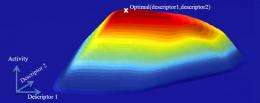
A representation of a volcano graph. SUNCAT uses volcano graphs to determine where important chemical properties coincide. A substance with those properties is a good candidate for a catalyst. Credit: Frank Abild-Pederson
(PhysOrg.com) -- SLAC researchers have taken a big step toward making useful catalysts easier to find or createprocesses that have previously relied on trial and error. As explained yesterday in the Proceedings of the National Academy of Sciences, SLAC researchers at the Center for Sustainable Energy through Catalysis, or SUNCAT, are using advances in surface chemistry research to better describe the intrinsically complex process of catalysis, a type of chemical reaction that occurs at the surfaces of materials.
In catalysis, a chemical called a catalyst helps speed chemical reactions between other molecules, without itself being changed. Catalysis is the basis for most important industrial chemical processes, used for years in everything from refining oil to producing plastic or fertilizers. It is also the basis for some of the crucial processes needed to turn sunlight into fuels and other chemicals. However, the theory to explain just why certain substances make chemical reactions happen faster or more efficientlyand, more importantly, to predict even better catalystshas lagged behind experimental efforts. The researchers at SUNCAT want to use an approach called density functional theory to change that.
"[The paper] is really almost a program for the theory portion of catalysis research at SLAC and Stanford," said Jens Norskov, director of SUNCAT and the paper's lead author. The paper does not shy away from the challenges such research still faces, he added, "but it illustrates where our methods can help." The methods of density functional theory involve identifying important trends for classes of catalysts and chemical reactions; those trends can then be used to predict new and better catalysts. In this approach, the electrons that are key to forming and dissolving chemical bonds are treated as interacting clouds of varying densities, and a descriptor, or more general way to describe their behavior, is developed. Thus far, density functional theory has been applied successfully for an important class of catalysts called transition metals.
"Our approach has been to try to reduce the number of parameters we need to describe each specific reaction," explained SUNCAT researcher and co-author of the paper Frank Abild-Pedersen. Such parameters include the structures of the substances involved, any impurities they contain, and what intermediate products are created during a processto name only a few. "Some groups do lots and lots of calculations. We want to simplify."
In the case of the transition metals, such simplification narrowed down a complex process to two important descriptors. This, for instance, enabled the researchers to identify nickel-iron catalysts as a cheaper, better alternative to nickel alonea catalyst commonly used in a process called catalytic methanation, which produces methane for synthetic fuels.
"You can always try to understand everything completely," said co-author and SUNCAT researcher Felix Studt, "but to predict something new you need a simple model." Despite the simplifications, Nørskov's team still needs to perform a certain amount of number crunching to pin down the behavior of a representative member of a class of catalysts before any descriptors can be developed.
"We had to develop an understanding based on some transition metals to be able to predict how the rest would react," Studt explained. An important consideration is to find a descriptor that is easy to calculate.
All three scientists agree that the transition metals are a simple example. In contrast, "Oxides, nitrides, sulfidesdensity functional theory doesn't describe them as well," Abild-Pedersen said. The team is working to refine not only their descriptors, but how they develop them, to address tougher cases.
"We're deriving an approach," Studt said. "We start with finding new catalysts for easy classes, and in the process we refine and extend our approach."
Provided by
SLAC National Accelerator Laboratory
-
From lemons to lemonade: Reaction uses carbon dioxide to make carbon-based semiconductor,
29 comments
-
Thioridazine kills cancer stem cells in human while avoiding toxic side-effects of conventional cancer treatments,
3 comments
-
SpaceX private rocket blasts off for space station (Update),
42 comments
-
Climate scientists say they have solved riddle of rising sea,
30 comments
-
Scotland passes turbine test to harness tidal power,
41 comments
-
Schwartz reagent-- NMR/MS/IR
8 hours ago
-
Inversion temp
13 hours ago
-
High school chemistry EEI
20 hours ago
-
oxidation of I- by KMnO4
May 25, 2012
-
Invesion temp
May 25, 2012
-
Hybridization of SnCl3 -
May 25, 2012
- More from Physics Forums - Chemistry
More news stories
From lemons to lemonade: Reaction uses carbon dioxide to make carbon-based semiconductor
(Phys.org) -- A materials scientist at Michigan Technological University has discovered a chemical reaction that not only eats up the greenhouse gas carbon dioxide, it also creates something useful. And, by ...
May 21, 2012 |
4.7 / 5 (88) |
28
|
New CO2-removing catalyst can take the heat
(Phys.org) -- The current method of removing the greenhouse gas carbon dioxide (CO2) from the flues of coal-fired power plants uses so much energy that no one bothers to use it. So says Roger Aines, principal ...
May 24, 2012 |
5 / 5 (7) |
7
|
High-speed method to aid search for solar energy storage catalysts
Eons ago, nature solved the problem of converting solar energy to fuels by inventing the process of photosynthesis.
May 25, 2012 |
5 / 5 (3) |
3
|
Researchers demonstrate possible primitive mechanism of chemical info self-replication
(Phys.org) -- When scientists think about the replication of information in chemistry, they usually have in mind something akin to what happens in living organisms when DNA gets copied: a double-stranded molecule ...
May 25, 2012 |
5 / 5 (4) |
2
|
Castor oil: Action mechanism of one of the oldest drugs known to man elucidated
Castor oil is known primarily as an effective laxative; however, it was also used in ancient times with pregnant women to induce labour. Only now have scientists at the Max Planck Institute for Heart and Lung ...
May 21, 2012 |
3 / 5 (2) |
3
|
Dell tablet leak: 10.1-inch display, two-battery choice
(Phys.org) -- Headline after headline talks about vendors tablets in the wings as likely number-one contenders for the iPad. Such claims have justifiably been taken with a grain of salt, considering ...
Scientist: Evolution debate will soon be history
(AP) -- Richard Leakey predicts skepticism over evolution will soon be history. Not that the avowed atheist has any doubts himself.
Keep food safety in mind this memorial day weekend
(HealthDay) -- Picnics, parades and cookouts are as much a part of Memorial Day weekend as tributes to the United States' war veterans.
SpaceX capsule has 'new car' smell, astronauts say (Update)
SpaceX's Dragon cargo vessel smells like a new car, said astronauts at the International Space Station after opening the hatches Saturday following the spacecraft's landmark mission to the orbiting lab.
SpotterRF debuts Radar Backpack Kit (w/ Video)
(Phys.org) -- SpotterRF has announced a special radar backpack kit designed to enhance situational awareness for soldiers on the ground. The company says its special radar is designed for warfighters as part ...
Australia hails surprise super-telescope decision
Australia has hailed a surprise decision giving it a role in a radio telescope project aimed at revolutionising astronomy, vowing to draw on its decades of experience in space science.
Jan 12, 2011
Rank: not rated yet
"processes that have previously relied on trial and error." Israel Wachs and many others, for decades, have been using a ground up approach by studying catalysts with spectroscopy and kinetic analyses to understand the fundamental mechanisms that take place. From their data they can then tailor a catalyst or design a completely new one since they understand the underlying phenomenon of the chemical reaction and catalyst interaction. That being said, DFT is certainly welcomed with open arms in the catalysis community, as catalysis theory has not caught up with experimental achievements.