Southwest headed for permanent drought
January 31, 2011 By David Funkhouser

Southwest headed for permanent drought

Enlarge

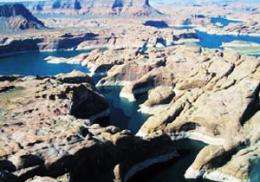
Aerial view of Lake Powell in Arizona. The prominent white rings surrounding the edges of the cliffs are due to steadily receding water levels.

(PhysOrg.com) -- The American Southwest has seen naturally induced dry spells throughout the past, but now human-induced global warming could push the region into a permanent drought in the coming decades, according to Lamont-Doherty scientist Richard Seager and others who have been studying the area’s climate.

Seager, who focuses on climate variability and climate change, began his work studying droughts by looking into the past using sea surface temperature records gathered by ships plying the oceans in the 19th century. He and colleagues used computer models to recreate a climate history that showed periodic droughts. Focusing on North America, they also used tree rings to look back as far as the Middle Ages, when the Southwest experienced a lasting hundreds of years.

“You begin to see that there’s a natural cycle of droughts, large and small,” says Seager, the Palisades Geophysical Institute/Lamont research professor at Lamont-Doherty Earth Observatory. “But when you add in the human effects from rising greenhouse gases, we could be pushing subtropical regions like the American Southwest into a permanent state of aridity. There are signs it’s already underway.”

In a 2007 paper, Seager and colleagues used computer models to show the Southwest is on the verge of a transition to a more arid climate. And in the December 2010 issue of Proceedings of the National Academy of Sciences, Seager and Gabriel Vecchi of NOAA pinned the drying to a drop in winter precipitation and showed how this is caused by changes in atmospheric circulation and water vapor transports induced by warming temperatures.

The warming also shortens the snow season, reduces the snow mass that serves as natural storage for water, and forces an earlier spring melt, disrupting the supply system that waters much of the Southwest—the region from the western Great Plains to the Pacific, and the Oregon border to southern Mexico.

That is ominous news for a region that has seen explosive growth in population, land use and water demands in recent decades. A reduction in the flow of important water resources such as the Colorado River will have serious consequences.

“I’m curious how the Southwest is going to handle this,” Seager says.

He says the natural variations between wet and dry periods are driven mostly by the El Niño/La Niña cycle of sea surface warming and cooling in the Pacific. “The anthropogenic signal is currently small compared to the natural variability,” Seager says. “But you can see it, and it’s consistent with the climate models. It works across the whole subtropics. Right now the human effect is small, but it will become a serious problem in the decades down the road.”

Local water system managers want to know how much will be available in coming years, but Seager can’t offer information that detailed. Still, almost all of the models point to a much drier region by around 2050. “You could wait to the middle of the century and say, well, did this happen, or didn’t it happen?” Seager says. “But that’s not a very sensible thing to do.”

Provided by Columbia University search and more info website

3.7 /5 (14 votes)  

Filter


Move the slider to adjust rank threshold, so that you can hide some of the comments.


Display comments: newest first

Branden520
Jan 31, 2011

Rank: 2.7 / 5 (7)
Too bad this global warming thing is bringing us more moisture than ever. Last winter the mountains in Tucson had over a 10 foot base of snow. Sounds like a drought for sure.
Skeptic_Heretic
Jan 31, 2011

Rank: 3.5 / 5 (6)
Too bad this global warming thing is bringing us more moisture than ever. Last winter the mountains in Tucson had over a 10 foot base of snow. Sounds like a drought for sure.

You should probably learn what a drought is.

Beyond that, the Southwest was a desert before we irrigated it. This appears to be an article about water management, not desertification.
omatumr
Jan 31, 2011

Rank: 2.3 / 5 (9)
This is backwards: ". . . now human-induced global warming could push . . ."

It seems to be more propaganda than science.

1. First establish that human-induced global warming exists.

2. Then speculate on all the possible consequences.
Doug_Huffman
Jan 31, 2011

Rank: 4.5 / 5 (2)
Lake Powell is a reservoir damned by the Glen Canyon Dam, and so its level is controlled by other than natural forces. To use it's varying levels is disingenuous at best. I left the Sierra Club for its ineffectual response to the *proposal* to build the boondoggle that is Glen Canyon Damn. It was doomed to sedimentation ab initio.

Predicting rainfall so far in the future as a basis for investment is not appreciably different from predicting earthquakes at the same remove.
kivahut
Feb 01, 2011

Rank: 5 / 5 (2)
Desertification is more a consequence of geology and not of climatology. The SW US is a desert because of the Sierra Nevada range. We're actually getting more snow fall in the last 3 years than we have before. Maybe it's due to the warmer temperatures over the Pacific.
GSwift7
Feb 01, 2011

Rank: 1 / 5 (1)
This appears to be an article about water management


Well, the study may have been about water management, but this article is about anthropogenic global warming causing human catastrophy.

You are right that there is more than one definition of a drought. Depending on what field you are working in, it could mean decreased precipitation or it could simply mean that people are using too much water, or a combo of both. Unfortunately, most people today have come to think that drought just means no rain, and the way this article is written supports that myth.

I actually read a study a couple months ago that was based on defining what a drought is. It cited numerous cases where the different variations of the term are used to abuse the systems for government aid and to avoid water control laws, as well as to make sensational headlines. They said that even amongst leading authorities, there are many different official definitions of "drought".
GSwift7
Feb 01, 2011

Rank: 1 / 5 (1)
Lake Powell is a reservoir damned by the Glen Canyon Dam, and so its level is controlled by other than natural forces. To use it's varying levels is disingenuous at best. I left the Sierra Club for its ineffectual response to the *proposal* to build the boondoggle that is Glen Canyon Damn. It was doomed to sedimentation ab initio


lol, yes. If you use lake level, then Cumberland Lake in Kentucky is in trouble (they drained it about half way down because of questions about the dam's safety).

On the good side, if you are right that the Glen Canyon Dam was a bad idea, then there's always the option to drain it and tear the dam down. Dams can be undone and I bet nature would return to that area VERY quickly. All that accumulated sediment would make PRIME growing soil. That would be a really interesting experiment. I wonder what would happen if they drained some of the dams here in South Carolina, and returned them to swampland. They mostly run those power plants on coal anyway.
GSwift7
Feb 01, 2011

Rank: 1 / 5 (1)
In the interest of proving my point about nature returning when you let water out of a dam, the forst around Cumberland lake has already grown back down to the new water level. It's kinda funny that the forest extended down to the water faster than some of the boat launches did. There's still docks and boat launches that don't reach the water now. I guess people figured that they would fill the lake back up by now.
Arkaleus
Feb 01, 2011

Rank: 3 / 5 (4)
There is no justification for the predictions of drought and desertification. Those are the results of computer models and outright crystal ballery. We have as much reason to believe climate change will result in a greener, more verdant world, with longer growing seasons and more favorable plant conditions. The only reason why the alarmists bang their little bells about the desertification of the world is to create a hysteria. There is nothing these climate scientists can do about climate change; their efforts stem from social ideologies, not science.
Rank 3.7 /5 (14 votes)
Relevant PhysicsForums posts

More news stories

Australia hails surprise super-telescope decision

Australia has hailed a surprise decision giving it a role in a radio telescope project aimed at revolutionising astronomy, vowing to draw on its decades of experience in space science.

Space & Earth / Astronomy

created 7 hours ago | popularity 5 / 5 (2) | comments 0

Astronomers seize last chance in lifetime for Venus Transit

Astronomers are gearing for one the rarest events in the Solar System: an alignment of Earth, Venus and the Sun that will not be seen for another 105 years.

Space & Earth / Astronomy

created 7 hours ago | popularity 5 / 5 (1) | comments 0

SpaceX capsule has 'new car' smell, astronauts say

SpaceX's Dragon cargo vessel smells like a new car, said astronauts at the International Space Station after opening the hatches Saturday following the spacecraft's landmark mission to the orbiting lab.

Space & Earth / Space Exploration

created 7 hours ago | popularity 4.3 / 5 (9) | comments 0

Astronauts enter world's 1st private supply ship

(AP) -- Space station astronauts floated into the Dragon on Saturday, a day after its heralded arrival as the world's first commercial supply ship.

Space & Earth / Space Exploration

created 7 hours ago | popularity 5 / 5 (3) | comments 0

Dragon makes history with space station docking

The private company SpaceX made history Friday with the docking of its Dragon capsule to the International Space Station, the most impressive feat yet in turning routine spaceflight over to the commercial ...

Space & Earth / Space Exploration

created 22 hours ago | popularity 4.9 / 5 (9) | comments 0


SpotterRF debuts Radar Backpack Kit (w/ Video)

(Phys.org) -- SpotterRF has announced a special radar backpack kit designed to enhance situational awareness for soldiers on the ground. The company says its special radar is designed for warfighters as part ...

Thousands of shellfish found dead in Peru

Thousands of crustaceans were found dead off the coast of Lima following the mystery mass death of dolphins and pelicans, the Peruvian Navy said Friday.

Family history of Alzheimer's affects functional connectivity

(HealthDay) -- Cognitively normal individuals with a family history of late-onset Alzheimer's disease (AD) may display lower resting state functional connectivity in the default mode network (DMN) of the brain, ...

High-speed method to aid search for solar energy storage catalysts

Eons ago, nature solved the problem of converting solar energy to fuels by inventing the process of photosynthesis.

Transvaginal mesh op restores pelvic organ prolapse at price

(HealthDay) -- Transvaginal mesh (TVM) procedures are effective for anatomical restoration of pelvic organ prolapse (POP), but patients report a worsening of sexual function following surgery, according to ...

Travel to high altitudes tied to Crohn's, colitis flare-ups

(HealthDay) -- People with inflammatory bowel disease, which includes Crohn's disease and colitis, may be at increased risk for flare-ups when they fly or travel to high altitudes for skiing or mountain climbing, ...