Smithsonian instrument 'fills the gap,' views sun's innermost corona
January 4, 2011

Smithsonian instrument 'fills the gap,' views sun's innermost corona

Enlarge

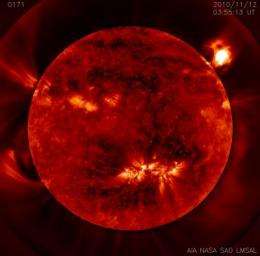
This photograph of the sun, taken by the Atmospheric Imaging Assembly instrument on NASA's Solar Dynamics Observatory, shows how image processing techniques developed at SAO can reveal the faint, inner corona. At the sun's limb, prominences larger than the Earth arc into space. Bright active regions like the one on the Sun's face at lower center are often the source of huge eruptions known as coronal mass ejections. Credit: NASA/LMSAL/SAO

During a total eclipse of the Sun, skywatchers are awed by the shimmering corona -- a faint glow that surrounds the Sun like gossamer flower petals. This outer layer of the Sun's atmosphere is, paradoxically, hotter than the Sun's surface, but so tenuous that its light is overwhelmed by the much brighter solar disk. The corona becomes visible only when the Sun is blocked, which happens for just a few minutes during an eclipse.

Now, an instrument on board NASA's Solar Dynamics Observatory (SDO), developed by Smithsonian scientists, is giving unprecedented views of the innermost corona 24 hours a day, 7 days a week.

"We can follow the corona all the way down to the Sun's surface," said Leon Golub of the Harvard-Smithsonian Center for Astrophysics (CfA).

Previously, solar astronomers could observe the corona by physically blocking the solar disk with a coronagraph, much like holding your hand in front of your face while driving into the setting Sun. However, a also blocks the area immediately surrounding the Sun, leaving only the outer corona visible.

The Atmospheric Imaging Assembly (AIA) instrument on SDO can "fill" this gap, allowing astronomers to study the corona all the way down to the Sun's surface. The resulting images highlight the ever-changing connections between gas captured by the Sun's magnetic field and gas escaping into interplanetary space.

The Sun's magnetic field molds and shapes the corona. Hot solar plasma streams outward in vast loops larger than Earth before plunging back onto the Sun's surface. Some of the loops expand and stretch bigger and bigger until they break, belching plasma outward.

Smithsonian instrument 'fills the gap,' views sun's innermost corona

This zoomed-in image shows how the sun's magnetic field shapes hot coronal plasma. Photos like this highlight the ever-changing connections between gas captured by the sun's magnetic field and gas escaping into interplanetary space. Credit: NASA/LMSAL/SAO

"The AIA solar images, with better-than-HD quality views, show and dynamics that we've never seen before on the Sun," said CfA astronomer Steven Cranmer. "This is a whole new area of study that's just beginning."

Cranmer and CfA colleague Alec Engell developed a computer program for processing the AIA images above the Sun's edge. These processed images imitate the blocking-out of the Sun that occurs during a total solar eclipse, revealing the highly dynamic nature of the inner . They will be used to study the initial eruption phase of coronal mass ejections (CMEs) as they leave the and to test theories of solar wind acceleration based on magnetic reconnection.

Provided by Harvard-Smithsonian Center for Astrophysics search and more info website

3.5 /5 (2 votes)  

Filter


Move the slider to adjust rank threshold, so that you can hide some of the comments.


Display comments: newest first

omatumr
Jan 04, 2011

Rank: 1 / 5 (4)
I am pleased with this interest in the star next door - Earth's heat source.

We do not see the Sun, but the outward flow of waste products (Hydrogen and Helium) from the core neutron star that emit light (photons) when they reach the top of the Sun's atmosphere.

They continue outward and surround this iron-rich ball of dirt with the outer layer of the Sun (the heliosphere). The Sun is not “up there” emitting photons. We literally live in the Sun.

A friend suggested this TV screen metaphor:

“Once the set is switched on, the entertaining images seen are those created by emitted photons and, of course, they hide what is really inside the television set (only of interest to electronics specialists).”

With kind regards,
Oliver K. Manuel
Nik_2213
Jan 04, 2011

Rank: 5 / 5 (1)
Uh, doesn't the recent results from helioseismology, incidentally finding those 'deep currents' linked to sunspots, invalidate that neutron star core hypothesis ??
omatumr
Jan 04, 2011

Rank: 1 / 5 (4)
No, not at all.
vidyunmaya
Feb 05, 2011

Rank: 1 / 5 (2)
Sub: Welcome change to new dimensions
ENVIRONMENT SENSEX-EARTH'S GLOW-SUN-LIFE SIGNIFICANCE
www [dot]newciv [dot] org/nl/newslog [dot] php/_v162
VIDYARDHI NANDURI
Rank 3.5 /5 (2 votes)
Relevant PhysicsForums posts
  • revamping general concept and cosmological principle
    createdMay 25, 2012
  • Transiting Exoplanet Light Curve
    createdMay 25, 2012
  • Math behind Theoretical Physics
    createdMay 24, 2012
  • Do we know whats at the center of galaxies yet?
    createdMay 23, 2012
  • Structure of the Milky Way?
    createdMay 20, 2012
  • What would it take to terraform Pluto and Charon?
    createdMay 19, 2012
  • More from Physics Forums - General Astronomy

More news stories

Australia hails surprise super-telescope decision

Australia has hailed a surprise decision giving it a role in a radio telescope project aimed at revolutionising astronomy, vowing to draw on its decades of experience in space science.

Space & Earth / Astronomy

created 7 hours ago | popularity 5 / 5 (2) | comments 0

Astronomers seize last chance in lifetime for Venus Transit

Astronomers are gearing for one the rarest events in the Solar System: an alignment of Earth, Venus and the Sun that will not be seen for another 105 years.

Space & Earth / Astronomy

created 7 hours ago | popularity 5 / 5 (1) | comments 0

SpaceX capsule has 'new car' smell, astronauts say

SpaceX's Dragon cargo vessel smells like a new car, said astronauts at the International Space Station after opening the hatches Saturday following the spacecraft's landmark mission to the orbiting lab.

Space & Earth / Space Exploration

created 7 hours ago | popularity 4.3 / 5 (9) | comments 0

Astronauts enter world's 1st private supply ship

(AP) -- Space station astronauts floated into the Dragon on Saturday, a day after its heralded arrival as the world's first commercial supply ship.

Space & Earth / Space Exploration

created 7 hours ago | popularity 5 / 5 (3) | comments 0

Dragon makes history with space station docking

The private company SpaceX made history Friday with the docking of its Dragon capsule to the International Space Station, the most impressive feat yet in turning routine spaceflight over to the commercial ...

Space & Earth / Space Exploration

created 22 hours ago | popularity 4.9 / 5 (9) | comments 0


SpotterRF debuts Radar Backpack Kit (w/ Video)

(Phys.org) -- SpotterRF has announced a special radar backpack kit designed to enhance situational awareness for soldiers on the ground. The company says its special radar is designed for warfighters as part ...

Thousands of shellfish found dead in Peru

Thousands of crustaceans were found dead off the coast of Lima following the mystery mass death of dolphins and pelicans, the Peruvian Navy said Friday.

Family history of Alzheimer's affects functional connectivity

(HealthDay) -- Cognitively normal individuals with a family history of late-onset Alzheimer's disease (AD) may display lower resting state functional connectivity in the default mode network (DMN) of the brain, ...

High-speed method to aid search for solar energy storage catalysts

Eons ago, nature solved the problem of converting solar energy to fuels by inventing the process of photosynthesis.

Transvaginal mesh op restores pelvic organ prolapse at price

(HealthDay) -- Transvaginal mesh (TVM) procedures are effective for anatomical restoration of pelvic organ prolapse (POP), but patients report a worsening of sexual function following surgery, according to ...

Travel to high altitudes tied to Crohn's, colitis flare-ups

(HealthDay) -- People with inflammatory bowel disease, which includes Crohn's disease and colitis, may be at increased risk for flare-ups when they fly or travel to high altitudes for skiing or mountain climbing, ...