Scientists make holograms of atoms using electrons
January 6, 2011 By Lisa Zyga feature

Scientists make holograms of atoms using electrons

Enlarge

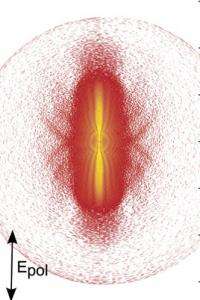
This velocity map image shows the velocity distribution of ionized electrons, which are used to create a hologram of a Xenon atom. Image credit: Y. Huismans, et al. ©2010 Science.

(PhysOrg.com) -- While holography is often associated with artistic 3D images, it can also be used for many other purposes. In a new study, scientists have created holograms of atoms using laser-driven electron motion, which could lead to a new type of ultra-fast photoelectron spectroscopy. In the future, this type of holography could enable scientists to study the structures of molecules in a more direct way than before.

The scientists, Ymkje Huismans from the FOM-Institute AMOLF in Amsterdam, The Netherlands, and an international research team have published their study in a recent issue of .

“What we have experimentally demonstrated is that it is possible to make holograms by taking an electron out of a molecule and, using a laser field, redirect the electron toward the molecule,” coauthor Marc Vrakking, of the FOM-Institute AMOLF and the Max Born Institute in Berlin, told PhysOrg.com.

In their experiments, the scientists beamed an intense infrared laser light at an atom or molecule, which resulted in the atom or molecule becoming ionized and releasing an electron. The laser field causes the liberated electron to oscillate away from and toward the ion. Sometimes, an electron and ion collide, releasing a very short burst of radiation.

Because the is fully coherent, meaning it always has the same phase, the scientists realized that they could apply holographic techniques to record information about the ion and electron. The key to holographic electron imaging is to observe the interference between a reference wave (which is emitted by the electron and doesn’t interact with the ion) and a signal wave (which scatters off the ion and encodes its structure). When the reference wave and signal wave interfere on a detector, the encoded information about the electron and ion is stored and can be viewed in the future. As the scientists explained, the result is a hologram of an atom produced by its own electrons.

The researchers also developed theoretical models to simulate their measurements, confirming that the hologram had stored spatial and temporal information about the and ions. By using the holographic structures to develop a new kind of ultra-fast , researchers could be able to directly measure electron and movements on the attosecond timescale. This ability would be useful for understanding chemical reactions at the most basic level, particularly in that cannot be easily studied by other methods.

More information: Y. Huismans, et al. “Time-Resolved Holography with Photoelectrons.” Science Express. 16 December 2010. DOI:10.1126/science.1198450

Copyright 2010 PhysOrg.com.
All rights reserved. This material may not be published, broadcast, rewritten or redistributed in whole or part without the express written permission of PhysOrg.com.

4.9 /5 (40 votes)  

Filter


Move the slider to adjust rank threshold, so that you can hide some of the comments.


Display comments: newest first

wiyosaya
Jan 06, 2011

Rank: 5 / 5 (7)
What could be really cool about this is if they find a way to take advantage of the fact that if you view a hologram with a longer wave reference source, the original image appears magnified.

This article does not give the "wavelength" of the "reference" wave, but if that wavelength is very short and there is a way of using a much longer wavelength "reference" to reconstruct the image, then they might get a very magnified image. Perhaps even finer details of the atom itself might be seen than what this article indicates.
xamien
Jan 06, 2011

Rank: not rated yet
That would definitely be cool if that was possible. If I understand the details of atomic structure correctly, though, you would only get a very grainy picture the more you zoomed in.
QuantaUniverseCom
Jan 06, 2011

Rank: 1 / 5 (5)
Galaxies appear to be self-similar fractal analogues of an atomic nucleus, much like vast molecular clouds are larger scale structures composed of hydrogen atoms. I have a great story on the milky way galaxy bubbles being a carbon or oxygen analogue at QuantaUniverse.com

seatco2
Jan 07, 2011

Rank: 3 / 5 (2)
My scientific take is that it looks a lot like an electric-fire muscular tubular tract leading from the uterus to the exterior of the body in a female placental mammal.
natetuvkok
Jan 07, 2011

Rank: 5 / 5 (2)
My scientific take is that it looks a lot like an electric-fire muscular tubular tract leading from the uterus to the exterior of the body in a female placental mammal.

WHAT?????
seatco2
Jan 07, 2011

Rank: 1 / 5 (1)
Well at least someone saw it before it was JERKED OFF this site. ;)
Skepticus
Jan 07, 2011

Rank: 5 / 5 (2)
The caption of the picture is technically incorrect. "Ionization is the physical process of converting an atom or molecule into an ion by adding or removing charged particles such as electrons or other ions"(Wikipedia). So the electron itself can't be ionized! There is no such thing as ionized electrons, i.e. "electron ions"
Skepticus
Jan 07, 2011

Rank: not rated yet
My scientific take is that it looks a lot like an electric-fire muscular tubular tract leading from the uterus to the exterior of the body in a female placental mammal.

WHAT?????

A technical and politically correct way of refering to the doorway from which all of us enter the world. Very well said!
wileruilaer
Jan 07, 2011

Rank: 5 / 5 (1)
I know little about these things. Just wondering: how likely is it that the ability to measure electron movements on the attosecond timescale, and record spatial and temporal information, would enable researchers to bypass the principle that you cannot know position and velocity of a particle at the same time?
TheFlynn
Jan 07, 2011

Rank: not rated yet
I thought a hologram was a projection of a 3d image into an empty space. A holograph is similar but is actually a very high resolution photograph which can present a 3d image from a film. I found this substitution of words confusing.
bluehigh
Jan 09, 2011

Rank: not rated yet
a low res micrograph of a magnet (field)
dconine
Jan 15, 2011

Rank: not rated yet
This is some interesting science work. The technology of imaging atoms from their own electrons (nano-MRI ?) can be used to advance other imaging and measurement systems.
Good stuff.
Rank 4.9 /5 (40 votes)
Relevant PhysicsForums posts

More news stories

Landmark calculation clears the way to answering how matter is formed

(Phys.org) -- An international collaboration of scientists, including Thomas Blum, associate professor of physics, is reporting in landmark detail the decay process of a subatomic particle called a kaon – ...

Physics / General Physics

created May 25, 2012 | popularity 4.6 / 5 (16) | comments 43 | with audio podcast

Is a classical electrodynamics law incompatible with special relativity?

(Phys.org) -- The laws of classical electromagnetism that were developed in the 19th century are the same laws that scientists use today. They include Maxwell’s four equations along with the Lorentz la ...

Physics / General Physics

created May 24, 2012 | popularity 4.7 / 5 (15) | comments 35 | with audio podcast feature

Lying in wait for WIMPs: Researchers seek to dramatically increase sensitivity of Large Underground Xenon detector

Although it's invisible, dark matter accounts for at least 80 percent of the matter in the universe. No one knows what it is, but most scientists would bet on weakly interacting massive particles, or WIMPs.

Physics / General Physics

created May 23, 2012 | popularity 4.2 / 5 (6) | comments 15 | with audio podcast

Hall effect at the speed of light: How can you demonstrate relativistic effects with your mobile phone?

The relativistic Hall effect describing objects rotating at speeds comparable with the speed of light has been reported.

Physics / General Physics

created May 21, 2012 | popularity 4.3 / 5 (3) | comments 8

Cloak of invisibility: Engineers use plasmonics to create an invisible photodetector

A team of engineers at Stanford and the University of Pennsylvania has for the first time used "plasmonic cloaking" to create a device that can see without being seen - an invisible machine that detects light. It is the first ...

Physics / General Physics

created May 21, 2012 | popularity 4.8 / 5 (16) | comments 7 | with audio podcast


SpotterRF debuts Radar Backpack Kit (w/ Video)

(Phys.org) -- SpotterRF has announced a special radar backpack kit designed to enhance situational awareness for soldiers on the ground. The company says its special radar is designed for warfighters as part ...

Australia hails surprise super-telescope decision

Australia has hailed a surprise decision giving it a role in a radio telescope project aimed at revolutionising astronomy, vowing to draw on its decades of experience in space science.

Astronomers seize last chance in lifetime for Venus Transit

Astronomers are gearing for one the rarest events in the Solar System: an alignment of Earth, Venus and the Sun that will not be seen for another 105 years.

Thousands of shellfish found dead in Peru

Thousands of crustaceans were found dead off the coast of Lima following the mystery mass death of dolphins and pelicans, the Peruvian Navy said Friday.

SpaceX capsule has 'new car' smell, astronauts say

SpaceX's Dragon cargo vessel smells like a new car, said astronauts at the International Space Station after opening the hatches Saturday following the spacecraft's landmark mission to the orbiting lab.

Family history of Alzheimer's affects functional connectivity

(HealthDay) -- Cognitively normal individuals with a family history of late-onset Alzheimer's disease (AD) may display lower resting state functional connectivity in the default mode network (DMN) of the brain, ...