New romaine lettuce lines launched
January 18, 2011

New romaine lettuce lines launched

Enlarge

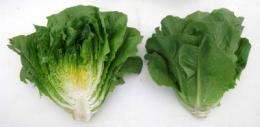
SM09A, one of two new romaine lettuce breeding lines found to be resistant to dieback disease, also showed good shelf life. Credit: Photo by Ivan Simko.

California and Arizona, the two largest lettuce-producing states, account for more than 95% of the lettuce grown in the United States. Since the early 1990s, the states' lettuce crops have been subject to "dieback", a disease indicated by symptoms including mottling, yellowing, and death of older leaves, and stunting and eventual death of lettuce plants. Dieback disease, caused by two soil-borne viruses, affects romaine and leaf-type lettuce, often leading to crop loss of 60% or more. Most disturbing is the news that the virus is not effectively reduced using either chemical treatment or rotation with nonhost crops, and the virus can live on in infested soil.

In an effort to control looming economic losses to the region's vital lettuce industry, scientists are being challenged to develop new breeding lines that provide to the virus. Add in another challenge for researchers: some recently developed romaine cultivars that are resistant to dieback have limited shelf life, decaying quickly when processed for salad.Three romaine-type breeding lines with resistance to the disease were previously released by the U.S. Department of Agriculture-Agricultural Research Service in Salinas, California. Now, the Salinas breeding program has introduced new romaine breeding lines that prove praiseworthy in terms of both disease resistance and shelf life. Ivan Simko and Ryan J. Hayes from the USDA-ARS in Salinas, Krishna V. Subbarao of the Department of at the University of California, and Rebecca Grube from the University of New Hampshire introduced the new romaine lines in a recent issue of HortScience.

SM09A and SM09B are F8 romaine breeding lines of lettuce (Lactuca sativa L.) resistant to the dieback disease and with good shelf life. SM09B was selected from a cross between 'Darkland' and PI 491224. SM09A was developed from 'Green Towers' ('Darkland' x PI 491224). "In replicated field trials, the two breeding lines showed complete resistance to dieback. Testing of salad-cut lettuce in modified atmosphere packaging indicated slower decay in the two breeding lines compared with other dieback-resistant romaine varieties", noted Simko.

More information: The complete study and abstract are available on the ASHS HortScience electronic journal web site: http://hortsci.ash … ull/45/4/670

Provided by American Society for Horticultural Science

4.5 /5 (2 votes)  

Rank 4.5 /5 (2 votes)
Relevant PhysicsForums posts

More news stories

Thousands of shellfish found dead in Peru

Thousands of crustaceans were found dead off the coast of Lima following the mystery mass death of dolphins and pelicans, the Peruvian Navy said Friday.

Biology / Ecology

created 7 hours ago | popularity 4.7 / 5 (3) | comments 4

It's in the genes: Research pinpoints how plants know when to flower

Scientists believe they've pinpointed the last crucial piece of the 80-year-old puzzle of how plants "know" when to flower.

Biology / Biotechnology

created 22 hours ago | popularity 3.9 / 5 (8) | comments 1 | with audio podcast

Researchers solve structure of human protein critical for silencing genes

In a study published in the journal Cell on May 24, Cold Spring Harbor Laboratory (CSHL) scientists describe the three-dimensional atomic structure of a human protein bound to a piece of RNA that "guides" the pr ...

Biology / Cell & Microbiology

created 22 hours ago | popularity 4.7 / 5 (7) | comments 0 | with audio podcast

More plant species responding to global warming than previously thought

(Phys.org) -- Far more wild plant species may be responding to global warming than previous large-scale estimates have suggested.

Biology / Ecology

created May 22, 2012 | popularity 4.6 / 5 (14) | comments 18 | with audio podcast

Totally rad: Scientists create rewritable digital data storage in DNA

(Phys.org) -- Scientists from Stanford's Department of Bioengineering have devised a method for repeatedly encoding, storing and erasing digital data within the DNA of living cells.

Biology / Biotechnology

created May 21, 2012 | popularity 4.9 / 5 (15) | comments 11 | with audio podcast


SpotterRF debuts Radar Backpack Kit (w/ Video)

(Phys.org) -- SpotterRF has announced a special radar backpack kit designed to enhance situational awareness for soldiers on the ground. The company says its special radar is designed for warfighters as part ...

Australia hails surprise super-telescope decision

Australia has hailed a surprise decision giving it a role in a radio telescope project aimed at revolutionising astronomy, vowing to draw on its decades of experience in space science.

Astronomers seize last chance in lifetime for Venus Transit

Astronomers are gearing for one the rarest events in the Solar System: an alignment of Earth, Venus and the Sun that will not be seen for another 105 years.

SpaceX capsule has 'new car' smell, astronauts say

SpaceX's Dragon cargo vessel smells like a new car, said astronauts at the International Space Station after opening the hatches Saturday following the spacecraft's landmark mission to the orbiting lab.

Family history of Alzheimer's affects functional connectivity

(HealthDay) -- Cognitively normal individuals with a family history of late-onset Alzheimer's disease (AD) may display lower resting state functional connectivity in the default mode network (DMN) of the brain, ...

Astronauts enter world's 1st private supply ship

(AP) -- Space station astronauts floated into the Dragon on Saturday, a day after its heralded arrival as the world's first commercial supply ship.