Predation by foxes aided by Earth's magnetic field
Jan 14, 2011 by Lin Edwards report
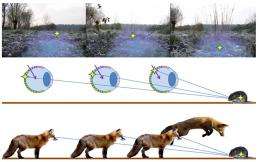
Hypothetical principle of a "magnetic range-finder" in the red fox assuming radical-pair-based magnetoreception. Image credit: [i]Biology Letters[/i], doi:10.1098/rsbl.2010.1145

(PhysOrg.com) -- Scientists in the Czech Republic and Germany studying the hunting behavior of red foxes have discovered the foxes are more successful if they jump on their prey towards the north.

Professor Hynek Burda of the University of Duisburg-Essen in Germany, and colleagues in the Czech Republic, studied the (Vulpes vulpes), which hunts small prey in long vegetation or under snow by slowly creeping forward and listening intently before jumping high and pouncing on the prey from above, a process known as mousing.

A total of 84 wild red foxes were observed in 65 locations in the Czech Republic by 23 wildlife biologists and hunters between April 2008 and September 2010. The observers used a to measure body orientation of the foxes as they prepared to make hunting jumps on 592 occasions in total, with the immediate success or failure of 200 of the jumps being clear. The observations were made in different seasons and habitats and different times of day.

The researchers found that the foxes tended to prepare for their jumps in long vegetation or snow with their body aligned in a roughly north-easterly direction (around 20° clockwise from magnetic north). In short vegetation, where the foxes were more likely to be able to see their prey, there was no bias towards any particular direction.

This video is not supported by your browser at this time.

In long vegetation and snow 72.5 % of successful attacks were made when the fox’s head was facing towards the north (340°-40°) and attacks from other directions were mostly unsuccessful, except for a successful cluster 15% at due south. These results were found regardless of the time of year, time of day, cloud cover, wind direction, or age and gender of the fox.

The researchers say their findings suggest the successful attacks were enhanced by magnetic alignment, and Burda said their favorite hypothesis is that the fox uses information on the Earth’s magnetic field as a range finder. Burda said the fox could sense the magnetic northerly direction as a patch of dark or light. In the northern hemisphere the magnetic field tilts downwards below the horizontal at an angle of 60-70°, so the fox edges forward in search of the point at which the angle of the sound from the prey meets the slope of the . At that point the is a fixed jump distance away.

If the hypothesis is correct, the red fox would be the first animal ever shown to use magnetic fields as an aid to , and the first to be shown to use it as an aid to estimating distance rather than direction. Many other animals are known to be able to detect magnetic fields, and in Burda’s earlier work in 2008, herds of cows and deer were shown to align in a north-south direction, except when grazing under high-voltage power lines, which produce strong magnetic fields.

The paper was published in Biology Letters and is available online.

Explore further: CU-Boulder helps tap crowds to digitize museum records of bugs and plants

More information: Directional preference may enhance hunting accuracy in foraging foxes, Jaroslav Červený et al., Biology Letters, Published online before print January 12, 2011, doi: 10.1098/rsbl.2010.1145

Related Stories

Cattle respond to magnetic fields from power lines

Mar 16, 2009

(AP) -- High-voltage power lines mess with animal magnetism. Researchers, who reported last year that most cows and deer tend to orient themselves in a north-south alignment, have now found that power lines can disorient ...

Tasmania plans to eradicate red foxes

Nov 20, 2006

Tasmania plans to spend millions of dollars destroying red foxes, an animal that until recently was thought not to have spread there.

Fox spit helped Forest Service confirm rare find

Sep 03, 2010

(PhysOrg.com) -- Three weeks ago, when U.S. Forest Service biologists thought they had found a supposedly extinct fox in the mountains of central California, they turned to UC Davis for confirmation.

Study: Foxes can't outfox coyotes

May 25, 2006

Illinois wildlife biologists say coyotes, known to be killers of domestic pets, might also be causing a decline in the Chicago area's fox population.

Recommended for you

Bittersweet: Bait-averse cockroaches shudder at sugar

2 hours ago

Sugar isn't always sweet to German cockroaches, especially to the ones that avoid roach baits. In a study published May 24 in the journal Science, North Carolina State University entomologists show the ne ...

White tiger mystery solved

4 hours ago

White tigers today are only seen in zoos, but they belong in nature, say researchers reporting new evidence about what makes those tigers white. Their spectacular white coats are produced by a single change ...

Scientists announce Top 10 New Species from 2012

12 hours ago

An amazing glow-in-the-dark cockroach, a harp-shaped carnivorous sponge and the smallest vertebrate on Earth are just three of the newly discovered top 10 species selected by the International Institute for ...

User comments : 7

Adjust slider to filter visible comments by rank

Display comments: newest first

Smellyhat
not rated yet Jan 14, 2011
You are standing at a latitude of 50°N on a planet which rotates in orbit so that its star appears to move across the sky from east to west. The maximum attitude of the star above the southerly horizon in the course of this passage ranges from approximately 17° in the winter to 63° in the summer.

You are searching for an example of a small native animal, longer than he is broad or tall. This specimen will be partially concealed by tall vegetation, breaking up its profile. Fortunately, its surface has a distinctly different colour than that of the surrounding brush; thus, it can be spotted if it is well illuminated, and the contrast effects of the light source are not too high.

When you spot him, which direction will he most likely be facing?

gwrede
3 / 5 (2) Jan 14, 2011
So, hang a magnet in the fox's collar, and see what happens.

I don't think we should jump to conclusions yet.
Twin
5 / 5 (2) Jan 14, 2011
Fighter pilots often attack with the sun at their backs --- I mean along magnetic lines of force.
gmurphy
not rated yet Jan 14, 2011
gwrede has the right idea, perform a test with an artificial magnetic field and see if the behaviour changes.
group0
5 / 5 (1) Jan 15, 2011
To Smellyhat:

"These results were found regardless of the time of year, time of day, cloud cover, wind direction, or age and gender of the fox."
braindead
not rated yet Jan 15, 2011
Plenty of red foxes in Australia- so that might be the next spot to do some research.
Cybedon
not rated yet Jan 18, 2011
Check to see what direction your home stadium or arena is facing...if North and South...then if the home team is startng fresh on the south end of the stadium...72.5% chance to win. Place your bet's.

More news stories

Scientists discover how rapamycin slows cell growth

University of Montreal researchers have discovered a novel molecular mechanism that can potentially slow the progression of some cancers and other diseases of abnormal growth. In the May 23 edition of the prestigious journal ...

White tiger mystery solved

White tigers today are only seen in zoos, but they belong in nature, say researchers reporting new evidence about what makes those tigers white. Their spectacular white coats are produced by a single change ...

Hubble reveals the ring nebula's true shape

(Phys.org) —The Ring Nebula's distinctive shape makes it a popular illustration for astronomy books. But new observations by NASA's Hubble Space Telescope of the glowing gas shroud around an old, dying, ...

NASA head views progress on asteroid lasso mission

Surrounded by engineers, NASA chief Charles Bolden inspected a prototype spacecraft engine that could power an audacious mission to lasso an asteroid and tow it closer to Earth for astronauts to explore.

Solar Kettle allows for boiling water off the grid

(Phys.org) —A company called Contemporary Energy has unveiled a new device it calls the Solar Kettle. It looks very much like a normal coffee thermos, but has flaps on one side that open to allow for collecting ...