US sees massive drop in bumble bees: study (Update)
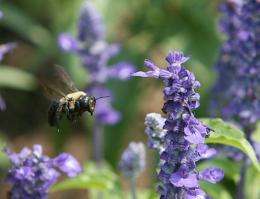
A bumble bee collects pollen on flowers in Washington, DC. Weakened by inbreeding and disease, bumble bees have died off at an astonishing rate over the past 20 years, with some US populations diving more than 90 percent, according to a new study.
Weakened by inbreeding and disease, bumble bees have died off at an astonishing rate over the past 20 years, with some US populations diving more than 90 percent, according to a new study.
The findings are of concern because bees play a crucial role in pollinating crops such as tomatoes, peppers and berries, said the findings of a three-year study published in the Proceedings of the National Academy of Sciences (PNAS).
Similar declines have also been seen in Europe and Asia, said Sydney Cameron, of the Department of Entomology and Institute for Genomic Biology at the University of Illinois, the main author of the study.
"The decline of bumble bees in the US is associated with two things we were able to study: the pathogen Nosema bombi and a decline in genetic diversity. But we are not saying Nosema is the cause. We don't know," said Cameron.
"It's just an association. There may be other causes."
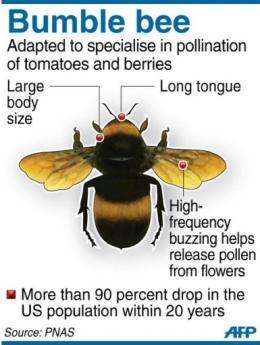
Fact file on bumble bees. US populations of the species have dropped more than 90 percent in 20 years, according to a new study.
He added that the decline is "huge and recent," having taken place in the last two decades.Nosema bombi is a bee pathogen that has also afflicted European bumble bees.
Researchers examined eight species of North American bumble bees and found that the "relative abundance of four species has dropped by more than 90 percent, suggesting die-offs further supported by shrinking geographic ranges," said the study.
"Compared with species of relatively stable population sizes, the dwindling bee species had low genetic diversity, potentially rendering them prone to pathogens and environmental pressures."
Their cousins, the honey bees, have also experienced catastrophic die-offs since 2006 in a phenomenon known as "colony collapse disorder," though the causes have yet to be fully determined.
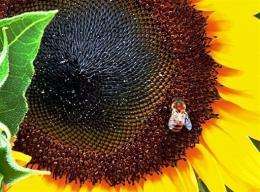
Bees play a crucial role in pollinating crops such as tomatoes, peppers and berries and their decline would have a serious impact on agriculture. Some US populations have declined by 90 percent.
Bumble bees also make honey, but it is used to feed the colony, not farmed for human consumption.They are however raised in Europe for pollinating greenhouse vegetables in a multi-billion-dollar industry that has more recently taken off in Japan and Israel and is being developed in Mexico and China, Cameron said.
"We need to start to develop other bees for pollination beside honey bees, because they are suffering enormously," he added.
There are around 250 species of bumble bee, including 50 in the United States alone.
(c) 2011 AFP
-
From lemons to lemonade: Reaction uses carbon dioxide to make carbon-based semiconductor,
28 comments
-
Thioridazine kills cancer stem cells in human while avoiding toxic side-effects of conventional cancer treatments,
3 comments
-
SpaceX private rocket blasts off for space station (Update),
41 comments
-
Climate scientists say they have solved riddle of rising sea,
30 comments
-
Scotland passes turbine test to harness tidal power,
41 comments
-
How do I identify different bacteria on culture plates?
9 hours ago
-
Why Do Dogs do Strange things...
May 25, 2012
-
What does exophillic and endophillic mean in terms of mosquito and their control?
May 24, 2012
-
Semen stains glows under black lights (uv light)?
May 23, 2012
-
Question on Human Chromosome 2
May 23, 2012
-
How important is composition of TBST in diluting antibodies and Western Blotting?
May 22, 2012
- More from Physics Forums - Biology
More news stories
Thousands of shellfish found dead in Peru
Thousands of crustaceans were found dead off the coast of Lima following the mystery mass death of dolphins and pelicans, the Peruvian Navy said Friday.
8 hours ago |
4.7 / 5 (3) |
4
It's in the genes: Research pinpoints how plants know when to flower
Scientists believe they've pinpointed the last crucial piece of the 80-year-old puzzle of how plants "know" when to flower.
23 hours ago |
3.9 / 5 (8) |
1
|
Researchers solve structure of human protein critical for silencing genes
In a study published in the journal Cell on May 24, Cold Spring Harbor Laboratory (CSHL) scientists describe the three-dimensional atomic structure of a human protein bound to a piece of RNA that "guides" the pr ...
23 hours ago |
4.7 / 5 (7) |
0
|
More plant species responding to global warming than previously thought
(Phys.org) -- Far more wild plant species may be responding to global warming than previous large-scale estimates have suggested.
May 22, 2012 |
4.6 / 5 (14) |
18
|
Totally rad: Scientists create rewritable digital data storage in DNA
(Phys.org) -- Scientists from Stanford's Department of Bioengineering have devised a method for repeatedly encoding, storing and erasing digital data within the DNA of living cells.
May 21, 2012 |
4.9 / 5 (15) |
11
|
SpotterRF debuts Radar Backpack Kit (w/ Video)
(Phys.org) -- SpotterRF has announced a special radar backpack kit designed to enhance situational awareness for soldiers on the ground. The company says its special radar is designed for warfighters as part ...
Australia hails surprise super-telescope decision
Australia has hailed a surprise decision giving it a role in a radio telescope project aimed at revolutionising astronomy, vowing to draw on its decades of experience in space science.
Astronomers seize last chance in lifetime for Venus Transit
Astronomers are gearing for one the rarest events in the Solar System: an alignment of Earth, Venus and the Sun that will not be seen for another 105 years.
SpaceX capsule has 'new car' smell, astronauts say
SpaceX's Dragon cargo vessel smells like a new car, said astronauts at the International Space Station after opening the hatches Saturday following the spacecraft's landmark mission to the orbiting lab.
Family history of Alzheimer's affects functional connectivity
(HealthDay) -- Cognitively normal individuals with a family history of late-onset Alzheimer's disease (AD) may display lower resting state functional connectivity in the default mode network (DMN) of the brain, ...
High-speed method to aid search for solar energy storage catalysts
Eons ago, nature solved the problem of converting solar energy to fuels by inventing the process of photosynthesis.


Jan 03, 2011
Rank: 3.5 / 5 (8)
Jan 03, 2011
Rank: not rated yet
Are bumble bees colonial?
Jan 03, 2011
Rank: 5 / 5 (2)
"Bumblebees form colonies. These colonies are usually much less extensive than those of honey bees... Often, mature bumblebee nests will hold fewer than 50 individuals."
So yes.
Jan 03, 2011
Rank: 5 / 5 (2)
Jan 03, 2011
Rank: not rated yet
Jan 03, 2011
Rank: 3 / 5 (2)
Bees use ultraviolet light to see, so if the amount of UV drops significantly (20-30% during this past cycle), they can't find food from the dimming and die out.
Jan 03, 2011
Rank: 1 / 5 (4)
There are a lot of ecological models using differential equations. When you didn't have better tools, that gave you some insight into how ecological systems worked. Then came both chaos theory and the computers to actually run complex models. No surprise, real ecologies are huge chaotic systems.
What that means for any individual species, is that numbers will vary wildly with time, if the numbers go too low, that species will disappear. Usually because some more fit species has come along.
Apply this to individual species of bumble bees, and you can be almost certain that the most populous species ten years ago won't be the most populous species of bumble bees today. Will it again be the most populous species some time in the future? Again with probability approaching one.
Jan 04, 2011
Rank: 5 / 5 (1)
So I'm unsure if article is really about long-standing(last decade) decline in Honey Bees, or this is a new finding, really about Bumble Bees?
Jan 04, 2011
Rank: 3 / 5 (4)
Who knows? The quality of Physorg is getting worse and worse. Even the quality of people leaving comments has dropped to ridiculous lows recently.
Jan 04, 2011
Rank: not rated yet
hahah, good job man, good logic you are incredibly ignorant I admit!
Jan 04, 2011
Rank: 1 / 5 (2)
I think not.
Jan 04, 2011
Rank: 1 / 5 (2)
Jan 04, 2011
Rank: not rated yet
Jan 06, 2011
Rank: not rated yet
Jan 06, 2011
Rank: 1 / 5 (1)
It happens all the time with lots of different animals, the last case I know is with the dieing off of frogs in South America-full devastation, what can we do, well not much nature will find its balance, it always does.Actually we can GM them to be resistant- this is the way to be always one step ahead from illneses.
And as you think it is really logical, it can spread really fast, bees from different colonies feeding from one plant, and then this bees spreading it into the hive....Actually to confirm this they should look is there any correlation between density of hives and the persisting problem, and are isolated hives more healty.
Jan 11, 2011
Rank: not rated yet