Identity parade clears cosmic collisions of the suspicion of promoting black hole growth
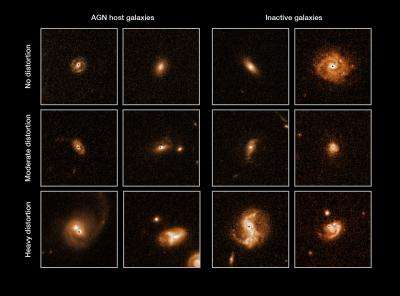
Selected galaxies from the COSMOS survey. Credit: NASA, ESA, M. Cisternas (Max-Planck Institute for Astronomy)
(PhysOrg.com) -- What happens when galaxies crash together? For years, these cosmic collisions have been blamed for triggering violent outbursts at the hearts of galaxies. Now, a remarkable piece of detective work has given a verdict: galactic mergers do not usually whet the appetite of the black holes that power these active galactic nuclei, meaning other, less dramatic phenomena are responsible.
Most galaxies, including our own, have a huge but well-behaved black hole at their heart, while some have messy eaters that suck in vast amounts of matter which then shines brightly as it falls towards oblivion. This causes the telltale bright spots at the centre of galaxies known as active galactic nuclei (AGN). Why are the two types so different? Until now, the leading theory has been that mergers between galaxies are instrumental in driving matter into the black holes, making them grow.
In a new study, the largest of its kind so far, astronomers set up an identity parade of galaxies to test this theory. Comparing 140 active galaxies with a control group of over 1200 comparable inactive galaxies, they found that there has been no significant link between AGN activity and galactic mergers for at least the past eight billion years. Therefore, other phenomena such as instabilities within galaxies, collisions of molecular clouds or tidal disruption by other galaxies flying by must instead be to blame.
The results will be published in the Astrophysical Journal on 10 January.
This video is not supported by your browser at this time.
This video offers a zoom on the largest sky survey ever carried out by Hubble: COSMOS. The COSMOS survey is a detailed map of a patch of sky roughly 10 times the size of the area covered by the full moon, which has been studied by Hubble and other telescopes at different wavelengths. Data from the COSMOS survey has been used for much important research, including creating a 3-dimensional map of the Universe’s dark matter distribution, and a study into the relationship between major mergers of galaxies and active galactic nuclei. Credit: ESA/Hubble (M. Kornmesser & L. L. Christensen)
The emission of radiation from active galactic nuclei is driven by the behaviour of matter such as gas clouds and even stars as it heats up and falls into the galaxy's supermassive central black hole. But an open question in the physics of active galaxies is precisely how matter crosses the final few hundreds of light-years to reach the immediate neighbourhood of the black hole before being swallowed.Team leader Mauricio Cisternas from Germany's Max Planck Institute for Astronomy explains: "A study of this scope has become possible only recently, as the large surveys undertaken using the Hubble Space Telescope have become available. These have given us a huge sample of galaxies, both active and inactive, meaning that we can now study many distant galaxies in exquisite detail. Before these surveys, we hadn't examined many active galaxies at large cosmic distances in sufficient detail."
Cisternas and his team chose 140 active galaxies from the COSMOS survey. The COSMOS field is an area of sky roughly 10 times the area covered by the Moon, in the constellation of Sextans (the Sextant), which has been comprehensively mapped by Hubble and other telescopes at different wavelengths. It contains several hundred thousand distant galaxies of all types. The team was able to identify active galaxies from among these using X-ray observations from ESA's XMM-Newton space telescope, and they then studied the more detailed optical images of them taken by the NASA/ESA Hubble Space Telescope.
For each of the active galaxies in the study, they selected nine non-active galaxies at roughly the same distances, and thus roughly in the same stage of cosmic evolution, from the same Hubble images. This gives a grand total of just over 1400 galaxies that the team could then test for the telltale signs of mergers.
"You can usually tell when galaxies have been involved in a merger," explains Knud Jahnke, co-author of the study. "Instead of the neat, geometric spiral or smooth elliptical shapes you usually see in Hubble images, colliding galaxies typically look distorted and warped. We planned to find out whether these misshapen galaxies were more likely than regular ones to host active nuclei."
Identifying whether or not a galaxy is distorted is a matter of judgement for which the expert eye of a trained astronomer is far better than any computerised assessment. To harness this human expertise without introducing the risk of unwitting bias, Cisternas set up a kind of identity parade of galaxies, in which he had modelled and removed the bright spot that reveals the AGN. Ten galaxy experts, based at eight different institutions, independently assessed whether each of the galaxies was distorted or not, without being told which had an AGN.
None of the experts found a significant correlation between a galaxy's activity and its distortion, that is, between its black hole being well-fed and its involvement in a major merger.
While mergers are a common phenomenon, and are thought to play a role at least for some AGN, the study shows that they provide neither a universal nor a dominant mechanism for feeding black holes. By the study's statistics, at least 75%, and possibly all, of AGN activity over the last eight billion years must have a different explanation. Possible ways of transporting matter towards a central black hole include instabilities of structures like a spiral galaxy's bar, the collisions of giant molecular clouds within the galaxy, or the fly-by of another galaxy that does not lead to a merger (known as galactic harassment).
Could there still be a causal connection between mergers and activity in the more distant past? That is the next question the group is gearing up to address. Suitable data is bound to come from two ongoing observational programmes (Multi-Cycle Treasury Programs) with the Hubble Space Telescope, as well as from observations by its successor, the James Webb Space Telescope, which is scheduled for launch after 2014.
Provided by
ESA/Hubble Information Centre
-
From lemons to lemonade: Reaction uses carbon dioxide to make carbon-based semiconductor,
28 comments
-
Thioridazine kills cancer stem cells in human while avoiding toxic side-effects of conventional cancer treatments,
3 comments
-
SpaceX private rocket blasts off for space station (Update),
41 comments
-
Climate scientists say they have solved riddle of rising sea,
30 comments
-
Scotland passes turbine test to harness tidal power,
40 comments
-
revamping general concept and cosmological principle
May 25, 2012
-
Transiting Exoplanet Light Curve
May 25, 2012
-
Math behind Theoretical Physics
May 24, 2012
-
Do we know whats at the center of galaxies yet?
May 23, 2012
-
Structure of the Milky Way?
May 20, 2012
-
What would it take to terraform Pluto and Charon?
May 19, 2012
- More from Physics Forums - General Astronomy
More news stories
Australia hails surprise super-telescope decision
Australia has hailed a surprise decision giving it a role in a radio telescope project aimed at revolutionising astronomy, vowing to draw on its decades of experience in space science.
6 hours ago |
5 / 5 (2) |
0
Astronomers seize last chance in lifetime for Venus Transit
Astronomers are gearing for one the rarest events in the Solar System: an alignment of Earth, Venus and the Sun that will not be seen for another 105 years.
6 hours ago |
5 / 5 (1) |
0
SpaceX capsule has 'new car' smell, astronauts say
SpaceX's Dragon cargo vessel smells like a new car, said astronauts at the International Space Station after opening the hatches Saturday following the spacecraft's landmark mission to the orbiting lab.
Space & Earth / Space Exploration
6 hours ago |
4.7 / 5 (7) |
0
Astronauts enter world's 1st private supply ship
(AP) -- Space station astronauts floated into the Dragon on Saturday, a day after its heralded arrival as the world's first commercial supply ship.
Space & Earth / Space Exploration
6 hours ago |
5 / 5 (3) |
0
Dragon makes history with space station docking
The private company SpaceX made history Friday with the docking of its Dragon capsule to the International Space Station, the most impressive feat yet in turning routine spaceflight over to the commercial ...
Space & Earth / Space Exploration
21 hours ago |
4.9 / 5 (8) |
0
SpotterRF debuts Radar Backpack Kit (w/ Video)
(Phys.org) -- SpotterRF has announced a special radar backpack kit designed to enhance situational awareness for soldiers on the ground. The company says its special radar is designed for warfighters as part ...
Family history of Alzheimer's affects functional connectivity
(HealthDay) -- Cognitively normal individuals with a family history of late-onset Alzheimer's disease (AD) may display lower resting state functional connectivity in the default mode network (DMN) of the brain, ...
Thousands of shellfish found dead in Peru
Thousands of crustaceans were found dead off the coast of Lima following the mystery mass death of dolphins and pelicans, the Peruvian Navy said Friday.
Transvaginal mesh op restores pelvic organ prolapse at price
(HealthDay) -- Transvaginal mesh (TVM) procedures are effective for anatomical restoration of pelvic organ prolapse (POP), but patients report a worsening of sexual function following surgery, according to ...
Travel to high altitudes tied to Crohn's, colitis flare-ups
(HealthDay) -- People with inflammatory bowel disease, which includes Crohn's disease and colitis, may be at increased risk for flare-ups when they fly or travel to high altitudes for skiing or mountain climbing, ...
High-speed method to aid search for solar energy storage catalysts
Eons ago, nature solved the problem of converting solar energy to fuels by inventing the process of photosynthesis.
Jan 05, 2011
Rank: not rated yet
Jan 05, 2011
Rank: 4.5 / 5 (2)
You can calculate the amount of power of a distant EM source through the usage of the inverse squared law, in meters. The farthest object I know of was allegedly 13.1 billion ly distant.
Essentially, use the formula for surface area of a sphere.
So convert ly to meters and then square this number gives: 1.536 *10^52 meters squared, and multiply by 4pi.
Then multiply by the amount of energy per second you obtain across 1 square meter of detector surface, this takes into account all the photons moving in directions that don't intersect the individual viewer. This will give the spherical power output of a point light source at the object's location.
The Sun is approximately: 3.82*10^26 watts.
Based on distance and apparant magnitude, Sirius should be: 1.014*10^28 watts.
Jan 05, 2011
Rank: not rated yet
Jan 05, 2011
Rank: not rated yet
Jan 05, 2011
Rank: not rated yet
Jan 05, 2011
Rank: 4.7 / 5 (3)
You also have to realize that many exposures of these very distant objects can take hours, days, or weeks for the telescopes to gather enough photons to present a clear picture.
I used to kind of wonder along the same lines as you. I had a thought that perhaps instead of a photon being a single little wavelet, it is more of a 3 dimensional spherical wave emanating in all directions from it's point of origin, thus allowing an infinite number observers to detect it.
However, given the research conducted on the quantum nature of light, I have not seen any evidence or suggestion by any of the scientific community for this being the case.
The most likely explanation is that these light sources just pump out truly immense quantities of photons.
There is probably some(vast) distance from a lightsource where you can no longer detect it due to the improbability of collecting any of it's far flung photons, let alone accurately tracing their origin back to a source
Jan 06, 2011
Rank: not rated yet
Jan 06, 2011
Rank: not rated yet
I'm not a scientist nor a physicist, I'm just a person of curiosity. But, I'd have to wonder at the mass represented by a sphere (cloud?) of photons 26 - 28 billion light years in diameter via the good 'ole E=MC^2. Yes, I know photons are supposed to be massless and come in different frequencies, but still - that a photon can be absorbed and by doing so change the energy level of an atom enough to release electrons tells me that something has to be there of value in the photon to add enough energy to to do this. It just seems natural that some substrate must exist in the photon to store its energy.
Jan 06, 2011
Rank: 1 / 5 (2)
You are so correct to question.
LIGHT travelling unimpeded is not unimpeded. It hits Suns, planets, moons, asteroids, etc.,etc., and is absorbed. Yet some LIGHT will continue on. Scientists believe LIGHT does not "die."
As for density, is there one? Is there a build-up or a singularity of composition? As for a souce, there is no one source; Suns are immemorial.
Jan 06, 2011
Rank: not rated yet
So, is there a correlation where the younger universe had more energy available than our present one?
Jan 06, 2011
Rank: 5 / 5 (5)
Photons indeed have mass (they have momentum, which has the classical formula of p=mv). They just don't have a rest mass: you can't "stop" a photon, put it on a balance, and weight it that way -- a photon must by definition always travel at the speed of light for as long as it exists.
The energy-mass conversion, as you point out, has a proportionality constant equal to c^2. If you were to take just 1 kg of matter, and convert it completely to energy, how many visible photons is that?
Let's say we choose a wavelength of 475 nm (blue color). Photons at that wavelength carry 2.615 eV of energy each, which translates to 2.9x10^-17 eV/c^2 of mass. 1 kg of matter is equivalent to ~5.6x10^35 eV/c^2 of energy.
So to have the equivalent of 1 kg of matter, you'd need to collect ~1.9x10^52 blue photons (of wavelength 475 nm.)
Jan 06, 2011
Rank: 5 / 5 (6)
You can think about photons as spatially confined wave packets traveling in "straight lines" or more correctly along geodesics in spacetime (the "particle" view) or as perpetually expanding spherical emanations that instantaneously collapse to a single random point upon measurement (the "wave" view according to the Copenhagen Interpretation.)
To me, the corpuscular view is easier to visualize and think about on cosmic scales, though mathematically the two are equivalent (just different sides of the same wave-particle duality coin.)
From the corpuscular view, a light source spits out a swarm of photons in every direction, and as you get farther away from it, the distances between photons grow. Eventually, per square meter of detector area you start seeing a "trickle-in" effect where individual photons arrive sporadically, one-by-one, separated by long periods of no signal at all. That's when it takes days or weeks for enough photons to trickle in, to make a picture.
Jan 07, 2011
Rank: 5 / 5 (1)
So, can we determine the distance from an energetic object based on photon count over a known sensor size over time? Provided of course you can group a singular object or neighboring objects via frequency or other method to classify photon types from a specific source.
Jan 07, 2011
Rank: 5 / 5 (5)
For Type 1A supernovas, the intrinsic brightness happens to be confined to a narrow range, due to the physical mechanisms that drive these explosions. So, Type 1A's are useful as "standard candles" (also easily identifiable by a very particular spectrum of emission and luminosity vs. time curve), and you can indeed estimate their distance based on their apparent luminosity.
But for most other objects, there is no reliable way to know what their true luminosity is. For very far-away objects, people rely mostly on redshift to estimate their distance.