Hubble zooms in on a space oddity
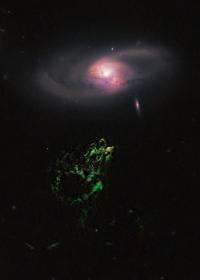
In this image by the NASA/ESA Hubble Space Telescope, an unusual, ghostly green blob of gas appears to float near a normal-looking spiral galaxy. The bizarre object, dubbed Hanny’s Voorwerp (Hanny’s Object in Dutch), is the only visible part of a streamer of gas stretching 300,000 light-years around the galaxy, called IC 2497. The greenish Voorwerp is visible because a searchlight beam of light from the galaxy’s core has illuminated it. This beam came from a quasar: a bright, energetic object that is powered by a black hole. The quasar may have turned off in the last 200,000 years. This Hubble view uncovers a pocket of star clusters, the yellowish-orange area at the tip of Hanny’s Voorwerp. The star clusters are confined to an area that is a few thousand light-years wide. The youngest stars are a couple of million years old. The Voorwerp is the size of the Milky Way, and its bright green color is from glowing oxygen. The image was made by combining data from the Advanced Camera for Surveys (ACS) and the Wide Field Camera 3 (WFC3) onboard Hubble, with data from the WIYN telescope at Kitt Peak, Ariz. The ACS exposures were taken April 12, 2010; the WFC3 data, April 4, 2010. Credit: NASA, ESA, William Keel (University of Alabama, Tuscaloosa), and the Galaxy Zoo team
A strange, glowing green cloud of gas that has mystified astronomers since its discovery in 2007 has been studied by Hubble. The cloud of gas is lit up by the bright light of a nearby quasar, and shows signs of ongoing star formation.
One of the strangest space objects ever seen is being scrutinised by the penetrating vision of the NASA/ESA Hubble Space Telescope. A mysterious, glowing green blob of gas is floating in space near a spiral galaxy. Hubble uncovered delicate filaments of gas and a pocket of young star clusters in the giant object, which is the size of the Milky Way.
The Hubble revelations are the latest finds in an ongoing probe of Hanny's Voorwerp (Hanny's Object in Dutch). It is named after Hanny van Arkel, the Dutch schoolteacher who discovered the ghostly structure in 2007 while participating in the online Galaxy Zoo project. Galaxy Zoo enlists the public to help classify more than a million galaxies catalogued in the Sloan Digital Sky Survey. The project has expanded to include Galaxy Zoo: Hubble, in which the public is asked to assess tens of thousands of galaxies in deep imagery from the Hubble Space Telescope.
In the sharpest view yet of Hanny's Voorwerp, Hubble's Wide Field Camera 3 and Advanced Camera for Surveys have uncovered star birth in a region of the green object that faces the spiral galaxy IC 2497, located about 650 million light-years from Earth. Radio observations have shown an outflow of gas arising from the galaxy's core. The new Hubble images reveal that the galaxy's gas is interacting with a small region of Hanny's Voorwerp, which is collapsing and forming stars. The youngest stars are a couple of million years old.
The greenish Voorwerp is visible because a searchlight beam of light from the galaxy's core has illuminated it. This beam came from a quasar a bright, energetic object that is powered by a black hole. The quasar is thought to have turned off less than 200 000 years ago.
Astronomer Bill Keel of the University of Alabama in Tuscaloosa, USA, leader of the Hubble study, is presenting his results on this object today at the American Astronomical Society meeting in Seattle, USA.
Provided by
ESA/Hubble Information Centre
-
From lemons to lemonade: Reaction uses carbon dioxide to make carbon-based semiconductor,
28 comments
-
Thioridazine kills cancer stem cells in human while avoiding toxic side-effects of conventional cancer treatments,
3 comments
-
SpaceX private rocket blasts off for space station (Update),
41 comments
-
Climate scientists say they have solved riddle of rising sea,
30 comments
-
Scotland passes turbine test to harness tidal power,
40 comments
-
revamping general concept and cosmological principle
May 25, 2012
-
Transiting Exoplanet Light Curve
May 25, 2012
-
Math behind Theoretical Physics
May 24, 2012
-
Do we know whats at the center of galaxies yet?
May 23, 2012
-
Structure of the Milky Way?
May 20, 2012
-
What would it take to terraform Pluto and Charon?
May 19, 2012
- More from Physics Forums - General Astronomy
More news stories
Australia hails surprise super-telescope decision
Australia has hailed a surprise decision giving it a role in a radio telescope project aimed at revolutionising astronomy, vowing to draw on its decades of experience in space science.
6 hours ago |
5 / 5 (2) |
0
Astronomers seize last chance in lifetime for Venus Transit
Astronomers are gearing for one the rarest events in the Solar System: an alignment of Earth, Venus and the Sun that will not be seen for another 105 years.
6 hours ago |
5 / 5 (1) |
0
SpaceX capsule has 'new car' smell, astronauts say
SpaceX's Dragon cargo vessel smells like a new car, said astronauts at the International Space Station after opening the hatches Saturday following the spacecraft's landmark mission to the orbiting lab.
Space & Earth / Space Exploration
6 hours ago |
4.7 / 5 (7) |
0
Astronauts enter world's 1st private supply ship
(AP) -- Space station astronauts floated into the Dragon on Saturday, a day after its heralded arrival as the world's first commercial supply ship.
Space & Earth / Space Exploration
6 hours ago |
5 / 5 (3) |
0
Dragon makes history with space station docking
The private company SpaceX made history Friday with the docking of its Dragon capsule to the International Space Station, the most impressive feat yet in turning routine spaceflight over to the commercial ...
Space & Earth / Space Exploration
21 hours ago |
4.9 / 5 (8) |
0
SpotterRF debuts Radar Backpack Kit (w/ Video)
(Phys.org) -- SpotterRF has announced a special radar backpack kit designed to enhance situational awareness for soldiers on the ground. The company says its special radar is designed for warfighters as part ...
Family history of Alzheimer's affects functional connectivity
(HealthDay) -- Cognitively normal individuals with a family history of late-onset Alzheimer's disease (AD) may display lower resting state functional connectivity in the default mode network (DMN) of the brain, ...
Thousands of shellfish found dead in Peru
Thousands of crustaceans were found dead off the coast of Lima following the mystery mass death of dolphins and pelicans, the Peruvian Navy said Friday.
Transvaginal mesh op restores pelvic organ prolapse at price
(HealthDay) -- Transvaginal mesh (TVM) procedures are effective for anatomical restoration of pelvic organ prolapse (POP), but patients report a worsening of sexual function following surgery, according to ...
Travel to high altitudes tied to Crohn's, colitis flare-ups
(HealthDay) -- People with inflammatory bowel disease, which includes Crohn's disease and colitis, may be at increased risk for flare-ups when they fly or travel to high altitudes for skiing or mountain climbing, ...
High-speed method to aid search for solar energy storage catalysts
Eons ago, nature solved the problem of converting solar energy to fuels by inventing the process of photosynthesis.
Jan 10, 2011
Rank: 4.6 / 5 (11)
Jan 10, 2011
Rank: 1 / 5 (6)
Jan 10, 2011
Rank: 4.3 / 5 (6)
Really? Do tell how this bundle of gas undermines everything we know about cosmology. I could use a good laugh!
Jan 10, 2011
Rank: 1 / 5 (5)
Don't try to pretend you don't know what's wrong with that.
Jan 10, 2011
Rank: 5 / 5 (5)
The article doesn't claim that the Voorwerp is pure oxygen - probably it is hydrogen and helium with a dash of oxygen. The star formation regions of the Voorwerp should definitely be hydrogen and helium. The northern lights also gets their green color from exited oxygen but the mechanism is probably a bit different.
Jan 10, 2011
Rank: 5 / 5 (3)
You're the one making outlandish claims. You tell me how this invalidates mainstream cosmology.
Jan 10, 2011
Rank: 3.7 / 5 (3)
For all we know we're the equivalent squirrels staring at the Goodyear blimp and figuring we have a pretty good read on what it is (a giant flying walnut)
Jan 11, 2011
Rank: 4 / 5 (4)
Jan 11, 2011
Rank: 5 / 5 (1)
Jan 11, 2011
Rank: 1 / 5 (2)
"Oxygen is only supposed to form in very massive stars and supernovas, not gigantic galaxy scale clouds."
Mainstream cosmology claims that hydrogen and helium were created some 13 billion years ago, and that other elements only form in fusion in stars, or in supernovas. You know this. Stop ignoring the truth, which is that a cloud like this totally contradicts that psuedo-science called the Big Bang.
Jan 11, 2011
Rank: 3.4 / 5 (5)
Since we can see that there are stars inside the object, and that Hanny's object in particular is between two large existant galaxies composed of stars, there's no contradiction in regards to the standard model of cosmology.
Before you call something pseudoscience, you may want to actually understand it.
Jan 11, 2011
Rank: not rated yet