Europe defends 'stupid' Galileo satellite
January 18, 2011 by Yann Ollivier

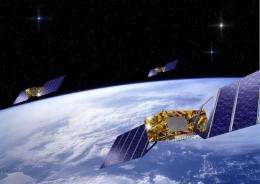
A computer-generated image shows part of the European Galileo navigation system network in 2002

Enlarge

A computer-generated image shows three satellites, part of the European Galileo navigation system network, in 2002. Europe stood by its much-delayed and over-budget Galileo satellite navigation system on Tuesday despite a rising price tag and a contractor's description of the project as "stupid."

Europe stood by its much-delayed and over-budget Galileo satellite navigation system on Tuesday despite a rising price tag and a contractor's description of the project as "stupid."

Previously estimated to cost 3.4 billion euros, the said an extra 1.9 billion euros was needed to complete the constellation of satellites, raising its price tag to 5.4 billion euros ($7.2 billion).

Aimed at rivaling the US-built (GPS) and Chinese and Russian projects, the system needs more cash due to the higher costs of the development phase and satellite launchers, the commission said.

"We need to bear in mind that Russia is engaged in deploying its global system and China is continuing to increase its own systems too. Japan and India are also entering the scene," Tajani said.

"That means Europeans cannot lag behind," he told a news conference at the European Parliament in Strasbourg, France.

Galileo is scheduled to go online in 2014 -- six years later than originally planned -- with an initial constellation of 18 satellites. The first two satellites will be launched in the third quarter of this year.

But the commission said in a policy paper that 3.4 billion euros was "not enough to complete the infrastructure."

An extra 1.9 billion euros is needed to launch the remaining 12 satellites by 2020 and offer the full services promised by the project.

In addition, the commission said the operating costs for Galileo and a sister system called EGNOS will amount to 800 million euros a year.

Europe wants to end its dependence on the US GPS system in a market the commission said would grow from 130 billion euros in 2010 to 240 billion euros in 2020.

"The Galileo project is going ahead, the commission has decided on this," Tajani said.

"It will improve the lives of citizens in sectors such as transport, agriculture, energy and combatting illegal immigration," he added.

A row erupted over the system after the whistleblower website WikiLeaks published a US diplomatic cable quoting scathing criticism from the head of German firm OHB Technology, which was awarded a 566-million-euro to develop 14 Galileo satellites.

According to an October 2009 cable from the US embassy in Berlin, OHB Technology chief Berry Smutny said: "I think Galileo is a stupid idea that primarily serves French interests."

He went on to say that Galileo was "a waste of EU taxpayers' money championed by French interests," according to the cable.

The company announced Tuesday that it had suspended Smutny, who has denied making the comments.

Tajani dismissed the WikiLeaks report, saying he had met Smutny before the leak and that he had stated that he believed in Galileo. The company has since committed "wholeheartdly to delivering the Galileo system," Tajani said.

"WikiLeaks isn't the gospel," Tajani said.

(c) 2011 AFP

4.8 /5 (6 votes)  

Filter


Move the slider to adjust rank threshold, so that you can hide some of the comments.


Display comments: newest first

LariAnn
Jan 18, 2011

Rank: 5 / 5 (5)
Seems to me this is one case where a unified effort by all concerned countries should have been undertaken so that a single integrated system would be deployed. What will happen, instead, is the deployment of a gaggle of competing systems, all incompatible with each other. That, IMO, is the "stupid" component of not only the Galileo system, but all of the separate systems, including the US GPS, because of rampant duplication of effort and the accompanying wastage of vast amounts of money. This, in economic conditions where saving these vast sums of money would be extremely beneficial to all countries concerned! Go figure!!
Kingsix
Jan 18, 2011

Rank: 5 / 5 (4)
Well LariAnn, that would just make to much sense and would fly in the face of the Global stupidity that plagues the highest level of all governments.
rwinners
Jan 18, 2011

Rank: 5 / 5 (7)
The US GPS system is run by and for the US military. Thus, availability world wide is subject to potential interruption. Thus the duplicate efforts. Sad.
xznofile
Jan 19, 2011

Rank: 5 / 5 (2)
yeah what if a country has to take out the satellite system of a country that they depend on for positioning? it could get awkward.
ereneon
Jan 19, 2011

Rank: 4.5 / 5 (2)
Redundancy is not necessarily stupid. What if the only GPS system in the world belonged to China? Would you feel comfortable? Redundancy is also a good way to make add robustness to a system.
That said, when the contractor building the system says outright that it is a stupid idea, something clearly isn't right.
jjoensuu
Jan 19, 2011

Rank: not rated yet
But I am sure that that contractor is only one of many. And why does his statement even make it to the news? Weird. In any case having more than one system is not necessary a bad idea...
Rank 4.8 /5 (6 votes)
Relevant PhysicsForums posts
  • revamping general concept and cosmological principle
    created23 hours ago
  • Transiting Exoplanet Light Curve
    createdMay 25, 2012
  • Math behind Theoretical Physics
    createdMay 24, 2012
  • Do we know whats at the center of galaxies yet?
    createdMay 23, 2012
  • Structure of the Milky Way?
    createdMay 20, 2012
  • What would it take to terraform Pluto and Charon?
    createdMay 19, 2012
  • More from Physics Forums - General Astronomy

More news stories

Australia hails surprise super-telescope decision

Australia has hailed a surprise decision giving it a role in a radio telescope project aimed at revolutionising astronomy, vowing to draw on its decades of experience in space science.

Space & Earth / Astronomy

created 4 hours ago | popularity 5 / 5 (1) | comments 0

Astronomers seize last chance in lifetime for Venus Transit

Astronomers are gearing for one the rarest events in the Solar System: an alignment of Earth, Venus and the Sun that will not be seen for another 105 years.

Space & Earth / Astronomy

created 4 hours ago | popularity 5 / 5 (1) | comments 0

SpaceX capsule has 'new car' smell, astronauts say

SpaceX's Dragon cargo vessel smells like a new car, said astronauts at the International Space Station after opening the hatches Saturday following the spacecraft's landmark mission to the orbiting lab.

Space & Earth / Space Exploration

created 4 hours ago | popularity 4 / 5 (2) | comments 0

Astronauts enter world's 1st private supply ship

(AP) -- Space station astronauts floated into the Dragon on Saturday, a day after its heralded arrival as the world's first commercial supply ship.

Space & Earth / Space Exploration

created 4 hours ago | popularity 5 / 5 (2) | comments 0

Dragon makes history with space station docking

The private company SpaceX made history Friday with the docking of its Dragon capsule to the International Space Station, the most impressive feat yet in turning routine spaceflight over to the commercial ...

Space & Earth / Space Exploration

created 19 hours ago | popularity 4.9 / 5 (7) | comments 0


SpotterRF debuts Radar Backpack Kit (w/ Video)

(Phys.org) -- SpotterRF has announced a special radar backpack kit designed to enhance situational awareness for soldiers on the ground. The company says its special radar is designed for warfighters as part ...

Family history of Alzheimer's affects functional connectivity

(HealthDay) -- Cognitively normal individuals with a family history of late-onset Alzheimer's disease (AD) may display lower resting state functional connectivity in the default mode network (DMN) of the brain, ...

Thousands of shellfish found dead in Peru

Thousands of crustaceans were found dead off the coast of Lima following the mystery mass death of dolphins and pelicans, the Peruvian Navy said Friday.

Transvaginal mesh op restores pelvic organ prolapse at price

(HealthDay) -- Transvaginal mesh (TVM) procedures are effective for anatomical restoration of pelvic organ prolapse (POP), but patients report a worsening of sexual function following surgery, according to ...

Travel to high altitudes tied to Crohn's, colitis flare-ups

(HealthDay) -- People with inflammatory bowel disease, which includes Crohn's disease and colitis, may be at increased risk for flare-ups when they fly or travel to high altitudes for skiing or mountain climbing, ...

It's in the genes: Research pinpoints how plants know when to flower

Scientists believe they've pinpointed the last crucial piece of the 80-year-old puzzle of how plants "know" when to flower.