Drilling for insights under the salty dead sea
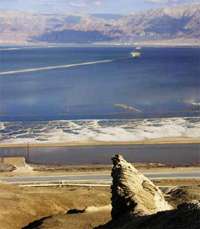
(PhysOrg.com) -- Scientists are drilling deep into the bed of the fast-shrinking Dead Sea, searching for clues to past climate changes and other events that may have affected human history even earlier than biblical times. They have found that the sea has come and gone in the past—a revelation with powerful implications for the current Mideast.
Bordering Israel and Jordan, the inland Dead Sea is Earth’s lowest-lying spot on land, with shores some 1,400 feet below ocean level and hyper-salty waters going down another 1,200 feet or more. Beneath it lie deep deposits of salts and sediments fed mainly by Jordan River drainage. The drilling is being conducted by investigators from Israel, the United States, Germany, Japan, Norway and Switzerland.
Steven L. Goldstein, professor of Earth and Environmental Sciences and a geochemist at Lamont-Doherty Earth Observatory, one of the project leaders, says that drill cores show that the Dead Sea has dried up at least twice without human intervention over hundreds of thousands of years. “Climate models predict a greater aridity with a warmer climate,” he noted. “Just imagine what this means if a warming climate results in the present day fresh water supply becoming scarcer and scarcer.”
Scarce fresh water is an explosive issue in this part of the world; the Dead Sea has been shrinking rapidly as Syria, Israel, Jordan and the Palestinian Authority pull virtually all the water from the Jordan River for agriculture and other uses. At its southern end also lie huge evaporation ponds, where Israel and Jordan mine salt. If changing climate further dries the region, pressure on the fresh water supply will increase.
Previous research along the Dead Sea’s shores determined that water levels fluctuated with the coming and going of ice ages over the last several hundred thousand years. Surrounding bluffs show higher shorelines; the current sea is more than 800 feet lower than it was during the height of the last glaciation some 20,000 years ago.
The main drill site is the deepest part of the sea, in about 1,000 feet of water 5 miles off the Israeli shore. Drilling began Nov. 21 and continued through mid-January when it was suspended for maintenance and repair. It is scheduled to resume in March. The International Continental Scientific Drilling Program is sponsoring the project and covering roughly 40 percent of the $2.5 million cost. The remaining funds come from funding agencies in Israel and the other participating countries, including the National Science Foundation in the United States.
Minerals that settle to the bottom of the Dead Sea during annual dry seasons contain uranium that allows researchers to date the sediment layers; dry season minerals alternate with layers of mud formed during the wet seasons. From these deposits, researchers can find evidence of water chemistry, prevailing winds and changing climate, not only year by year, but season by season. At two points, the researchers have already come across levels composed of pebbles, indicating that the middle of the Dead Sea was once a beach. These events could coincide with the end of the last glacial period around 13,000 to 14,000 years ago, and an earlier interglacial period 125,000 years ago.
Other levels show evidence of earthquakes, as layers of sediment that normally lie flat are twisted into convoluted shapes. With precise dating, these should form a detailed picture of the ancient history of earthquakes in the region. “An earthquake was almost certainly the source of the biblical story of Jericho, when the walls came tumbling down,” Goldstein says.
Information from the sediments could form valuable context for that and other ancient stories. The region is thought to have been the corridor for various human migrations, and is the primary route by which early people spread out from Africa. “This is looking at climate at a very important place in human history,” Goldstein said.
The chief Israeli scientists on the project are Mordechai Stein of the Geological Survey of Israel and Zvi Ben-Avraham of Tel Aviv University; others come from the German Research Center for Geosciences (GFZ), the Hebrew University of Jerusalem, the Swiss Federal Institute of Technology (ETH) in Zurich, the University of Geneva, the International Research Center for Japanese Studies in Kyoto and the University of Minnesota. The group is hoping to involve scientists from the Palestinian territories and Jordan as well.
The team hopes to recover cores of sediment going as far back in time as possible, up to several hundred thousand years ago.
Provided by Columbia University


