Dark matter does not act as growth factor
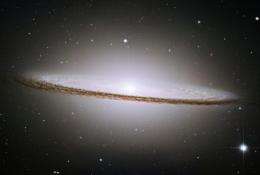
The Sombrero galaxy (M104, NGC 4594) is an example of a bulge dominated galaxy. The Sombrero contains a black hole of 1000 million solar masses. Credit: HST, STScI
(PhysOrg.com) -- Massive black holes have been found at the centers of almost all galaxies, where the largest galaxies which are also the ones embedded in the largest halos of Dark Matter harbor the most massive black holes. This has led to speculation that there is a direct link between Dark Matter and black holes, i.e. that exotic physics controls the growth of black holes. Scientists at the Max Planck Institute of Extraterrestrial Physics, the University Observatory Munich and the University of Texas in Austin conducted an extensive study of galaxies to prove that black hole mass is not directly related to the mass of the Dark Matter halo but rather appears to be determined by the formation of the galaxy bulge.
Galaxies, such as our own Milky Way, consist of billions of stars, as well as great amounts of gas and dust. Most of this can be observed at different wavelengths, from radio and infrared for cooler objects up to optical and X-rays for parts that have been heated to high temperatures. However, there are also two important components that do not emit light of any kind, and can only be inferred from their gravitational pull.
All galaxies are embedded in halos of so-called Dark Matter, which extends beyond the visible edge of the galaxy and dominates its total mass. This component cannot be observed directly, but can be measured through its effect on the motion of stars, gas and dust. The nature of this Dark Matter is still unknown, but scientists believe that it is made up of exotic particles unlike the normal (baryonic) matter, which the Earth, Sun and stars are made up.
The other invisible component in a galaxy is the super-massive black hole at its centre. Our own Milky Way harbours a black hole which is some four million times heavier than our Sun. Such gravity monsters, or even larger ones, have been found in all luminous galaxies with central bulges where a direct search is feasible; most and possibly all bulgy galaxies are believed to contain a central black hole. However, this component can also not be observed directly, the mass of the black hole can only be inferred from the motion of stars around it.
In 2002, it was speculated that a tight correlation between the mass of the Black Hole and the outer rotation velocities of the galaxy disk may exist, which is dominated by the Dark Matter halo, suggesting that the unknown physics of exotic Dark Matter somehow controls the growth of black holes. On the other hand, it had already been shown a few years earlier that the masses of black holes are well correlated with bulge mass or luminosity. Since larger galaxies in general also contain larger bulges, it remained unclear which of the correlations is the primary one driving the growth of black holes.
To test this idea, the astronomers John Kormendy from the University of Texax and Ralf Bender from the Max Planck Institute for Extraterrestrial Physics, the University Observatory Munich carried out high-quality spectral observations of many disk, bulge and pseudobulge galaxies. The increased accuracy of the resulting galaxy dynamics parameters led them to the conclusion that there is almost no correlation between Dark Matter and black holes.
By studying galaxies embedded in massive dark halos with high rotation velocities but small or no bulges, John Kormendy and Ralf Bender tried to answer this question. They indeed found that galaxies without a bulge - even if they are embedded in massive dark matter halos - can at best contain very low mass black holes. Thus, they could show that black hole growth is mostly connected to bulge formation and not to Dark Matter.
It is hard to conceive how the low-density, widely distributed non-baryonic Dark Matter could influence the growth of a black hole in a very tiny volume deep inside a galaxy, says Ralf Bender from the Max Planck Institute for Extraterrestrial Physics and the University Observatory Munich. John Kormendy, from the University of Texas, adds: It seems much more plausible that black holes grow from the gas in their vicinity, primarily when the galaxies were forming. In the accepted scenario of structure formation, galaxy mergers occur frequently, which scrambles disks, allowing gas to fall into the centre, thus trigger starbursts, and feed black holes. The observations carried out by Kormendy and Bender indicate that this must indeed be the dominant process of black hole formation and growth.
More information: John Kormendy & Ralf Bender. Supermassive black holes do not correlate with dark matter halos of galaxies, Nature, Vol. 469, pp.374-376, 20th January 2011.
Provided by
Max-Planck-Gesellschaft
-
From lemons to lemonade: Reaction uses carbon dioxide to make carbon-based semiconductor,
28 comments
-
Thioridazine kills cancer stem cells in human while avoiding toxic side-effects of conventional cancer treatments,
3 comments
-
SpaceX private rocket blasts off for space station (Update),
41 comments
-
Climate scientists say they have solved riddle of rising sea,
30 comments
-
Scotland passes turbine test to harness tidal power,
40 comments
-
revamping general concept and cosmological principle
23 hours ago
-
Transiting Exoplanet Light Curve
May 25, 2012
-
Math behind Theoretical Physics
May 24, 2012
-
Do we know whats at the center of galaxies yet?
May 23, 2012
-
Structure of the Milky Way?
May 20, 2012
-
What would it take to terraform Pluto and Charon?
May 19, 2012
- More from Physics Forums - General Astronomy
More news stories
Astronomers seize last chance in lifetime for Venus Transit
Astronomers are gearing for one the rarest events in the Solar System: an alignment of Earth, Venus and the Sun that will not be seen for another 105 years.
3 hours ago |
5 / 5 (1) |
0
Australia hails surprise super-telescope decision
Australia has hailed a surprise decision giving it a role in a radio telescope project aimed at revolutionising astronomy, vowing to draw on its decades of experience in space science.
3 hours ago |
5 / 5 (1) |
0
SpaceX capsule has 'new car' smell, astronauts say
SpaceX's Dragon cargo vessel smells like a new car, said astronauts at the International Space Station after opening the hatches Saturday following the spacecraft's landmark mission to the orbiting lab.
Space & Earth / Space Exploration
3 hours ago |
not rated yet |
0
Astronauts enter world's 1st private supply ship
(AP) -- Space station astronauts floated into the Dragon on Saturday, a day after its heralded arrival as the world's first commercial supply ship.
Space & Earth / Space Exploration
3 hours ago |
5 / 5 (2) |
0
Dragon makes history with space station docking
The private company SpaceX made history Friday with the docking of its Dragon capsule to the International Space Station, the most impressive feat yet in turning routine spaceflight over to the commercial ...
Space & Earth / Space Exploration
18 hours ago |
4.9 / 5 (7) |
0
SpotterRF debuts Radar Backpack Kit (w/ Video)
(Phys.org) -- SpotterRF has announced a special radar backpack kit designed to enhance situational awareness for soldiers on the ground. The company says its special radar is designed for warfighters as part ...
Family history of Alzheimer's affects functional connectivity
(HealthDay) -- Cognitively normal individuals with a family history of late-onset Alzheimer's disease (AD) may display lower resting state functional connectivity in the default mode network (DMN) of the brain, ...
Transvaginal mesh op restores pelvic organ prolapse at price
(HealthDay) -- Transvaginal mesh (TVM) procedures are effective for anatomical restoration of pelvic organ prolapse (POP), but patients report a worsening of sexual function following surgery, according to ...
Travel to high altitudes tied to Crohn's, colitis flare-ups
(HealthDay) -- People with inflammatory bowel disease, which includes Crohn's disease and colitis, may be at increased risk for flare-ups when they fly or travel to high altitudes for skiing or mountain climbing, ...
Thousands of shellfish found dead in Peru
Thousands of crustaceans were found dead off the coast of Lima following the mystery mass death of dolphins and pelicans, the Peruvian Navy said Friday.
High-speed method to aid search for solar energy storage catalysts
Eons ago, nature solved the problem of converting solar energy to fuels by inventing the process of photosynthesis.
Jan 26, 2011
Rank: not rated yet
No surpriase there. Read John Moffat (physicist at U Toronto) book "Reinventing Gravity". There is no such thing as "undetected dark matter", just a slightly more complicated law of gravity.
Jan 26, 2011
Rank: 5 / 5 (8)
Moffat's Theory is just another in a long long line of "new gravity" theories. It may be that a new theory is needed. Or not. After all, even if invisible in the EM spectrum, DM doesn't violate GR. And GR is THE theory of Gravity, without all the fuzziness of QM.
Jan 26, 2011
Rank: not rated yet
This is pretty much intuitive findings.
However, it directly contradicts an article that was posted on here a few weeks ago, in which it was claimed that galaxy collisions had little influence on black hole formations...
Jan 26, 2011
Rank: 1.5 / 5 (8)
More and more contradictory evidence, since the 'accepted' model is wrong. Too many AGN's can't be explained by collisions, for example. Stars ejected from our galactic core... The knowledge filter ridicules radical notions, like that the First Law of Thermodynamics is only a very good approximation under average conditions. But under extreme conditions, such as inside stellar cores, it is violated. Energy and matter enter our universe under such conditions, producing non-black holes which eject matter periodically, and power these AGN's, etc.
Meanwhile, astrophysicists will only become more confused, as they don' t dare challenge nuclear physics 'standard' models. Ridicule is a career-killer.
Jan 26, 2011
Rank: not rated yet
Why didn't they just say one billion?
Jan 26, 2011
Rank: 1.5 / 5 (8)
That is an old practice of astronomers and physicists "talking down" to their audience, whom they assume to be inferior to themselves.
You used to see this a LOT years ago in stuff like Asimov's writings, because the author is assuming the reader is too stupid to know what a trillion or a billion or a quadrillion means. So they used expressions like "thousand million" and "million million" and "million million million".
Jan 26, 2011
Rank: 5 / 5 (8)
Jan 26, 2011
Rank: 5 / 5 (8)
Jan 26, 2011
Rank: 5 / 5 (5)
1,0000,000 = 0ne million
1,000,000,000 = one thousand million
1,000,000,000,000 = one billion
1,000,000,000,000,000 = one thousand billion
1,000,000,000,000,000,000 = one trillion
American influence
1,000,000 = 1 million
1,000,000,000 = 1 billion
1,000,000,000,000 = 1 trillion
perhaps we need to go metric?
1,000 kilo
1,000,000 gigo
etc
Jan 26, 2011
Rank: 1.5 / 5 (11)
A short video "Scientific Genesis: 3. Neutron Repulsion" gives a short summary:
youtube.com/watch?v=sXNyLYSiPO0
With kind regards,
Oliver K. Manuel
Jan 27, 2011
Rank: 1.5 / 5 (8)
This galaxy is ridiculously close to uniform disk, in which gravitational acceleration, as I showed elsewhere, collapses to:
A = G*d*h*pi
Heck, this galaxy doesn't even have a bulge, so it's about as close to uniform density as you can find in the real world....
Jan 28, 2011
Rank: 1 / 5 (4)
Feb 17, 2011
Rank: 1 / 5 (3)
Once the particle has absorbed radiation creates a cloud of force fields around the particle, which manifests itself with a mass and gravity.
The particle with the force fields will not emit radiation and does not record the second radiation than the kind it engulfs.
Is the added radiation energetic (hot) destroyed the cloud of force fields surrounding the particle. This means that particles with these force fields do not exist near stars and other heat sources.
This kind of particles with clouds of force fields around them may even be observed in accelerators, where they manifest themselves with an ever-increasing mass and when the accelerated particles hit the target, lose their force fields, particle and emerges as the particles could be observed thereby.
Feb 17, 2011
Rank: 5 / 5 (4)
I think you could use a bit more substance there. Not substance as mass but substance as justification instead of word wooze.
Ethelred