Ants' ecosystem role is 'key'
January 31, 2011

Ants' ecosystem role is 'key'

Enlarge

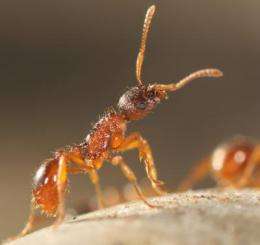
This is a close-up of a common red ant (Myrmica rubra). Credit: Dirk Sanders

Research by the University of Exeter has revealed that ants have a big impact on their local environment as a result of their activity as 'ecosystem engineers' and predators.

The study, published in the Journal of Animal Ecology, found that ants have two distinct effects on their local environment.

Firstly, through moving of soil by nest building activity and by collecting food they affect the level of nutrients in the soil. This can indirectly impact the local populations of many animal groups, from decomposers such as Collembola, to species much higher up the food chain.

Secondly, they prey on a wide range of other animals, including larger prey which can be attacked by vast numbers of ant workers.

Dirk Sanders, an author of the study from the university's Centre for Ecology and Conservation, said: "Ants are very effective predators which thrive in huge numbers. They're also very territorial and very aggressive, defending their resources and territory against other predators. All of this means they have a strong influence on their surrounding area.

"In this research, we studied for the first time how big this impact is and the subtleties of it. What we found is that despite being , their presence can also lead to an increase in density and diversity of other animal groups. They genuinely play a key role in the local environment, having a big influence on the grassland food web."

The study, carried out in Germany, studied the impact of the presence of different combinations and densities of black garden ants (Lasius niger) and common red ants (Myrmica rubra), both species which can be found across Europe, including in the UK.

It found that a low density of ants in an area increased the diversity and density of other animals in the local area, particularly the density of herbivores and decomposers. At higher densities ants had no or the opposite effect, showing that predation is counteracting the positive influence.

Dr Frank van Veen, another author on the study, said: "What we find is that the impact of ants on soil nutrient levels has a positive effect on animal groups at low levels, but as the number of increases, their predatory impacts have the bigger effect – thereby counteracting the positive influence via ecosystem engineering."

More information: The full paper from the study, Ecosystem engineering and predation: the multi-trophic impact of two ant species, can be viewed online at: http://onlinelibra … 01796.x/full

Provided by University of Exeter search and more info website


Rank 5 /5 (1 vote)
Relevant PhysicsForums posts

More news stories

Thousands of shellfish found dead in Peru

Thousands of crustaceans were found dead off the coast of Lima following the mystery mass death of dolphins and pelicans, the Peruvian Navy said Friday.

Biology / Ecology

created 3 hours ago | popularity 5 / 5 (1) | comments 0

Researchers solve structure of human protein critical for silencing genes

In a study published in the journal Cell on May 24, Cold Spring Harbor Laboratory (CSHL) scientists describe the three-dimensional atomic structure of a human protein bound to a piece of RNA that "guides" the pr ...

Biology / Cell & Microbiology

created 18 hours ago | popularity 4.7 / 5 (7) | comments 0 | with audio podcast

It's in the genes: Research pinpoints how plants know when to flower

Scientists believe they've pinpointed the last crucial piece of the 80-year-old puzzle of how plants "know" when to flower.

Biology / Biotechnology

created 18 hours ago | popularity 3.9 / 5 (8) | comments 1 | with audio podcast

More plant species responding to global warming than previously thought

(Phys.org) -- Far more wild plant species may be responding to global warming than previous large-scale estimates have suggested.

Biology / Ecology

created May 22, 2012 | popularity 4.7 / 5 (13) | comments 16 | with audio podcast

Totally rad: Scientists create rewritable digital data storage in DNA

(Phys.org) -- Scientists from Stanford's Department of Bioengineering have devised a method for repeatedly encoding, storing and erasing digital data within the DNA of living cells.

Biology / Biotechnology

created May 21, 2012 | popularity 4.9 / 5 (15) | comments 11 | with audio podcast


SpotterRF debuts Radar Backpack Kit (w/ Video)

(Phys.org) -- SpotterRF has announced a special radar backpack kit designed to enhance situational awareness for soldiers on the ground. The company says its special radar is designed for warfighters as part ...

Family history of Alzheimer's affects functional connectivity

(HealthDay) -- Cognitively normal individuals with a family history of late-onset Alzheimer's disease (AD) may display lower resting state functional connectivity in the default mode network (DMN) of the brain, ...

Transvaginal mesh op restores pelvic organ prolapse at price

(HealthDay) -- Transvaginal mesh (TVM) procedures are effective for anatomical restoration of pelvic organ prolapse (POP), but patients report a worsening of sexual function following surgery, according to ...

Travel to high altitudes tied to Crohn's, colitis flare-ups

(HealthDay) -- People with inflammatory bowel disease, which includes Crohn's disease and colitis, may be at increased risk for flare-ups when they fly or travel to high altitudes for skiing or mountain climbing, ...

Astronomers seize last chance in lifetime for Venus Transit

Astronomers are gearing for one the rarest events in the Solar System: an alignment of Earth, Venus and the Sun that will not be seen for another 105 years.

Australia hails surprise super-telescope decision

Australia has hailed a surprise decision giving it a role in a radio telescope project aimed at revolutionising astronomy, vowing to draw on its decades of experience in space science.