'Air laser' may sniff bombs, pollutants from a distance (w/ Video)
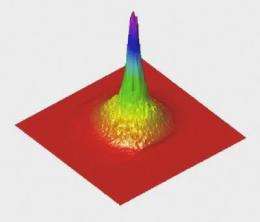
Researchers at Princeton University developed a technique for generating a laser beam out of nothing but air. They focus a pump laser on a distant point in the air and another laser beam comes back. The image shows a pulse of infra-red light from this "air laser." The center region represents the highest intensity; the outer areas have lower intensity light. The technique could be used for sensing minute quantities of gas in the air from a distance. Credit: Image courtesy Arthur Dogariu, Princeton University
Princeton University engineers have developed a new laser sensing technology that may allow soldiers to detect hidden bombs from a distance and scientists to better measure airborne environmental pollutants and greenhouse gasses.
"We are able to send a laser pulse out and get another pulse back from the air itself," said Richard Miles, a professor of mechanical and aerospace engineering at Princeton, the research group leader and co-author on the paper. "The returning beam interacts with the molecules in the air and carries their finger prints."
The new technique differs from previous remote laser-sensing methods in that the returning beam of light is not just a reflection or scattering of the outgoing beam. It is an entirely new laser beam generated by oxygen atoms whose electrons have been "excited" to high energy levels. This "air laser" is a much more powerful tool than previously existed for remote measurements of trace amounts of chemicals in the air.
The researchers, whose work is funded by the Office of Naval Research's basic research program on Sciences Addressing Asymmetric Explosive Threats, published their new method Jan. 28 in the journal Science.
Miles collaborated with three other researchers: Arthur Dogariu, the lead author on the paper, and James Michael of Princeton, and Marlan Scully, a professor with joint appointments at Princeton and Texas A&M University.
This video is not supported by your browser at this time.
Researchers at Princeton University developed a technique for generating a laser beam out of nothing but air. They focus a pump laser on a distant point in the air and another laser beam comes back. The video shows 100 pulses of infra-red light from this "air laser." The center region represents the highest intensity; the outer areas have lower intensity light. The technique could be used for sensing minute quantities of gas in the air from a distance. Credit: Image courtesy Arthur Dogariu, Princeton University
The new laser sensing method uses an ultraviolet laser pulse that is focused on a tiny patch of air, similar to the way a magnifying glass focuses sunlight into a hot spot. Within this hot spot a cylinder-shaped region just 1 millimeter long oxygen atoms become "excited" as their electrons get pumped up to high energy levels. When the pulse ends, the electrons fall back down and emit infrared light. Some of this light travels along the length of the excited cylinder region and, as it does so, it stimulates more electrons to fall, amplifying and organizing the light into a coherent laser beam aimed right back at the original laser.
Researchers plan to use a sensor to receive the returning beam and determine what contaminants it encountered on the way back.
"In general, when you want to determine if there are contaminants in the air you need to collect a sample of that air and test it," Miles said. "But with remote sensing you don't need to do that. If there's a bomb buried on the road ahead of you, you'd like to detect it by sampling the surrounding air, much like bomb-sniffing dogs can do, except from far away. That way you're out of the blast zone if it explodes. It's the same thing with hazardous gases you don't want to be there yourself. Greenhouse gases and pollutants are up in the atmosphere, so sampling is difficult."
The most commonly used remote laser-sensing method, LIDAR -- short for light detection and ranging -- measures the scattering of a beam of light as it reflects off a distant object and returns back to a sensor. It is commonly used for measuring the density of clouds and pollution in the air, but can't determine the actual identity of the particles or gases. Variants of this approach can identify contaminants, but are not sensitive enough to detect trace amounts and cannot determine the location of the gases with much accuracy.
The returning beam is thousands of times stronger in the method developed by the Princeton researchers, which should allow them to determine not just how many contaminants are in the air but also the identity and location of those contaminants.
The stronger signal should also allow for detection of much smaller concentrations of airborne contaminants, a particular concern when trying to detect trace amounts of explosive vapors. Any chemical explosive emits various gases depending on its ingredients, but for many explosives the amount of gas is miniscule.
While the researchers are developing the underlying methods rather than deployable detectors, they envision a device that is small enough to be mounted on, for example, a tank and used to scan a roadway for bombs.
So far, the researchers have demonstrated the process in the laboratory over a distance of about a foot and a half. In the future they plan to increase the distance over which the beams travel, which they note is a straightforward matter of focusing the beam farther way. They also plan to fine-tune the sensitivity of the technique to identify small amounts of airborne contaminants.
In addition, the research group is developing other approaches to remote detection involving a combination of lasers and radar.
"We'd like to be able to detect contaminants that are below a few parts per billion of the air molecules," Miles said. "That's an incredibly small number of molecules to find among the huge number of benign air molecules."
Provided by
Princeton University
-
From lemons to lemonade: Reaction uses carbon dioxide to make carbon-based semiconductor,
28 comments
-
Thioridazine kills cancer stem cells in human while avoiding toxic side-effects of conventional cancer treatments,
3 comments
-
SpaceX private rocket blasts off for space station (Update),
41 comments
-
Climate scientists say they have solved riddle of rising sea,
30 comments
-
Scotland passes turbine test to harness tidal power,
40 comments
-
How can squinting be used by both a myopic & hyperopic eye?
3 hours ago
-
The need for practical electronic and mechanical skills for aspiring experimentalists
8 hours ago
-
Refraction and splitting of a photon
9 hours ago
-
Total pressure load on a chain...
10 hours ago
-
Water under pressure and temperature effects
13 hours ago
-
Flow, different liquid, pressure
14 hours ago
- More from Physics Forums - General Physics
More news stories
Landmark calculation clears the way to answering how matter is formed
(Phys.org) -- An international collaboration of scientists, including Thomas Blum, associate professor of physics, is reporting in landmark detail the decay process of a subatomic particle called a kaon ...
May 25, 2012 |
4.8 / 5 (13) |
39
|
Is a classical electrodynamics law incompatible with special relativity?
(Phys.org) -- The laws of classical electromagnetism that were developed in the 19th century are the same laws that scientists use today. They include Maxwell’s four equations along with the Lorentz la ...
Lying in wait for WIMPs: Researchers seek to dramatically increase sensitivity of Large Underground Xenon detector
Although it's invisible, dark matter accounts for at least 80 percent of the matter in the universe. No one knows what it is, but most scientists would bet on weakly interacting massive particles, or WIMPs.
May 23, 2012 |
4 / 5 (5) |
14
|
Hall effect at the speed of light: How can you demonstrate relativistic effects with your mobile phone?
The relativistic Hall effect describing objects rotating at speeds comparable with the speed of light has been reported.
May 21, 2012 |
4.3 / 5 (3) |
8
Cloak of invisibility: Engineers use plasmonics to create an invisible photodetector
A team of engineers at Stanford and the University of Pennsylvania has for the first time used "plasmonic cloaking" to create a device that can see without being seen - an invisible machine that detects light. It is the first ...
May 21, 2012 |
4.8 / 5 (16) |
7
|
SpotterRF debuts Radar Backpack Kit (w/ Video)
(Phys.org) -- SpotterRF has announced a special radar backpack kit designed to enhance situational awareness for soldiers on the ground. The company says its special radar is designed for warfighters as part ...
Family history of Alzheimer's affects functional connectivity
(HealthDay) -- Cognitively normal individuals with a family history of late-onset Alzheimer's disease (AD) may display lower resting state functional connectivity in the default mode network (DMN) of the brain, ...
Transvaginal mesh op restores pelvic organ prolapse at price
(HealthDay) -- Transvaginal mesh (TVM) procedures are effective for anatomical restoration of pelvic organ prolapse (POP), but patients report a worsening of sexual function following surgery, according to ...
Travel to high altitudes tied to Crohn's, colitis flare-ups
(HealthDay) -- People with inflammatory bowel disease, which includes Crohn's disease and colitis, may be at increased risk for flare-ups when they fly or travel to high altitudes for skiing or mountain climbing, ...
Thousands of shellfish found dead in Peru
Thousands of crustaceans were found dead off the coast of Lima following the mystery mass death of dolphins and pelicans, the Peruvian Navy said Friday.
Astronomers seize last chance in lifetime for Venus Transit
Astronomers are gearing for one the rarest events in the Solar System: an alignment of Earth, Venus and the Sun that will not be seen for another 105 years.
Jan 28, 2011
Rank: not rated yet
Jan 28, 2011
Rank: not rated yet
colossalstorage Anthrax and other Molecular Detection
Jan 29, 2011
Rank: 4 / 5 (1)
Jan 29, 2011
Rank: not rated yet
Jan 30, 2011
Rank: not rated yet
Jan 31, 2011
Rank: not rated yet