A willingness to be bullied may be inherited
Dec 01, 2010 by Lin Edwards report
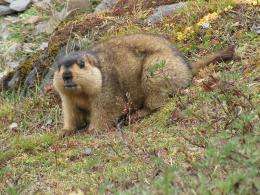
Himalayan Marmot - (Marmota himalayana) - photographed at Tshophu Lake altitude 4100 metres near Jangothang, Bhutan. Image: Christopher Fynn, via Wikipedia.

(PhysOrg.com) -- A new study of the behavior of marmots suggests that a willingness to accept some extent of bullying, rather than shying away from interactions that could lead to conflict, may be inherited.

Amanda J. Lea of the Department of Ecology and at the University of California in Los Angeles, and her colleagues wanted to test the that traits concerned with relationships that are initiated or directed by an individual may be more heritable than other traits. To find out, they studied a population of yellow-bellied marmots during the period 2003 to 2008.

The marmots live in large networks among the burrows of the in Colorado, and the scientists observing them were able to map out these networks and and determine the relationships, the number of ties each individual had, and the between the various individuals. Some of the interections, such as mutual grooming, were friendly, but marmots can also be antagonistic towards each other, chasing other individuals or nipping them. By collating data on their interactions and data on , the researchers were able to determine which traits were likely to have been inherited.

The researchers were surpprised to find that there was no evidence of heritability of traits concerned with initiating social interactions themselves, but there was a small in traits concerned with being on the receiving end of interactions, particularly antagonistic ones. The tendency to be victimized was especially inheritable.

Another of the paper's authors, Daniel Blumstein, said marmots thrive if they are "in the middle of things socially," but being in the thick of it also means they are likely to encounter more conflicts with others, and they may be on the losing end. Blumstein said being willing to tolerate abuse instead of avoiding interactions that may turn sour could be a trait that is favored by evolutionary forces, since the benefits of living in a group are greater than the drawback of at times being the victim of bullying.

Blumstein said marmots that were well-connected tended to live longer and reproduce more than those that interacted less with others. This was true even if the interactions of well-connected marmots tended to lead to aggression towards them. He said interacting with others was beneficial "even if the interactions are nasty." This may be because being in a group provides protection against predation, and being bullied is a better option than becoming prey.

Lea said the study, which was published in the journal Proceedings of the National Academy of Sciences (PNAS) on November 29, suggests scientists need to re-think their traditional view of friendly interactions as being good and unfriendly ones as bad.

Explore further: Front-row seats to climate change

More information: Heritable victimization and the benefits of agonistic relationships, PNAS November 29, 2010. Published online before print, doi:10.1073/pnas.1009882107

Related Stories

Marmots are returned to the Dolomites

Jun 05, 2006

Twenty pairs of marmots -- Europe's version of the U.S.'s groundhog -- have been reintroduced into Italy's National Park of the Belluno Dolomites.

Marmots can teach us about obesity

Jun 02, 2010

A nutrient that's common to all living things can make hibernating marmots hungry - a breakthrough that could help scientists understand human obesity and eating disorders, according to a new study by a Colorado State University ...

Predators and parasites may increase evolutionary stability

Oct 26, 2007

A new study explores the role of natural enemies, such as predators and parasites, for mixed mating, a reproductive strategy in which hermaphroditic plants and animals reproduce through both self- and cross-fertilization. ...

Recommended for you

Lovelorn frogs bag closest crooner

1 hour ago

What lures a lady frog to her lover? Good looks, the sound of his voice, the size of his pad or none of the above? After weighing up their options, female strawberry poison frogs (Oophaga pumilio) bag th ...

Honeybees trained in Croatia to find land mines

18 hours ago

(AP)—Mirjana Filipovic is still haunted by the land mine blast that killed her boyfriend and blew off her left leg while on a fishing trip nearly a decade ago. It happened in a field that was supposedly ...

Front-row seats to climate change

May 17, 2013

By day, insects provide the white noise of the South, but the night belongs to the amphibians. In a typical year, the Southern air hangs heavy from the humidity and the sounds of wildlife.

User comments : 4

Adjust slider to filter visible comments by rank

Display comments: newest first

_ilbud
not rated yet Dec 01, 2010
Reads like observer bias to me.
patnclaire
3 / 5 (2) Dec 01, 2010
pretty dismal - be eaten or be columbined. There must be a better way. Society's propensity to lay down its defenses and be abused began even at that distant evolutionary point?
JRDarby
not rated yet Dec 01, 2010
How is that dismal? It's nature: it is what it is. It also, I'm sure, allows for a population and resource distribution equilibrium. It may not be "nice" (a concept limited to humans, perhaps) but if you transcend the perception of the individual and look at the *ecosystem* it works. That said, it's just one meme and perhaps another might work better.
Skepticus
not rated yet Dec 01, 2010
Spledid research! I didn't know marmots has been scientifically proven to think and behave EXACTLY as humans!#$%^!

More news stories

Lovelorn frogs bag closest crooner

What lures a lady frog to her lover? Good looks, the sound of his voice, the size of his pad or none of the above? After weighing up their options, female strawberry poison frogs (Oophaga pumilio) bag th ...

Engineered microbes grow in the dark

Scientists at the University of California, Davis have engineered a strain of photosynthetic cyanobacteria to grow without the need for light. They report their findings today at the 113th General Meeting of the American ...

Why we need to put the fish back into fisheries

Overfishing has reduced fish populations and biodiversity across much of the world's oceans. In response, fisheries are increasingly reliant on a handful of highly valuable shellfish. However, new research by the University ...

Honeybees trained in Croatia to find land mines

(AP)—Mirjana Filipovic is still haunted by the land mine blast that killed her boyfriend and blew off her left leg while on a fishing trip nearly a decade ago. It happened in a field that was supposedly ...

Blame your parents for bunion woes

A novel study reports that white men and women of European descent inherit common foot disorders, such as bunions (hallux valgus) and lesser toe deformities, including hammer or claw toe. Findings from the Framingham Foot ...