Double vision: New instrument casts its eyes to the sky
December 7, 2010 By Whitney Clavin

New instrument casts its eyes to the sky

Enlarge

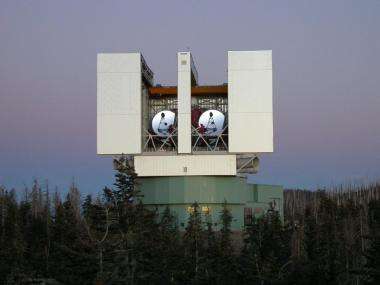
The Large Binocular Telescope at Mt. Graham, Arizona. Image credit: Large Binocular Telescope Observatory

The Large Binocular Telescope Interferometer has taken its first images of the star Beta Peg in the constellation Pictor -- an encouraging start for an instrument designed to probe the cosmic neighborhoods where Earth-like planets could exist.

Eight years in development, the NASA-funded instrument combines beams of light from twin 8.4-meter (28-foot) mirrors mounted atop the Large Binocular on Mount Graham, Ariz. "By combining the light of the telescopes, we're able to realize its full potential," said Project Manager Tom McMahon of the University of Arizona, Tucson. "Together, the two mirrors form the largest single-mount telescope in the world."

"The quality of the first-light images is wonderful," said the principal investigator for the project, Phil Hinz of the University of Arizona. "The telescope was stable and the instrument was working properly."

With this high-resolution imaging capability, astronomers hope to probe nearby solar systems -- specifically, the areas in these systems where Earth-like with could exist. Though the Large Binocular Telescope won't be able to detect Earth-size planets, it will be able to see dust disks that are indicative of , in addition to detecting large, Jupiter-size planets farther out from the star. These findings will help future, space-based exoplanet missions know where to search for Earth-like planets in our own galactic neighborhood.

With its ability to probe this "" of other solar systems, the Large Binocular Telescope Interferometer will also complement the capabilities of other NASA missions -- the Keck Interferometer, which can find dust very close to stars; and the , which is adept at observing planet-forming dust that is much more distant.

"This instrument will help complete our picture of what planetary systems look like and be a pathfinder for finding Earth-like planets that are close by," Hinz said.

With a major upgrade of the Large Binocular Telescope's adaptive optics system scheduled for next year, the interferometer will undergo testing and commissioning for the majority of 2011, and during that time, scientific observations will begin.

"This is the highest-resolution instrument of its kind in the world," McMahon said. "We won't just be able to image exoplanets, but extragalactic objects, nebulae and galaxies. It's taken time to make sure it works as envisioned, but now it's time to do science."

Provided by JPL/NASA search and more info website

4.9 /5 (9 votes)  

Filter


Move the slider to adjust rank threshold, so that you can hide some of the comments.


Display comments: newest first

Raveon
Dec 08, 2010

Rank: not rated yet
Nice. Wonder why they put them so close together.
Rank 4.9 /5 (9 votes)
Relevant PhysicsForums posts
  • revamping general concept and cosmological principle
    created22 hours ago
  • Transiting Exoplanet Light Curve
    createdMay 25, 2012
  • Math behind Theoretical Physics
    createdMay 24, 2012
  • Do we know whats at the center of galaxies yet?
    createdMay 23, 2012
  • Structure of the Milky Way?
    createdMay 20, 2012
  • What would it take to terraform Pluto and Charon?
    createdMay 19, 2012
  • More from Physics Forums - General Astronomy

More news stories

Astronomers seize last chance in lifetime for Venus Transit

Astronomers are gearing for one the rarest events in the Solar System: an alignment of Earth, Venus and the Sun that will not be seen for another 105 years.

Space & Earth / Astronomy

created 2 hours ago | popularity 5 / 5 (1) | comments 0

Australia hails surprise super-telescope decision

Australia has hailed a surprise decision giving it a role in a radio telescope project aimed at revolutionising astronomy, vowing to draw on its decades of experience in space science.

Space & Earth / Astronomy

created 2 hours ago | popularity not rated yet | comments 0

SpaceX capsule has 'new car' smell, astronauts say

SpaceX's Dragon cargo vessel smells like a new car, said astronauts at the International Space Station after opening the hatches Saturday following the spacecraft's landmark mission to the orbiting lab.

Space & Earth / Space Exploration

created 2 hours ago | popularity not rated yet | comments 0

Astronauts enter world's 1st private supply ship

(AP) -- Space station astronauts floated into the Dragon on Saturday, a day after its heralded arrival as the world's first commercial supply ship.

Space & Earth / Space Exploration

created 2 hours ago | popularity 5 / 5 (2) | comments 0

Dragon makes history with space station docking

The private company SpaceX made history Friday with the docking of its Dragon capsule to the International Space Station, the most impressive feat yet in turning routine spaceflight over to the commercial ...

Space & Earth / Space Exploration

created 17 hours ago | popularity 4.9 / 5 (7) | comments 0


SpotterRF debuts Radar Backpack Kit (w/ Video)

(Phys.org) -- SpotterRF has announced a special radar backpack kit designed to enhance situational awareness for soldiers on the ground. The company says its special radar is designed for warfighters as part ...

Family history of Alzheimer's affects functional connectivity

(HealthDay) -- Cognitively normal individuals with a family history of late-onset Alzheimer's disease (AD) may display lower resting state functional connectivity in the default mode network (DMN) of the brain, ...

Transvaginal mesh op restores pelvic organ prolapse at price

(HealthDay) -- Transvaginal mesh (TVM) procedures are effective for anatomical restoration of pelvic organ prolapse (POP), but patients report a worsening of sexual function following surgery, according to ...

Oldest Jewish archaeological evidence on the Iberian Peninsula

German archaeologists of the Friedrich Schiller University Jena found one of the oldest archaeological evidence so far of Jewish Culture on the Iberian Peninsula at an excavation site in the south of Portugal, ...

Travel to high altitudes tied to Crohn's, colitis flare-ups

(HealthDay) -- People with inflammatory bowel disease, which includes Crohn's disease and colitis, may be at increased risk for flare-ups when they fly or travel to high altitudes for skiing or mountain climbing, ...

Thousands of shellfish found dead in Peru

Thousands of crustaceans were found dead off the coast of Lima following the mystery mass death of dolphins and pelicans, the Peruvian Navy said Friday.