A swarm of ancient stars
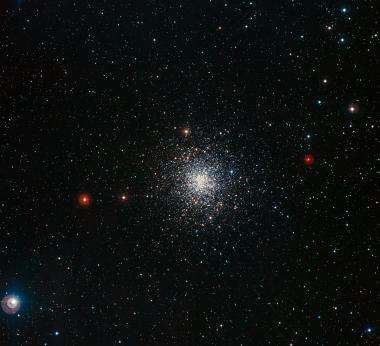
The globular cluster Messier 107, also known as NGC 6171, is located about 21 000 light-years away in the constellation of Ophiuchus. Messier 107 is about 13 arcminutes across, which corresponds to about 80 light-years at its distance. As is typical of globular clusters, a population of thousands of old stars in Messier 107 is densely concentrated into a volume that is only about 20 times the distance between our sun and its nearest stellar neighbor, Alpha Centauri, across. This image was created from exposures taken through blue, green and near-infrared filters, using the Wide Field Imager (WFI) on the MPG/ESO 2.2-meter telescope at La Silla Observatory, Chile. Credit: ESO
(PhysOrg.com) -- We know of about 150 of the rich collections of old stars called globular clusters that orbit our galaxy, the Milky Way. This sharp new image of Messier 107, captured by the Wide Field Imager on the 2.2-metre telescope at ESOs La Silla Observatory in Chile, displays the structure of one such globular cluster in exquisite detail. Studying these stellar swarms has revealed much about the history of our galaxy and how stars evolve.
The globular cluster Messier 107, also known as NGC 6171, is a compact and ancient family of stars that lies about 21 000 light-years away. Messier 107 is a bustling metropolis: thousands of stars in globular clusters like this one are concentrated into a space that is only about twenty times the distance between our Sun and its nearest stellar neighbour, Alpha Centauri, across. A significant number of these stars have already evolved into red giants, one of the last stages of a star's life, and have a yellowish colour in this image.
Globular clusters are among the oldest objects in the Universe. And since the stars within a globular cluster formed from the same cloud of interstellar matter at roughly the same time typically over 10 billion years ago they are all low-mass stars, as lightweights burn their hydrogen fuel supply much more slowly than stellar behemoths. Globular clusters formed during the earliest stages in the formation of their host galaxies and therefore studying these objects can give significant insights into how galaxies, and their component stars, evolve.
This video is not supported by your browser at this time.
In this zoom sequence we start with the spectacular vista of the central regions of the Milky Way galaxy. We then close in on a fuzzy ball of stars, the globular cluster Messier 107, also known as NGC 6171. It lies about 21 000 light-years away in the constellation of Ophiuchus. The final close up view was created from exposures taken through blue, green and near-infrared filters, using the Wide Field Imager (WFI) on the MPG/ESO 2.2-metre telescope at La Silla Observatory, Chile. Credit: ESO
Messier 107 has undergone intensive observations, being one of the 160 stellar fields that was selected for the Pre-FLAMES Survey a preliminary survey conducted between 1999 and 2002 using the 2.2-metre telescope at ESO's La Silla Observatory in Chile, to find suitable stars for follow-up observations with the VLT's spectroscopic instrument FLAMES. Using FLAMES, it is possible to observe up to 130 targets at the same time, making it particularly well suited to the spectroscopic study of densely populated stellar fields, such as globular clusters.M107 is not visible to the naked eye, but, with an apparent magnitude of about eight, it can easily be observed from a dark site with binoculars or a small telescope. The globular cluster is about 13 arcminutes across, which corresponds to about 80 light-years at its distance, and it is found in the constellation of Ophiuchus, north of the pincers of Scorpius. Roughly half of the Milky Way's known globular clusters are actually found in the constellations of Sagittarius, Scorpius and Ophiuchus, in the general direction of the centre of the Milky Way. This is because they are all in elongated orbits around the central region and are on average most likely to be seen in this direction.
Messier 107 was discovered by Pierre Méchain in April 1782 and it was added to the list of seven Additional Messier Objects that were originally not included in the final version of Messier's catalogue, which was published the previous year. On 12 May 1793, it was independently rediscovered by William Herschel, who was able to resolve this globular cluster into stars for the first time. But it was not until 1947 that this globular cluster finally took its place in Messier's catalogue as M107, making it the most recent star cluster to be added to this famous list.
This image is composed from exposures taken through the blue, green and near-infrared filters by the Wide Field Camera (WFI) on the MPG/ESO 2.2-metre telescope at the La Silla Observatory in Chile.
Provided by
ESO
-
From lemons to lemonade: Reaction uses carbon dioxide to make carbon-based semiconductor,
28 comments
-
Thioridazine kills cancer stem cells in human while avoiding toxic side-effects of conventional cancer treatments,
3 comments
-
SpaceX private rocket blasts off for space station (Update),
41 comments
-
Climate scientists say they have solved riddle of rising sea,
30 comments
-
Scotland passes turbine test to harness tidal power,
40 comments
-
revamping general concept and cosmological principle
20 hours ago
-
Transiting Exoplanet Light Curve
May 25, 2012
-
Math behind Theoretical Physics
May 24, 2012
-
Do we know whats at the center of galaxies yet?
May 23, 2012
-
Structure of the Milky Way?
May 20, 2012
-
What would it take to terraform Pluto and Charon?
May 19, 2012
- More from Physics Forums - General Astronomy
More news stories
Astronauts enter world's 1st private supply ship
(AP) -- Space station astronauts floated into the Dragon on Saturday, a day after its heralded arrival as the world's first commercial supply ship.
Space & Earth / Space Exploration
50 minutes ago |
5 / 5 (1) |
0
Australia hails surprise super-telescope decision
Australia has hailed a surprise decision giving it a role in a radio telescope project aimed at revolutionising astronomy, vowing to draw on its decades of experience in space science.
48 minutes ago |
not rated yet |
0
SpaceX capsule has 'new car' smell, astronauts say
SpaceX's Dragon cargo vessel smells like a new car, said astronauts at the International Space Station after opening the hatches Saturday following the spacecraft's landmark mission to the orbiting lab.
Space & Earth / Space Exploration
48 minutes ago |
not rated yet |
0
Astronomers seize last chance in lifetime for Venus Transit
Astronomers are gearing for one the rarest events in the Solar System: an alignment of Earth, Venus and the Sun that will not be seen for another 105 years.
45 minutes ago |
5 / 5 (1) |
0
Dragon arrives at space station in historic 1st (Update 2)
The privately bankrolled Dragon capsule made a historic arrival at the International Space Station on Friday, triumphantly captured by astronauts wielding a giant robot arm.
Space & Earth / Space Exploration
22 hours ago |
5 / 5 (8) |
16
SpotterRF debuts Radar Backpack Kit (w/ Video)
(Phys.org) -- SpotterRF has announced a special radar backpack kit designed to enhance situational awareness for soldiers on the ground. The company says its special radar is designed for warfighters as part ...
Thousands of shellfish found dead in Peru
Thousands of crustaceans were found dead off the coast of Lima following the mystery mass death of dolphins and pelicans, the Peruvian Navy said Friday.
Travel to high altitudes tied to Crohn's, colitis flare-ups
(HealthDay) -- People with inflammatory bowel disease, which includes Crohn's disease and colitis, may be at increased risk for flare-ups when they fly or travel to high altitudes for skiing or mountain climbing, ...
Transvaginal mesh op restores pelvic organ prolapse at price
(HealthDay) -- Transvaginal mesh (TVM) procedures are effective for anatomical restoration of pelvic organ prolapse (POP), but patients report a worsening of sexual function following surgery, according to ...
Oldest Jewish archaeological evidence on the Iberian Peninsula
German archaeologists of the Friedrich Schiller University Jena found one of the oldest archaeological evidence so far of Jewish Culture on the Iberian Peninsula at an excavation site in the south of Portugal, ...
MIT researchers devise new means to synchronize a group of robots (w/ Video)
(Phys.org) -- For several years, roboticists have been working out ways to get a group of robots to perform synchronized activities as demonstrated most often in dance routines. Its not just about trying ...