Strange new twist: Researchers discover Mobius symmetry in metamaterials
December 20, 2010 by Lynn Yarris
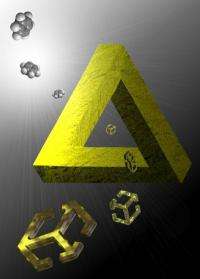
Berkeley Lab researcher have discovered Möbius symmetry in metamolecular trimers made from metals and dielectrics. Credit: Image by Chih-Wei Chang
(PhysOrg.com) -- Möbius symmetry, the topological phenomenon that yields a half-twisted strip with two surfaces but only one side, has been a source of fascination since its discovery in 1858 by German mathematician August Möbius. As artist M.C. Escher so vividly demonstrated in his "parade of ants," it is possible to traverse the "inside" and "outside" surfaces of a Möbius strip without crossing over an edge. For years, scientists have been searching for an example of Möbius symmetry in natural materials without any success. Now a team of scientists has discovered Möbius symmetry in metamaterials materials engineered from artificial "atoms" and "molecules" with electromagnetic properties that arise from their structure rather than their chemical composition.
Xiang Zhang, a scientist with the U.S. Department of Energy's Lawrence Berkeley National Laboratory (Berkeley Lab) and a professor at the University of California (UC) Berkeley, led a study in which electromagnetic Möbius symmetry was successfully introduced into composite metamolecular systems made from metals and dielectrics. This discovery opens the door to finding and exploiting novel phenomena in metamaterials.
"We have experimentally observed a new topological symmetry in electromagnetic metamaterial systems that is
equivalent to the structural symmetry of a Möbius strip, with the number of twists controlled by sign changes in the electromagnetic coupling between the meta-atoms," Zhang says. "We have further demonstrated that metamaterials with different coupling signs exhibit resonance frequencies that depend on the number but not the locations of the twists. This confirms the topological nature of the symmetry."
Working with metallic resonant meta-atoms configured as coupled split-ring resonators, Zhang and members of his research group assembled three of these meta-atoms into trimers. Through careful design of the electromagnetic couplings between the constituent meta-atoms, these trimers displayed Möbius C3 symmetry meaning Möbius cyclic symmetry through three rotations of 120 degrees. The Möbius twists result from a change in the signs of the electromagnetic coupling constants between the constituent meta-atoms.
"The topological Möbius symmetry we found in our meta-molecule trimers is a new symmetry not found in naturally occurring materials or molecules." Zhang says. "Since the coupling constants of metamolecules can be arbitrarily varied from positive to negative without any constraints, the number of Möbius twists we can introduce are unlimited. This means that topological structures that have thus far been limited to mathematical imagination can now be realized using metamolecules of different designs."
Details on this discovery have been published in the journal Physical Review Letters, in a paper titled "Optical Möbius Symmetry in Metamaterials." Co-authoring the paper with Zhang were Chih-Wei Chang, Ming Liu, Sunghyun Nam, Shuang Zhang, Yongmin Liu and Guy Bartal.
Xiang Zhang is a principal investigator with Berkeley Lab's Materials Sciences Division and the Ernest S. Kuh Endowed Chaired Professor at UC Berkeley, where he directs the Center for Scalable and Integrated NanoManufacturing (SINAM), a National Science Foundation Nano-scale Science and Engineering Center.
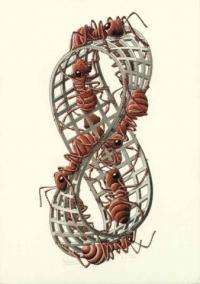
In his “parade of ants,” Artist M.C. Escher demonstrated that it is possible to traverse the “inside” and “outside” surfaces of a Möbius band without crossing over an edge.
In science, symmetry is defined as a system feature or property that is preserved when the system undergoes a change. This is one of the most fundamental and crucial concepts in science, underpinning such physical phenomena as the conservation laws and selection rules that govern the transition of a system from one state to another. Symmetry also dictates chemical reactions and drives a number of important scientific tools, including crystallography and spectroscopy.While some symmetries, such as spatial geometries, are easily observed, others, such as optical symmetries, may be hidden. A powerful investigative tool for uncovering hidden symmetries is a general phenomenon known as "degeneracy." For example, the energy level degeneracy of an atom in a crystal is correlated with the crystal symmetry. A three-body system, like a trimer, can be especially effective for studying the correlation between degeneracy and symmetry because, although it is a relatively simple system, it reveals a rich spectrum of phenomena.
"The unique properties of a three-body system make experimental investigations of hidden symmetries possible," says Chih-Wei Chang, a former post-doc in Zhang's group and the lead author of the paper in Physical Review Letters, says. "Intrigued by the extraordinary engineering flexibilities of metamaterials, we decided to investigate some non-trivial symmetries hidden beneath these metamolecules by studying their degeneracy properties"
The authors tested their metamaterials for hidden symmetry by shining a light and monitoring the optical resonances. The resulting resonant frequencies revealed that degeneracy is kept even when the coupling constants between meta-atoms flip signs.
"Because degeneracy and symmetry are always correlated, there must be some symmetry hidden beneath the observed degeneracy" says Chang.
The researchers showed that whereas trimer systems with uniform negative (or positive) coupling signs could be symbolized as an equilateral triangle, trimer systems with mixed signs of couplings could only be symbolized as a Möbius strip with topological C3 symmetry. Furthermore, in other metamolecular systems made of six meta-atoms, the authors demonstrated up to three Möbius twists.
Says Chang, now a faculty member at National Taiwan University in Taipei, "When going from natural systems to artificial meta-atoms and metamolecules, we can expect to encounter phenomena far beyond our conventional conceptions. The new symmetries we find in metamaterials could be extended to other kinds of artificial systems, such as Josephson junctions, that will open new avenues for novel phenomena in quantum electronics and quantum optics."
Provided by
Lawrence Berkeley National Laboratory
-
From lemons to lemonade: Reaction uses carbon dioxide to make carbon-based semiconductor,
28 comments
-
Thioridazine kills cancer stem cells in human while avoiding toxic side-effects of conventional cancer treatments,
3 comments
-
SpaceX private rocket blasts off for space station (Update),
41 comments
-
Climate scientists say they have solved riddle of rising sea,
30 comments
-
Scotland passes turbine test to harness tidal power,
40 comments
-
The need for practical electronic and mechanical skills for aspiring experimentalists
5 hours ago
-
Refraction and splitting of a photon
7 hours ago
-
Total pressure load on a chain...
8 hours ago
-
Water under pressure and temperature effects
11 hours ago
-
Flow, different liquid, pressure
11 hours ago
-
Dimensions and Degrees of Freedom
12 hours ago
- More from Physics Forums - General Physics
More news stories
Landmark calculation clears the way to answering how matter is formed
(Phys.org) -- An international collaboration of scientists, including Thomas Blum, associate professor of physics, is reporting in landmark detail the decay process of a subatomic particle called a kaon ...
May 25, 2012 |
4.8 / 5 (12) |
36
|
Is a classical electrodynamics law incompatible with special relativity?
(Phys.org) -- The laws of classical electromagnetism that were developed in the 19th century are the same laws that scientists use today. They include Maxwell’s four equations along with the Lorentz la ...
Lying in wait for WIMPs: Researchers seek to dramatically increase sensitivity of Large Underground Xenon detector
Although it's invisible, dark matter accounts for at least 80 percent of the matter in the universe. No one knows what it is, but most scientists would bet on weakly interacting massive particles, or WIMPs.
May 23, 2012 |
4 / 5 (5) |
14
|
Hall effect at the speed of light: How can you demonstrate relativistic effects with your mobile phone?
The relativistic Hall effect describing objects rotating at speeds comparable with the speed of light has been reported.
May 21, 2012 |
4.3 / 5 (3) |
8
Cloak of invisibility: Engineers use plasmonics to create an invisible photodetector
A team of engineers at Stanford and the University of Pennsylvania has for the first time used "plasmonic cloaking" to create a device that can see without being seen - an invisible machine that detects light. It is the first ...
May 21, 2012 |
4.8 / 5 (16) |
7
|
SpotterRF debuts Radar Backpack Kit (w/ Video)
(Phys.org) -- SpotterRF has announced a special radar backpack kit designed to enhance situational awareness for soldiers on the ground. The company says its special radar is designed for warfighters as part ...
Astronauts enter world's 1st private supply ship
(AP) -- Space station astronauts floated into the Dragon on Saturday, a day after its heralded arrival as the world's first commercial supply ship.
Australia hails surprise super-telescope decision
Australia has hailed a surprise decision giving it a role in a radio telescope project aimed at revolutionising astronomy, vowing to draw on its decades of experience in space science.
SpaceX capsule has 'new car' smell, astronauts say
SpaceX's Dragon cargo vessel smells like a new car, said astronauts at the International Space Station after opening the hatches Saturday following the spacecraft's landmark mission to the orbiting lab.
Thousands of shellfish found dead in Peru
Thousands of crustaceans were found dead off the coast of Lima following the mystery mass death of dolphins and pelicans, the Peruvian Navy said Friday.
Astronomers seize last chance in lifetime for Venus Transit
Astronomers are gearing for one the rarest events in the Solar System: an alignment of Earth, Venus and the Sun that will not be seen for another 105 years.

Dec 20, 2010
Rank: 5 / 5 (1)
Dec 20, 2010
Rank: 4.5 / 5 (8)
and again the editors of physorg have no idea what they are talking about. the möbius strip has also ONLY ONE surface, not two. that's what makes it special, together with the one edge.
and the reason they used the image of a penrose triangle instead of a möbius strip remains a mystery as well.
Dec 20, 2010
Rank: 3 / 5 (4)
Dec 20, 2010
Rank: 1 / 5 (7)
Dec 20, 2010
Rank: not rated yet
Dec 21, 2010
Rank: not rated yet
Dec 21, 2010
Rank: not rated yet
Dec 21, 2010
Rank: 1 / 5 (2)
NOpe. That would be a peice of paper simulating a mobius strip.
A true mathematical mobius strip has thickness = zero.
I'm trying to envision a motherboard stretched like a rubber band and given a half-twist back upon itself.
No clue why you'd do that.
Although, if you made a motherboard as just a hollow, cyclindrical tube, the distance between some devices along the surface would be cut in half. If you then folded the tube into a torus, the distance between some of the other devices would be cut in half. Everything would be as little as half as far away from anything that is already over half the board's width in distance...
On the other hand, if the motherboard was a mobius strip, it would double the distance between devices...
Dec 22, 2010
Rank: 5 / 5 (1)
Dec 22, 2010
Rank: 1 / 5 (2)
Ok, a Torus is a 3-dimensional object which ends up having 1 surface and no edges. A torus is produced by revolving a circle into the third dimension around an axis outside itself, but parrallel to the plane of the original circle.
Although you could modify the location of the axis into the third dimension, but this would produce an eliptical toroid, or a toroidal elipse, depending on the orientation of the axis of revolution...
A mobius strip is a 2-dimensional object which has been half-twisted into the third dimension back upon itself, therefore making it a closed object with only one surface and one edge.
Dec 22, 2010
Rank: 5 / 5 (4)
A Moebius strip, however, has only one surface. Any point P1 can be connected to any point P2 by a continuous path.
Dec 22, 2010
Rank: 2.3 / 5 (3)
See, that's only true of the torus is hollow, which would be an inner tube.
But in normal geometry, they are normally referring to a solid object when they use the term "torus". Nobody ever counts the "back" of a surface in geometry.
think about the formula for area of a square or circle.
X^2.
pi(r^2)
Surface area of a cube, which has six faces.
6x^2
Surface area of sphere, which has 1 surface
4pi(r^2)
See, nobody ever says anything like what you are saying. We treat the sphere as a solid, just as we treat a torus as a solid.
In technical terms, an inner tube is not a torus. It is a complex object formed by removing one torus from the center of another torus with a smaller little "r" component in the volume of a torus formula.
An inner tube has an internal surface, but a torus has only one surface, just like a sphere.
Dec 22, 2010
Rank: not rated yet
Take a line that measures the diameter of the solid ring of the torus. Move it through the solid part of the torus, rotating it 90 degrees until it returns to its starting point. You have traced a mobius strip.
Dec 23, 2010
Rank: 3 / 5 (2)
I can only argue with an idiot for so long until they drag me down to their level of stupidity and beat me with experience in said stupidity.
Dec 24, 2010
Rank: 3 / 5 (2)
A donut, or a twist. Both are good. Personally, I prefer the maple glazed, old-fashioned variety.
Dec 24, 2010
Rank: 1 / 5 (2)
You can't rotate a line on an axis 90 degrees and return it to its starting point.
Also, you can't cut a torus into a mobius strip. It will always have two sides (the inside, and the outside). This is because the two sides in a torus never meet, and you can't make them meet by cutting funny shapes out of the torus.
Dec 28, 2010
Rank: 2 / 5 (1)
Rubbish - the reason you cannot cut a torus into a mobius strip is because one is three dimensional object the other is 1 dimensional object.
You could however carve a shape that looked like a mobius strip out of a torus if you wanted to. You could also carve the same shape out of a cube so that is no test of anything.
Dec 29, 2010
Rank: 1 / 5 (1)
Dec 29, 2010
Rank: 2 / 5 (1)
From SpaceTime to TimeSpace. From within to without,
in one continous loop.
Jan 04, 2011
Rank: 5 / 5 (2)
ubavontuba - is the winner with a perfectly correct answer to all questions stated. We could get into the math - but who would want to read it?