Snails with shells coiling to the left survive snake attacks (w/ Video)
December 10, 2010 by Lin Edwards report

Snails with shells coiling to the left survive snake attacks (w/ Video)

Enlarge

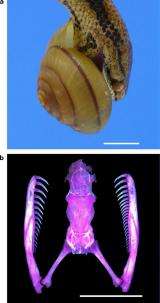
(a) Feeding behaviour of P. iwasakii. (b) A skull specimen (dorsal view) of P. iwasakii, exhibiting half a dozen more teeth on the right side of mandibles than on the left before hatching. Bars: 10 mm. Image credit: Nature Communications, doi:10.1038/ncomms1133

(PhysOrg.com) -- Snail shells can spiral to the left (sinistral) or to the right (dextral), as determined by a single gene, and a new study has found the advantage of being in the minority sinistral group: they survive predation by snakes much better than dextral snails. The effect of this advantage is so great they could separate into a distinct species.

Mating between sinistral and dextral is almost impossible because their genitals are on opposite sides of their bodies. In the large Satsuma snails, for example, mating takes place face-to-face. All snails have both male and female reproductive organs, and when both snails are dextral or both are sinistral, everything lines up nicely. When one is dextral and the other is sinistral the genitals line up male-male and female-female.

Dextral snails are far more common than sinistral snails, and therefore have far more mating opportunities. This and the difficulty in mating means sinistral snails should become extinct unless sinistrality has some unknown advantage. Now, scientists in Japan and Taiwan have discovered the advantage is a resistance to snake predation.

Southeast Asian snakes of the pareatidae family — the oriental slug-eating snakes — specialize in eating slugs and snails, and because the majority of snails are dextral with the shells on the right side, the snakes attack from the left, grabbing the shell with its upper jaw and sticking its lower jaw into the gap. The snakes have also evolved asymmetrical mouth parts with more fangs on one side than the other to help them eat the dextral snails. These changes, however, make it difficult for them to eat sinistral snails, especially as the snakes continue to attack from the left.

Researchers led by Dr. Masaki Hoso of Tohoku University looked at the distribution of Satsuma snails and the slug-eating snake species in Japan, and discovered that in areas where the snakes are found, sinistral Satsuma snails are more prevalent than elsewhere.

The team predicted that sinistral snails with larger shells such as Satsuma snails should also survive better than Bradybaena similaris snails, which have smaller shells, because they were more difficult for the snakes to handle.

This video is not supported by your browser at this time.

"Right-handed" foraging behavior of a snail-eating snake (Pareas iwasakii) which successfully preys on a dextral snail (Satsuma mercatoria).

This video is not supported by your browser at this time.

Failure of a snail-eating snake (Pareas iwasakii) in “right-handed” predation on a sinistral snail (Satsuma perversa).

To test their hypotheses the researchers kept sinistral and dextral snails of both species and exposed them to predation from slug-eating . The results were that none of the dextral Satsuma snails escaped being eaten, but 87.5 percent of the sinistral snails survived. In the smaller snails the survival rate for sinistral snails was smaller but they still had a huge advantage over dextral snails.

The results led Dr. Hoso to predict that at some point the protection from predation would outweigh the mating difficulties and the chirality, or direction in which the shell coils, would become fixed in the opposite direction and the two groups become separate species and evolve their separate ways. To test this idea, the researchers sequenced the DNA of all Satsuma snail species found in Japan and built a family tree to show their relationships. The tree demonstrated clearly that sinistral species have evolved from dextral snails at least six times, and that in at least four of these occasions the reversal was due to a change in a single gene.

The reversal results in a massive advantage, because virtually overnight a group of snails is adapted to survive predation and is separated from other members of the species and can evolve separately. Hoso said these events represent the “hopeful monster,” an idea put forward by geneticist Richard Goldschmidt, who said small genetic changes could result in large evolutionary change.

The paper is published in the journal .

More information: A speciation gene for left–right reversal in snails results in anti-predator adaptation, Masaki Hoso et al, Nature Communications 1, Article number: 133. doi:10.1038/ncomms1133

© 2010 PhysOrg.com

4.6 /5 (14 votes)  

Filter


Move the slider to adjust rank threshold, so that you can hide some of the comments.


Display comments: newest first

trekgeek1
Dec 10, 2010

Rank: not rated yet
Really? "The effect of this advantage is so great they could separate into a distinct species", and there aren't any creationists here yet? I almost kind of miss them now, almost.

I wonder how long it will take before the snake's jaw asymmetry reverses due to snakes starving to death. I would be curious to see if the snail population will actually shift, or will the snake's evolution match, and reverse it. Perhaps we'll have symmetrical snakes and snails.
dsaini
Dec 10, 2010

Rank: 5 / 5 (1)
wow a perfect example of frequency-dependant selection?
Rank 4.6 /5 (14 votes)
Relevant PhysicsForums posts

More news stories

Thousands of shellfish found dead in Peru

Thousands of crustaceans were found dead off the coast of Lima following the mystery mass death of dolphins and pelicans, the Peruvian Navy said Friday.

Biology / Ecology

created 17 minutes ago | popularity not rated yet | comments 0

Researchers solve structure of human protein critical for silencing genes

In a study published in the journal Cell on May 24, Cold Spring Harbor Laboratory (CSHL) scientists describe the three-dimensional atomic structure of a human protein bound to a piece of RNA that "guides" the pr ...

Biology / Cell & Microbiology

created 15 hours ago | popularity 4.7 / 5 (6) | comments 0 | with audio podcast

It's in the genes: Research pinpoints how plants know when to flower

Scientists believe they've pinpointed the last crucial piece of the 80-year-old puzzle of how plants "know" when to flower.

Biology / Biotechnology

created 15 hours ago | popularity 4 / 5 (5) | comments 1 | with audio podcast

Copy of the genetic makeup travels in a protein suitcase

Scientists from the Institute for Physical and Theoretical Chemistry at the University of Bonn have succeeded for the first time in the real time filming of the transport of an important information carrier in biological ...

Biology / Cell & Microbiology

created 21 hours ago | popularity not rated yet | comments 0 | with audio podcast

'Transformer' protein makes different sized transport pods

These spheres may look almost identical, but subtle differences between them revealed a molecular version of the robots from Transformers. Each sphere is a vesicle, a pod that cells use to transport materials ...

Biology / Cell & Microbiology

created 21 hours ago | popularity not rated yet | comments 0


SpotterRF debuts Radar Backpack Kit (w/ Video)

(Phys.org) -- SpotterRF has announced a special radar backpack kit designed to enhance situational awareness for soldiers on the ground. The company says its special radar is designed for warfighters as part ...

Astronauts enter world's 1st private supply ship

(AP) -- Space station astronauts floated into the Dragon on Saturday, a day after its heralded arrival as the world's first commercial supply ship.

Australia hails surprise super-telescope decision

Australia has hailed a surprise decision giving it a role in a radio telescope project aimed at revolutionising astronomy, vowing to draw on its decades of experience in space science.

SpaceX capsule has 'new car' smell, astronauts say

SpaceX's Dragon cargo vessel smells like a new car, said astronauts at the International Space Station after opening the hatches Saturday following the spacecraft's landmark mission to the orbiting lab.

Astronomers seize last chance in lifetime for Venus Transit

Astronomers are gearing for one the rarest events in the Solar System: an alignment of Earth, Venus and the Sun that will not be seen for another 105 years.

Travel to high altitudes tied to Crohn's, colitis flare-ups

(HealthDay) -- People with inflammatory bowel disease, which includes Crohn's disease and colitis, may be at increased risk for flare-ups when they fly or travel to high altitudes for skiing or mountain climbing, ...