Russian satellites crash into Pacific: space official
Dec 05, 2010
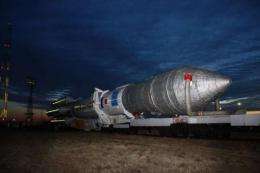
The Proton-M rocket -- carrying three satellites for Russia's Glonass navigation system -- is transported to the launch pad at the Baikonur cosmodrome on December 2. The rocket carrying the navigation satellites has blasted into space from the cosmodrome in Kazakhstan.

Three Russian navigation satellites crashed into the Pacific off the US state of Hawaii Sunday after the rocket carrying them failed to reach orbit, officials from the Russian space agency said.

The capsule carrying the three Glonass satellites plummeted into the sea 1,500 kilometres (900 miles) off Honolulu, one official told Russia's RIA-Novosty news agency, adding that there had been no casualties.

The failure is a setback for Russia's attempt to put a satellite navigation system in place to rival the United States's GPS (Global Positioning System) and steal a march on Europe's fledgling Galileo system.

Prime Minister Vladimir Putin has underscored the strategic significance of developing the Glonass system to ensure Russia's technological independence.

"According to preliminary data, the Proton rocket that took off from Baikonur at 1:25 pm (1025 GMT) took a wrong trajectory," said a Russian space agency source cited by Interfax.

"Consequently, the booster rocket could not put the satellites in the intended orbit and it fell back with them into the atmosphere," the source added.

Once separated from the Proton rocket, a second-stage booster rocket with the three satellites aboard should have put them in orbit about 20 kilometres (12 miles) above the earth.

"The ballistics experts have checked everything: the upper-stage rocket with the satellites is not on the main, intermediate nor emergency orbit," a source told RIA Novosti.

The three Glonass-M satellites, weighing 1.4 tonnes, were supposed to complete a constellation of satellites already put in place by Moscow.

Putin said in April that Russia planned to equip all new cars sold in Russia in 2012 with the new navigation system, developed by the Russian military in the 1980s.

He said Moscow planned to launch a total of seven new Glonass satellites which would ensure coverage of the entire planet, bringing to 27 or 28 the number of operational satellites.

Russia would spend 1.7 billion rubles (40 million dollars) in 2011, after two billion rubles spent in 2010, Putin said.

Rokosmos, the Russian space agency, said in 2008 that Venezuela and Cuba were interested in adopting the new system.

Russia's defence ministry confirmed the loss, but insisted Sunday's accident would not affect the roll-out of the new positioning system.

"There are currently 26 satellites in the Glonass constellation, including two emergency satellites. This allows complete coverage of Russian Federation territory," the ministry said in a statement.

"The Russian space industry's capacity enables us to react rapidly to what's happened," it said, adding that the system would be fully in place next year in any case.

Explore further: Field tests in Mojave Desert pave way for human exploration of small bodies

add to favorites email to friend print save as pdf

Related Stories

Russia launches US satellite into space

Apr 24, 2010

A Russian Proton rocket carrying a US AMC 49 telecommunications satellite was launched into orbit on Saturday, the Russian space agency said on its website.

Russia plans to launch six satellites

Mar 27, 2007

Russia will add six satellites to its global navigation system, GLONASS, in 2007, a spokesman at Moscow's Research Institute of Space Instrument-Making said.

Recommended for you

Mars rover Opportunity examines clay clues in rock

6 hours ago

(Phys.org) —NASA's senior Mars rover, Opportunity, is driving to a new study area after a dramatic finish to 20 months on "Cape York" with examination of a rock intensely altered by water.

NASA's STEREO detects a CME from the sun

19 hours ago

On 5:24 a.m. EDT on May 17, 2013, the sun erupted with an Earth-directed coronal mass ejection or CME, a solar phenomenon that can send billions of tons of solar particles into space that can reach Earth ...

Nine-year-old Mars rover passes 40-year-old record

May 17, 2013

While Apollo 17 astronauts Eugene Cernan and Harrison Schmitt visited Earth's moon for three days in December 1972, they drove their mission's Lunar Roving Vehicle 19.3 nautical miles (22.210 statute miles ...

Bright explosion on the Moon

May 17, 2013

For the past 8 years, NASA astronomers have been monitoring the Moon for signs of explosions caused by meteoroids hitting the lunar surface. "Lunar meteor showers" have turned out to be more common than anyone ...

User comments : 9

Adjust slider to filter visible comments by rank

Display comments: newest first

SteveL
4 / 5 (1) Dec 05, 2010
Probably fell into the Pacific ocean near Hawaii? We (humanity) can read a liscense plate from space, we can track 10k near earth objects but a missle that is being tracked and monitored gets lost? Someone is going to be unemployed.
axemaster
3 / 5 (6) Dec 05, 2010
Yeah, because it's totally easy to track something that sinks into thousands of feet of water in the middle of the ocean, possibly being dragged around by currents on the way down. Nice to see another brain going unused...
tkjtkj
2.5 / 5 (2) Dec 05, 2010

... but a missile that is being tracked and monitored gets lost? Someone is going to be unemployed.


Perhaps... but your comment assumes that the 'reporters' are being accurate in their reporting. I believe a lil matter known as 'WikiLeaks' can support that the opposite might be true.
Jotaf
not rated yet Dec 05, 2010
If rocket science was easy, we would all be doing it!
tkjtkj
1 / 5 (2) Dec 06, 2010
If rocket science was easy, we would all be doing it!


Were rules of English to be followed then the subjunctive would be the case. ;)
hexmat1233
not rated yet Dec 06, 2010
Realy tho why cant russia keep its sattalites running properly this is like the 5th one already that has failed modern teck
SteveL
5 / 5 (4) Dec 06, 2010
Yeah, because it's totally easy to track something that sinks into thousands of feet of water in the middle of the ocean, possibly being dragged around by currents on the way down. Nice to see another brain going unused...


I commented after the article was first posted. Not after it was edited to the version available now. Really, try to keep your insults in check.

The present article is over twice as long as it was when first posted and contains far more detailed information. The first version stated that it wasn't on one of three expected trajectories and that they think it fell into the pacific somewhere near Hawaii.

Just for your edification; I used to be a nuclear missile technician during the late 70's and early 80's. Even back then we had the technology to track our missiles and follow their trajectories. You don't just "lose" missiles, but according to the first version, that was exactly what was reported.
Justsayin
not rated yet Dec 07, 2010
Totally agree with ya SteveL.
dutchman
not rated yet Dec 10, 2010
Poor Russians - still won't know where they are, or they're going.....(?)

More news stories

Galaxy's Ring of Fire

Johnny Cash may have preferred this galaxy's burning ring of fire to the one he sang about falling into in his popular song. The "starburst ring" seen at center in red and yellow hues is not the product of ...

Alaska volcano shoots ash 15,000 feet into the air

(AP)—One of Alaska's most restless volcanoes has shot an ash cloud 15,000 feet into the air in an ongoing eruption that has drawn attention from a nearby community but isn't expected to threaten air traffic.

Chinese, Indian airlines face EU pollution fines

Eight Chinese and two Indian airlines face fines of up to several million euros for not paying for their greenhouse gas emissions during flights within the bloc, the European Commission said on Friday.

Yahoo Japan suspects 22 million IDs stolen

Yahoo Japan Corp. has said it suspects up to 22 million user IDs may have been stolen during an unauthorised attempt to access the administrative system of its Yahoo! Japan portal.

New colonoscope provides ground-breaking view of colon

A ground-breaking advance in colonoscopy technology signals the future of colorectal care, according to research presented today at Digestive Disease Week(DDW). Additional research focuses on optimizing the minimal withdrawal ...

US seizes Bitcoin operator accounts

US authorities seized the accounts of a Bitcoin digital currency exchange operator, claiming it was functioning as an "unlicensed money service business," court documents showed Friday.