Redrawing the map of Great Britain based on human interaction
December 8, 2010

Redrawing the map of Great Britain based on human interaction

Enlarge

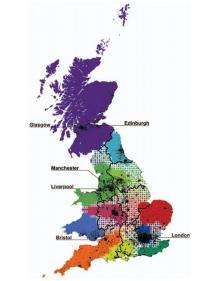
The core regions of Britain. By combining the output from several modularity optimization methods researchers obtain the results shown in this figure. The thick black boundary lines show the official Government Office Regions partitioning together with Scotland and Wales. The black background spots show Britain’s towns and cities, some of which are highlighted with a label. Credit: Plos ONE, doi:10.1371/journal.pone.0014248.g003

A group of researchers at MIT, Cornell University and University College London have used one of the world's largest databases of telecommunications records to redraw the map of Great Britain. The research, which will be published in the journal PLoS ONE on Dec. 8, is based on the analysis of 12 billion anonymized records representing more than 95% of Great Britain's residential and business landlines.

"Since the pioneering work of Christaller and Lösch in the early 20th century, a long-standing question in economic geography has been how to define regions in space," explains Carlo Ratti, director of the MIT SENSEable City Lab and one of the paper's authors. "Our paper proposes a novel, fine-grained approach to regional delineation, based on analyzing networks of billions of individual human transactions."

Given a geographical area and some measure of the strength of links between its inhabitants, the paper describes mathematically how to partition the area into smaller, non-overlapping regions while minimizing the disruption to each person's links. For the most part, the results of the partitioning correspond remarkably well with existing administrative regions, but they still unveil some unexpected spatial structures.

"We have discovered a new region just west of London which corroborates an earlier hypothesis of a 'western crescent' centered on high-tech activities," explains the Francesco Calabrese, one of the paper's authors. Wales, and to a lesser extent Yorkshire, also seem to have been incorporated into regions dominated by the major cities of the West and East Midlands regions, respectively.

"The difference between Scotland and Wales is striking," adds Ratti. "Based on our landline data, Scotland is very separated from the rest of Great Britain: just 23.3% of all call time placed or received there goes to or comes from another part of the country. Conversely, Wales, in spite of its unique cultural and linguistic heritage, is well integrated with its English neighbors to the East."

It's unlikely, of course, that Wales and England are going to merge anytime soon, so the discovery that several Welsh cities seem to depend heavily on the exchange of information with nearby English cities, and vice versa, probably won't have major political consequences. But, Ratti says, the value of the new work is that it shows that analyzing information flow could be a useful tool in the drawing of political boundaries. And, he says, it will only become more useful as data from other networks — the Internet, Internet telephone networks, instant-messaging networks — become available for analysis.
Redrawing the map of Great Britain based on human interaction
Enlarge

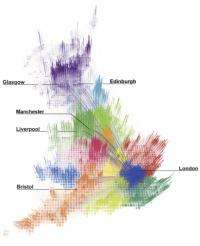
This diagram depicts the 80 percent of connections in the researchers’ study with the highest volume of information exchange. Although London has some strong connections to regions as far away as Scotland, the overwhelming majority of strong connections are between neighboring regions. Image: Senseable City Lab

The paper's approach belongs to an emerging field that has been recently termed "computational social sciences" — i.e., the ability to address social-science research questions using huge datasets that have emerged over the past decades as a result of digitalization. "We are particularly interested in how rich data at the individual level can promote a better understanding of our society, which, in the future, could lead to more democratic, bottom-up structures of governance," adds Calabrese.

"Very little in network theory has been done, believe it or not, on networks in geographical Euclidean space," says coauthor Professor Steven Strogatz, one of the pioneers of network science. "In reality, on top of the pure topology of who is connected to whom is the structure of actual distances. I think that the analysis of spatial networks, as in this paper, could be a really important area in the next few years."

More information: Ratti C, Sobolevsky S, Calabrese F, Andris C, Reades J, et al. (2010) Redrawing the Map of Great Britain from a Network of Human Interactions. PLoS ONE 5(12): e14248. doi:10.1371/journal.pone.0014248

Provided by Public Library of Science search and more info website

4.2 /5 (9 votes)  

Filter


Move the slider to adjust rank threshold, so that you can hide some of the comments.


Display comments: newest first

Glyndwr
Dec 08, 2010

Rank: not rated yet
Its no surprise the link between North Wales and Northwest England as a lot of welsh went to work in cities like Liverpool and Manchester from late 1700s to 1900s and also the more recently large influx of english speakers in rural Wales with Birmingham linked with mid wales. Links between the welsh ans the border counties like shropshire which has much welsh ancestry is a far more ancient link and should be expected....Would be interesting not to have the amorphous blob of south west and see differences between cornwall links and say dorset
masterofsea
Dec 09, 2010

Rank: 5 / 5 (2)
Scotland in fact is independent
resinoth
Dec 14, 2010

Rank: not rated yet
Would like to see same technique performed elsewhere.

*you'd* better get on this before the internet more fully dampens, or at least complicates, the data.
Magnette
Dec 14, 2010

Rank: not rated yet
Scotland in fact is independent


Really? From what?

Contrary to the way some Scots feel it is still an integral part of the UK.......according to the map they don't necessarily want to talk to us but then who's on good terms with all of their neighbours? :)
Rank 4.2 /5 (9 votes)
Relevant PhysicsForums posts

More news stories

Oldest Jewish archaeological evidence on the Iberian Peninsula

German archaeologists of the Friedrich Schiller University Jena found one of the oldest archaeological evidence so far of Jewish Culture on the Iberian Peninsula at an excavation site in the south of Portugal, ...

Other Sciences / Archaeology & Fossils

created 23 hours ago | popularity 4.3 / 5 (4) | comments 12

Math predicts size of clot-forming cells

UC Davis mathematicians have helped biologists figure out why platelets, the cells that form blood clots, are the size and shape that they are. Because platelets are important both for healing wounds and in strokes and other ...

Other Sciences / Mathematics

created 19 hours ago | popularity not rated yet | comments 0 | with audio podcast

Social welfare cuts ultimately come with heavy price, researchers say

(Phys.org) -- Slashing government funding for Medicaid, food stamps and other programs that serve the poor – while politically popular with some lawmakers and many conservatives – may do more harm ...

Other Sciences / Social Sciences

created May 24, 2012 | popularity 4.3 / 5 (11) | comments 80

Ancient Bethlehem seal unearthed in Jerusalem

Israeli archaeologists have discovered a 2,700-year-old seal that bears the inscription "Bethlehem," the Israel Antiquities Authority announced Wednesday, in what experts believe to be the oldest artifact ...

Other Sciences / Archaeology & Fossils

created May 23, 2012 | popularity 3.5 / 5 (13) | comments 22

Dollars and sense: Why are some people morally against tax?

As the U.S. presidential election campaigns heat up, the economic debate is dominated by bailouts, austerity and, inevitably, taxation. Now a new study published in Symbolic Interaction asks why tax is such an important issue ...

Other Sciences / Social Sciences

created May 23, 2012 | popularity 3 / 5 (2) | comments 12


Family history of Alzheimer's affects functional connectivity

(HealthDay) -- Cognitively normal individuals with a family history of late-onset Alzheimer's disease (AD) may display lower resting state functional connectivity in the default mode network (DMN) of the brain, ...

SpotterRF debuts Radar Backpack Kit (w/ Video)

(Phys.org) -- SpotterRF has announced a special radar backpack kit designed to enhance situational awareness for soldiers on the ground. The company says its special radar is designed for warfighters as part ...

Transvaginal mesh op restores pelvic organ prolapse at price

(HealthDay) -- Transvaginal mesh (TVM) procedures are effective for anatomical restoration of pelvic organ prolapse (POP), but patients report a worsening of sexual function following surgery, according to ...

Travel to high altitudes tied to Crohn's, colitis flare-ups

(HealthDay) -- People with inflammatory bowel disease, which includes Crohn's disease and colitis, may be at increased risk for flare-ups when they fly or travel to high altitudes for skiing or mountain climbing, ...

Thousands of shellfish found dead in Peru

Thousands of crustaceans were found dead off the coast of Lima following the mystery mass death of dolphins and pelicans, the Peruvian Navy said Friday.

Astronomers seize last chance in lifetime for Venus Transit

Astronomers are gearing for one the rarest events in the Solar System: an alignment of Earth, Venus and the Sun that will not be seen for another 105 years.