Magnetic fields on O-Class stars
December 20, 2010 By Jon Voisey

Magnetic fields on O-Class stars

Enlarge

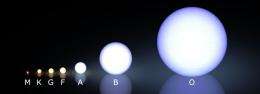
Star classifications. Credit: Kieff

The primary method by which astronomers can measure magnetic field strength on stars is the Zeeman effect. This effect is the splitting of spectral lines into two due to the magnetic field's effect on the quantum structure of the orbitals. For massive O-class stars, their spectra are largely featureless in the visual portion of the spectra due to an insufficient number of atoms with electrons in the necessary orbitals to undergo transitions which can produce visual spectral lines. Thus, determining whether or not these stars have magnetic fields has been a unique challenge.

A new paper from researchers at the University of Amsterdam, led by Roald Schnerr, looks for evidence of these fields in the form of synchrotron .

Synchrotron radiation is a form of light produced when relativistic, charged particles move through a . The light emitted can be generated in any portion of the from radio to , depending on the strength of the field. Astronomically, this was first detected in 1956 by Geoffrey Burbidge in the jets of M87 and has since been used to explain emission in planetary magnetospheres, , near , and around pulsars.

This form of energy distinguishes itself from other forms of light in two main fashions. The first is that it is highly polarized. This property is generated by the electric and magnetic components always being in the same planes and can be studied with filters that only allow light with its fields in appropriate planes to pass. The second is that the radiation created is “non-thermal”. In other words, it doesn’t match the distribution of wavelengths generated by a blackbody.

Models of massive, O-class stars suggest they should contain magnetic fields. Some evidence has seemed to confirm this. Previous studies have also shown that the stellar winds from some of these stars varies with timescales similar to the rotation rates of the stars which could be interpreted as winds being slowed on some faces by the magnetic field as it swept by.

Schnerr’s team attempted to bolster the evidence for magnetic fields by detecting the non-thermal radiation from these stars. The team selected 5 stars which have been shown to have strongly variable winds, some with cyclic variations and used the Westerbork Synthesis Radio Telescope, in the Netherlands to search for non-blackbody signals. The radio range was selected due to the predicted magnetic field strength.

Ultimately, only three of the five selected targets could be observed with the chosen telescope and only one of those, ξ Persei, showed evidence of a non-thermal spectrum. But while this strengthens the case for magnetic fields on the star, it raises another question: From where do the relativistic originate? Although O-class stars have strong stellar winds, their speeds are well studied and well below the necessary velocity.

One clue could come from the fact that ξ Persei is a "runaway star". These stars have velocities and plunge through the interstellar medium at 30-200 km/sec. The team suggests that a bow shock created by this motion could result in sufficiently high velocities. Whether or not ξ Per has such a bow shock is something that could be determined with additional observations.

While this research provides some interesting clues to the nature of these magnetic fields on these stars, it still relies on a small sample. This technique can certainly be expanded to a larger number of in the future and may help astronomers better constrain their models of stellar workings.

Source: Universe Today


Rank 5 /5 (2 votes)
Relevant PhysicsForums posts
  • revamping general concept and cosmological principle
    created18 hours ago
  • Transiting Exoplanet Light Curve
    createdMay 25, 2012
  • Math behind Theoretical Physics
    createdMay 24, 2012
  • Do we know whats at the center of galaxies yet?
    createdMay 23, 2012
  • Structure of the Milky Way?
    createdMay 20, 2012
  • What would it take to terraform Pluto and Charon?
    createdMay 19, 2012
  • More from Physics Forums - General Astronomy

More news stories

Dragon arrives at space station in historic 1st (Update 2)

The privately bankrolled Dragon capsule made a historic arrival at the International Space Station on Friday, triumphantly captured by astronauts wielding a giant robot arm.

Space & Earth / Space Exploration

created 21 hours ago | popularity 5 / 5 (8) | comments 13

Dragon makes history with space station docking

The private company SpaceX made history Friday with the docking of its Dragon capsule to the International Space Station, the most impressive feat yet in turning routine spaceflight over to the commercial ...

Space & Earth / Space Exploration

created 14 hours ago | popularity 4.8 / 5 (6) | comments 0

Aliens don't want to eat us, says former SETI director

Alien life probably isn’t interested in having us for dinner, enslaving us or laying eggs in our bellies, according to a recent statement by former SETI director Jill Tarter.

Space & Earth / Space Exploration

created 22 hours ago | popularity 4.8 / 5 (10) | comments 26

SKA super telescope to be built in Australia, South Africa (Update 2)

A long-running joust to host a radio telescope that would give mankind its farthest peek into the Universe ended on Friday with a Solomon-like judgement to split the site between Australia and South Africa.

Space & Earth / Astronomy

created 22 hours ago | popularity 5 / 5 (5) | comments 2

NASA sees Hurricane Bud threaten western Mexico's coast

NASA satellites are providing rainfall, temperature, pressure, visible and infrared data to forecasters as Hurricane Bud is expected to make a quick landfall in western Mexico this weekend before turning back ...

Space & Earth / Earth Sciences

created 16 hours ago | popularity not rated yet | comments 0


Of mice and mental models: Neuroscientific implications of risk-optimized behavior in the mouse

(Medical Xpress) -- Regardless of an organism’s biological complexity, every encephalized animal continuously makes under-informed behavioral choices that can have serious consequences. Despite its ubiquity, ...

Landmark calculation clears the way to answering how matter is formed

(Phys.org) -- An international collaboration of scientists, including Thomas Blum, associate professor of physics, is reporting in landmark detail the decay process of a subatomic particle called a kaon – ...

High-speed method to aid search for solar energy storage catalysts

Eons ago, nature solved the problem of converting solar energy to fuels by inventing the process of photosynthesis.

It's in the genes: Research pinpoints how plants know when to flower

Scientists believe they've pinpointed the last crucial piece of the 80-year-old puzzle of how plants "know" when to flower.

Researchers solve structure of human protein critical for silencing genes

In a study published in the journal Cell on May 24, Cold Spring Harbor Laboratory (CSHL) scientists describe the three-dimensional atomic structure of a human protein bound to a piece of RNA that "guides" the pr ...

MIT researchers devise new means to synchronize a group of robots (w/ Video)

(Phys.org) -- For several years, roboticists have been working out ways to get a group of robots to perform synchronized activities as demonstrated most often in dance routines. It’s not just about trying ...