Giant ice volcano candidate found on Saturn moon Titan (w/ Video)
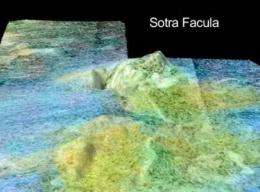
Astronomers have announced the discovery of a potential new ice volcano on Saturn's moon Titan.
Named Sotra, the volcano is more than 3,000 feet tall and has a one mile deep pit alongside it. Surrounded by giant sand dunes, it is thought to be the largest in a string of several volcanoes that once spewed molten ice from deep beneath the moon's surface.
“We think we have found the strongest case yet for an ice volcano on Titan,” said Randy Kirk, a geophysicist with the U.S. Geological Survey in Flagstaff, Ariz. “What we see is not just a flow like we see in other places, it's like a volcanic field would be on Earth.”
Titan is about the size of the planet Mercury but has an atmosphere thicker than Earth's. This makes it incredibly difficult for astronomers to know what's happening on the surface. Planetary scientists, including Kirk, are using NASA's Cassini spacecraft to map the moon, but so far only about half of Titan has been imaged.
Kirk and his team created a three dimensional mapping technique that patches together multiple images of the same area, so they were lucky that Sotra was in one of the rare places imaged twice.
“The classical volcano everybody thinks of when you say the word is a mountain with a crater on it and lava flows coming out of it,” said Kirk. “That's what we've found on Titan.”
The team can't be certain if the chain is active, but described the find as the best evidence found so far for a cryovolcano -- the scientific term for an ice volcano. Previously, bright spots seen in low-resolution satellite images have been interpreted as volcanic flows and craters. However, once those areas were mapped in 3-D, it became obvious they weren't volcanoes.
“We had noted Sotra Facula as a candidate cryovolcano before,” said Rosaly Lopes, a senior research scientist from NASA's Jet Propulsion Laboratory in Pasadena, Calif. “But it was only when Randy (Kirk) got the topography done that we realized, wow, this is it.”
Earth's interior is divided into distinct layers of rock and liquid magma. When this molten rock erupts through the planet's crust, it's known as volcanism. Titan's volcanism is more complicated because beneath the moon's surface lies a layer of ice. Even a small amount of internal heat could create molten ices. Because the liquid would be less dense, it would force its way to the surface. The result would be a massive eruption of slushy liquid and gases similar to what scientists have seen on other icy moons.
“Ice at outer solar system temperatures is very rigid,” Kirk said. “Ice at close to its melting point is soft. What would be a glacier on Earth would be a volcano on a body that's made of that same material. It's the difference between the cake and the frosting.”
Some have theorized that volcanoes on Titan are the best way to explain the strange abundance of methane gas in its atmosphere. This gas is constantly being stripped from Titan's upper atmosphere by the sun, shining a billion miles away. Without a source to replenish it, all of the methane would disappear in a few million years.
However, if an ice volcano like Sotra were to erupt, it would release volatiles like methane and ethane from inside Titan. Kirk's team calculates that it would take a Sotra-sized volcanic eruption every 1,000 years to maintain the current level of methane in Titan's atmosphere.
Others are skeptical about ice volcano claims and have proposed alternative theories to explain the methane abundance.
“There's been this whole list of volcanoes (on Titan) that have been published and then subsequently shot down,” said planetary scientist Jeffrey Moore, with the NASA Ames Research Center in Moffett Field, Calif. “This new feature doesn't make me change my tune that no one has unambiguously found a volcano on Titan.”
Moore believes that unlike Earth's well defined and separate layers, beneath Titan's surface is a huge layer of mixed rock and ice, or what's called a partially differentiated interior. If this is the case it would be much more difficult to heat ice enough to cause an eruption onto the surface.
Moore and others believe that Titan was once an enormous ice cube. According to their theory, as the sun aged and warmed, it heated Titan's surface. This process could have put methane into the atmosphere and subsequently fueled a rain-cycle that erased all impact craters. Moore said this would also have given Titan the young appearance that many have attributed to volcanism.
“If you press forward in time, all the methane will be erased and (Titan) will have a blue sky and a nitrogen atmosphere with sand dunes of hydrocarbons,” Moore said.
Provided by Inside Science News Service


