Cassini returns images of bright jets at Enceladus
Dec 02, 2010 By Jia-Rui Cook
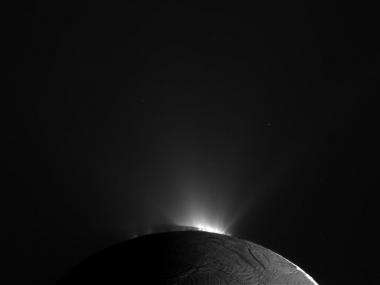
NASA's Cassini spacecraft obtained this raw image of the south polar region of Saturn's moon Enceladus on Nov. 30, 2010. The spacecraft was about 89,000 kilometers (55,000 miles) away from the moon's surface. Image Credit: NASA/JPL/SSI

(PhysOrg.com) -- NASA's Cassini spacecraft successfully dipped near the surface of Saturn's moon Enceladus on Nov. 30.

NASA's successfully dipped near the surface of Saturn's on Nov. 30. Though Cassini's closest approach took it to within about 48 kilometers (30 miles) of the moon's northern hemisphere, the spacecraft also captured shadowy images of the tortured south polar terrain and the brilliant jets that spray out from it.

Many of the raw images feature darkened terrain because winter has descended upon the southern hemisphere of Enceladus. But sunlight behind the moon backlights the jets of water vapor and icy particles. In some images, the jets line up in rows, forming curtains of spray.
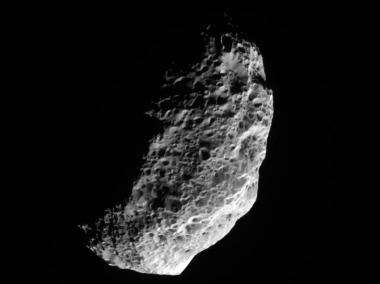
NASA's Cassini spacecraft obtained this raw image of the Saturnian moon Hyperion on Nov. 28, 2010. The spacecraft was about 73,000 kilometers (45,000 miles) away from the moon's surface. Image Credit: NASA/JPL/SSI

The Enceladus was the 12th of Cassini's mission, with the spacecraft swooping down around 61 degrees north latitude. This encounter and its twin three weeks later at the same altitude and latitude, are the closest Cassini will come to the northern hemisphere surface of Enceladus during the extended Solstice mission. (Cassini's closest-ever approach to Enceladus occurred in October 2008, when the spacecraft dipped to an altitude of 25 kilometers, or 16 miles.)

Among the observations Cassini made during this Enceladus flyby, the radio science subsystem collected gravity measurements to understand the moon's interior structure, and the fields and particles instruments sampled the charged particle environment around the moon.

About two days before the Enceladus flyby, Cassini also passed the sponge-like moon Hyperion, beaming back intriguing images of the craters on its surface. The flyby, at 72,000 kilometers (45,000 miles) in altitude, was one of the closest approaches to Hyperion that Cassini has made.

Scientists are still working to analyze the data and images collected during the flybys.

Explore further: Dark, massive asteroid to fly by Earth on May 31

More information: The new raw images can be seen at saturn.jpl.nasa.gov/photos/raw/ .

Related Stories

Cassini back to normal, ready for Enceladus

Nov 25, 2010

(PhysOrg.com) -- NASA's Cassini spacecraft resumed normal operations today, Nov. 24. All science instruments have been turned back on, the spacecraft is properly configured and Cassini is in good health. Mission ...

Cassini Returning Enceladus Gravity Data

May 03, 2010

(PhysOrg.com) -- NASA's Cassini spacecraft successfully completed its 26-hour gravity observation at Saturn's moon Enceladus this week, sending back data scientists will use to understand the moon's interior ...

Cassini Sends Back Images of Enceladus as Winter Nears

Nov 23, 2009

(PhysOrg.com) -- NASA's Cassini spacecraft has sailed seamlessly through the Nov. 21 flyby of Saturn's moon Enceladus and started transmitting uncalibrated temperature data and images of the rippling terrain. ...

Recommended for you

Dark, massive asteroid to fly by Earth on May 31

20 hours ago

It's 1.7 miles long. Its surface is covered in a sticky black substance similar to the gunk at the bottom of a barbecue. If it impacted Earth it would probably result in global extinction. Good thing it is ...

Research team explains 'Lazarus' comets

23 hours ago

Astronomers from the University of Antioquia have discovered a graveyard of comets. These once-dormant comets, dubbed by astronomers as "The Lazarus comets," are now rejuvenated.

NASA ships sensors for seafaring satellite to France

May 24, 2013

(Phys.org) —Three NASA-built instruments that are integral components of the next in a series of U.S./European ocean altimetry satellites have arrived in France for integration with their spacecraft in ...

Trip into space with DiCaprio costs $1.55m

May 24, 2013

Leonardo DiCaprio is going to get closer to stars of a different kind as he heads into space aboard the Virgin Galactic, and a well-heeled bidder at the Cannes Film Festival has paid 1.2 million euros (1.5 million) to be ...

User comments : 0

More news stories

Galaxies fed by funnels of fuel

(Phys.org) —Computer simulations of galaxies growing over billions of years have revealed a likely scenario for how they feed: a cosmic version of swirly straws.

Source of life running out: water scientists

The majority of people on Earth people will face severe water shortages within a generation or two if pollution and waste continues unabated, scientists warned at a conference in Bonn Friday.

Dark, massive asteroid to fly by Earth on May 31

It's 1.7 miles long. Its surface is covered in a sticky black substance similar to the gunk at the bottom of a barbecue. If it impacted Earth it would probably result in global extinction. Good thing it is ...

Yahoo, pay-TV operators among Hulu bidders

Online video site Hulu is again up for sale, with Yahoo and pay TV operators DirecTV and Time Warner Cable among the seven bidders, according to a person with direct knowledge of the matter.

Radiation leak at Japan lab; small impact expected

An atomic research lab in northern Japan has reported a radiation leak that may have affected about 50 people, though none were hospitalized and no impact was expected outside the facility, the lab's operator ...