Cassini finds warm cracks on Enceladus
Dec 01, 2010 By Jia-Rui C. Cook
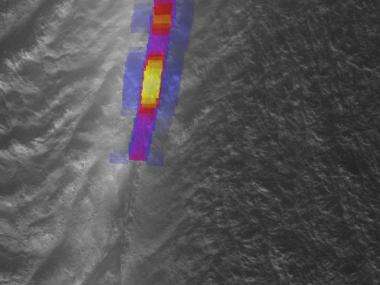
Data from NASA's Cassini spacecraft have enabled scientists to make the highest-resolution heat intensity maps yet for the hottest part of a "tiger stripe" fissure on Saturn's moon Enceladus. Image credit: NASA/JPL/GSFC/SWRI/SSI

New images and data from NASA's Cassini spacecraft give scientists a unique Saturn-lit view of active fissures through the south polar region of Saturn's moon Enceladus. They reveal a more complicated web of warm fractures than previously thought.

Scientists working jointly with Cassini's and its high-resolution imaging camera have constructed the highest-resolution heat intensity maps yet of the hottest part of a region of long fissures spraying and icy particles from Enceladus. These fissures have been nicknamed "tiger stripes." Additional high-resolution spectrometer maps of one end of the tiger stripes Alexandria Sulcus and Cairo Sulcus reveal never-before-seen warm fractures that branch off like split ends from the main tiger stripe trenches. They also show an intriguing warm spot isolated from other active surface fissures.
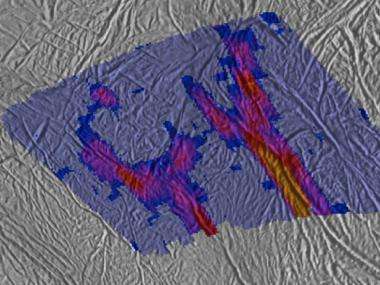
This image shows a high-resolution heat intensity map of part of the south polar region of Saturn's moon Enceladus, made from data obtained by NASA's Cassini spacecraft. Image credit: NASA/JPL/GSFC/SWRI/SSI

"The ends of the tiger stripes may be the places where the activity is just getting started, or is winding down, so the complex patterns of heat we see there may give us clues to the life cycle of tiger stripes," said John Spencer, a Cassini team scientist based at Southwest Research Institute in Boulder, Colo.

The images and maps come from the Aug. 13, 2010, Enceladus flyby, Cassini's last remote sensing flyby of the moon until 2015. The geometry of the many flybys between now and 2015 will not allow Cassini to do thermal scans like these, because the spacecraft will be too close to scan the surface and will not view the south pole. This Enceladus flyby, the 11th of Cassini's tour, also gave Cassini its last look at any part of the active south polar region in sunlight.
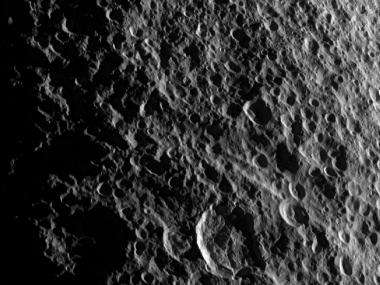
Geologic faults among craters on Saturn's moon Tethys are depicted in this image captured during a flyby of the moon by NASA's Cassini spacecraft on Aug. 14, 2010. Image credit: NASA/JPL/SSI

The highest-resolution spectrometer scan examined the hottest part of the entire tiger stripe system, part of the fracture called Damascus Sulcus. Scientists used the scan to measure fracture temperatures up to190 Kelvin (minus 120 degrees Fahrenheit). This temperature appears slightly higher than previously measured temperatures at Damascus, which were around 170 Kelvin (minus 150 degrees Fahrenheit).

Spencer said he isn't sure if this tiger stripe is just more active than it was the last time Cassini's spectrometer scanned it, in 2008, or if the hottest part of the tiger stripe is so narrow that previous scans averaged its temperature out over a larger area. In any case, the new scan had such good resolution, showing details as small as 800 meters (2,600 feet), that scientists could see for the first time warm material flanking the central trench of Damascus, cooling off quickly away from the trench. The Damascus thermal scan also shows large variations in heat output within a few kilometers along the length of the fracture. This unprecedented resolution will help scientists understand how the tiger stripes deliver heat to the surface of Enceladus.

Small water ice particles fly from fissures in the south polar region of Saturn's moon Enceladus in this image taken during the Aug. 13, 2010, flyby of the moon by NASA's Cassini spacecraft. Image credit: NASA/JPL/SSI

Cassini acquired the thermal map of Damascus simultaneously with a visible-light image where the tiger stripe is lit by sunlight reflecting off Saturn. The visible-light and thermal data were merged to help scientists understand the relationships between physical heat processes and surface geology.

"Our high-resolution images show that this section of Damascus Sulcus is among the most structurally complex and tectonically dynamic of the tiger stripes," said imaging science team associate Paul Helfenstein of Cornell University, Ithaca, N.Y. Some details in the appearance of the landforms, such as a peculiar pattern of curving striations along the flanks of Damascus, had not previously been noticed in ordinary sunlit images.

The day after the flyby, Cassini swooped by the icy moon Tethys, collecting images that helped fill in gaps in the Tethys global map. Cassini's new views of the heavily cratered moon will help scientists understand how tectonic forces, impact cratering, and perhaps even ancient resurfacing events have shaped the moon's appearance.

Explore further: Dark, massive asteroid to fly by Earth on May 31

More information: The new images are available at: www.nasa.gov/cassini

Related Stories

Cassini Finds Plethora of Plumes, Hotspots at Enceladus

Feb 23, 2010

(PhysOrg.com) -- Newly released images from last November's swoop over Saturn's icy moon Enceladus by NASA's Cassini spacecraft reveal a forest of new jets spraying from prominent fractures crossing the south ...

Cassini Sends Back Images of Enceladus as Winter Nears

Nov 23, 2009

(PhysOrg.com) -- NASA's Cassini spacecraft has sailed seamlessly through the Nov. 21 flyby of Saturn's moon Enceladus and started transmitting uncalibrated temperature data and images of the rippling terrain. ...

Cassini Returning Enceladus Gravity Data

May 03, 2010

(PhysOrg.com) -- NASA's Cassini spacecraft successfully completed its 26-hour gravity observation at Saturn's moon Enceladus this week, sending back data scientists will use to understand the moon's interior ...

Cassini Measures Tug of Enceladus

Apr 26, 2010

(PhysOrg.com) -- NASA's Cassini spacecraft will be gliding low over Saturn's moon Enceladus for a gravity experiment designed to probe the moon's interior composition.

Recommended for you

Dark, massive asteroid to fly by Earth on May 31

10 hours ago

It's 1.7 miles long. Its surface is covered in a sticky black substance similar to the gunk at the bottom of a barbecue. If it impacted Earth it would probably result in global extinction. Good thing it is ...

Research team explains 'Lazarus' comets

13 hours ago

Astronomers from the University of Antioquia have discovered a graveyard of comets. These once-dormant comets, dubbed by astronomers as "The Lazarus comets," are now rejuvenated.

NASA ships sensors for seafaring satellite to France

14 hours ago

(Phys.org) —Three NASA-built instruments that are integral components of the next in a series of U.S./European ocean altimetry satellites have arrived in France for integration with their spacecraft in ...

Trip into space with DiCaprio costs $1.55m

14 hours ago

Leonardo DiCaprio is going to get closer to stars of a different kind as he heads into space aboard the Virgin Galactic, and a well-heeled bidder at the Cannes Film Festival has paid 1.2 million euros (1.5 million) to be ...

User comments : 2

Adjust slider to filter visible comments by rank

Display comments: newest first

Modernmystic
3.7 / 5 (3) Dec 01, 2010
It's the monolith.
zevkirsh
1 / 5 (1) Dec 02, 2010
i'd like to see video from the surface of titan. enceldeas an io would be boring.

More news stories

Galaxies fed by funnels of fuel

(Phys.org) —Computer simulations of galaxies growing over billions of years have revealed a likely scenario for how they feed: a cosmic version of swirly straws.

Dark, massive asteroid to fly by Earth on May 31

It's 1.7 miles long. Its surface is covered in a sticky black substance similar to the gunk at the bottom of a barbecue. If it impacted Earth it would probably result in global extinction. Good thing it is ...

Source of life running out: water scientists

The majority of people on Earth people will face severe water shortages within a generation or two if pollution and waste continues unabated, scientists warned at a conference in Bonn Friday.

Google eyes emerging markets networks

Google has become deeply involved in a series of projects to build and operate wireless networks in emerging markets including sub-Saharan Africa and Southeast Asia, a report said Friday.