Breakthrough towards lab-on-chip system for fast detection of single nucleotide variations in DNA
December 10, 2010

Breakthrough towards lab-on-chip system for fast detection of single nucleotide variations in DNA

Enlarge

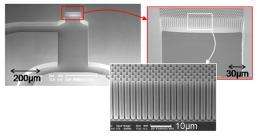
Micropillar array

Panasonic and Imec today present at the International Electron Devices Meeting in San Francisco various critical components of a biomedical lab-on-chip sensor enabling fast detection of Single Nucleotide Polymorphisms (SNPs) in DNA, such as a miniaturized pump for on-chip generation of high pressures, a micropillar filter optimized for DNA separation achieving world-record resolution, and a SNP detector allowing on-chip detection using very small sample volumes.

A SNP is a single nucleotide replacement in a DNA sequence which can result in different reaction by people to and medicines. Detection of these SNP’s is therefore becoming increasingly important with the move towards more personalized healthcare.

Existing methods to detect SNP’s require many sample processing steps in dedicated medical tools at medical laboratories. Such tests are labor intensive, time-consuming and expensive. Moreover, rather large blood samples are needed. A lab-on-chip device can bring huge advantages both to the patient and the healthcare system. Such devices enable fast, easy-to-use, cost-effective test methods which can be performed at regular times in a doctor’s office or even near the patient’s bed. This is very interesting for point-of-care applications such as personalized medicine.

By combining advanced micro-electronic fabrication processes with heterogeneous integration, imec and Panasonic aim to realize a state-of-the-art microfluidic device for SNP detection. In order to do this, advanced microfluidic components have been fabricated and optimized, such as a miniaturized pump for on-chip generation of high pressure, a micropillar filter optimized for DNA separation achieving world-record resolution, and a SNP detector allowing on-chip detection using very small sample volumes.

The entrance unit of the SNP detection system samples very small volumes of blood. This entrance unit features a miniaturized high-pressure pump based on an advanced conductive polymer actuator. After optimization, the actuator generates high pressures (up to 3MPa) at low voltage (~1.5V). The high pressure is essential to generate a fluid flow through the next unit of the SNP detection system. The on-chip low voltage operation is important because it opens the path to autonomy and portability of the lab-on-chip device.

Next, the DNA separation unit featuring an advanced micro-pillar array filter was developed. This deep-UV patterned silicon pillar array was realized using advanced MEMS technology. It consists of many micron-scale pillars, being typically 20µm high and with 1-2µm inter-pillar distance. The pillar array is used for DNA separation based on ion-pair reversed-phase (IR-RP) liquid chromatography. Imec and the VUB (Vrije Universiteit Brussel), a scientific partner of imec, optimized the pillar-based IR-RP liquid chromatography technique for DNA separation. This resulted in the first miniaturized on-chip system that enables fast and highly selective separation of short, double stranded DNA strands which only differ 50 base pairs in length. The resolution of the system is the highest in the world and proves the potential to handle 5 SNPs at the same time in the final SNP detection system.

The other functional units of the SNP detector are a unit for DNA extraction and polymerase chain reaction (PCR) using heaters and temperature sensors, and a SNP detection unit based on electrochemical sensors. The miniaturization of these sensors was of crucial importance, since the minimum required sensor volume determines the blood sampling volume needed for the SNP detection, and hence the dimensions of all components of the device. Scientists of Panasonic and imec demonstrated SNP detection capabilities using on-chip sensors handling a volume as small as 0.5µL.

Provided by IMEC


Rank 5 /5 (1 vote)
Relevant PhysicsForums posts
  • High school chemistry EEI
    created6 hours ago
  • oxidation of I- by KMnO4
    created19 hours ago
  • Invesion temp
    created22 hours ago
  • Hybridization of SnCl3 -
    created22 hours ago
  • Electrons And Radiation
    createdMay 25, 2012
  • Acid Base Theories
    createdMay 24, 2012
  • More from Physics Forums - Chemistry

More news stories

High-speed method to aid search for solar energy storage catalysts

Eons ago, nature solved the problem of converting solar energy to fuels by inventing the process of photosynthesis.

Chemistry / Materials Science

created 12 hours ago | popularity 5 / 5 (2) | comments 1 | with audio podcast

Researchers demonstrate possible primitive mechanism of chemical info self-replication

(Phys.org) -- When scientists think about the replication of information in chemistry, they usually have in mind something akin to what happens in living organisms when DNA gets copied: a double-stranded molecule ...

Chemistry / Materials Science

created 20 hours ago | popularity 5 / 5 (4) | comments 2 | with audio podcast

Building a better solar panel -- one molecule at a time

(Phys.org) -- One of the fundamental building blocks in modern chemistry, an organometallic chemical compound called ferrocene, has never been structurally defined - until now.

Chemistry / Materials Science

created 20 hours ago | popularity 5 / 5 (3) | comments 0 | with audio podcast

From lemons to lemonade: Reaction uses carbon dioxide to make carbon-based semiconductor

(Phys.org) -- A materials scientist at Michigan Technological University has discovered a chemical reaction that not only eats up the greenhouse gas carbon dioxide, it also creates something useful. And, by ...

Chemistry / Materials Science

created May 21, 2012 | popularity 4.7 / 5 (88) | comments 28 | with audio podcast

New CO2-removing catalyst can take the heat

(Phys.org) -- The current method of removing the greenhouse gas carbon dioxide (CO2) from the flues of coal-fired power plants uses so much energy that no one bothers to use it. So says Roger Aines, principal ...

Chemistry / Materials Science

created May 24, 2012 | popularity 5 / 5 (7) | comments 7 | with audio podcast


Of mice and mental models: Neuroscientific implications of risk-optimized behavior in the mouse

(Medical Xpress) -- Regardless of an organism’s biological complexity, every encephalized animal continuously makes under-informed behavioral choices that can have serious consequences. Despite its ubiquity, ...

Dragon arrives at space station in historic 1st (Update 2)

The privately bankrolled Dragon capsule made a historic arrival at the International Space Station on Friday, triumphantly captured by astronauts wielding a giant robot arm.

Landmark calculation clears the way to answering how matter is formed

(Phys.org) -- An international collaboration of scientists, including Thomas Blum, associate professor of physics, is reporting in landmark detail the decay process of a subatomic particle called a kaon – ...

It's in the genes: Research pinpoints how plants know when to flower

Scientists believe they've pinpointed the last crucial piece of the 80-year-old puzzle of how plants "know" when to flower.

Researchers solve structure of human protein critical for silencing genes

In a study published in the journal Cell on May 24, Cold Spring Harbor Laboratory (CSHL) scientists describe the three-dimensional atomic structure of a human protein bound to a piece of RNA that "guides" the pr ...

MIT researchers devise new means to synchronize a group of robots (w/ Video)

(Phys.org) -- For several years, roboticists have been working out ways to get a group of robots to perform synchronized activities as demonstrated most often in dance routines. It’s not just about trying ...