Biologist illuminates unique world of cave creatures
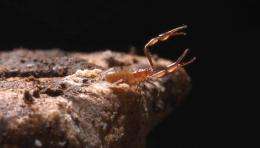
They are dark, sometimes forbidding landscapes molded by volcanic eruptions or subterranean streams, but caves are also home to a host of creatures strangely adapted to the underworld.
Many of these organisms are pale, furtive and multi-legged. Some lack eyes or other light-sensing organs altogether. Others, like bats and cave crickets, roost in caves by day and forage in the outer world at night.
Steven Taylor, a macro-invertebrate biologist with the Illinois Natural History Survey at the University of Illinois, has spent more than two decades plumbing the mysteries of cave life. With the help of a handful of other specialists in cave biology, he is documenting invertebrate life in the limestone caves of Arkansas, Missouri, Texas and southern Illinois; in Lava Beds National Monument in California; and in mountainside caves in Great Basin National Park in Nevada.
The work has its glories and its indignities. Taylor has searched among the stalagtites of a tour cave in Great Basin; rappelled through thick mats of spiders – "daddy longlegs" – clogging a cave entrance in central Texas; explored lava tubes in the Galapagos Islands; and collected millipedes, spiders, pseudoscorpions and other creatures making their living – directly or indirectly – from fungi or bacteria growing on bat or cricket guano on cave floors.
"I've even had a cave maggot named after me," he said. (Megacilia taylori is a phorid fly that often frequents caves; its larval form is the maggot.)
The work requires much preparation, a talent for squeezing through tight places and a willingness to go into the blackness armed with no less than three flashlights.
"In a cave, there's no light and literally once you get away from the entrance twilight zone you can wave your hand in front of your face and it's like somebody severed your optic nerves," Taylor said. "There's nothing."
Because there is no sunlight, "cave systems are low energy environments," he said. "The primary energy source is debris that's fallen or washed into a cave or is brought in by organisms or things that wander in or can't find their way out and die."
Leaf litter and guano are at the base of the cave food chain, he said.
"Fungi and bacteria grow on that, then millipedes and springtails (tiny, mite-sized bugs) graze on that," he said. "And then there are the larger organisms, spiders and pseudoscorpions, that feed on the springtails."
There are also aquatic amphipods: pale, multi-appendaged (and often blind) crustaceans that swim and feed on debris in the water and are themselves consumed by (sometimes eyeless) aquatic salamanders.
Taylor and his colleagues are limited by the size of the underground passages they can squeeze through. But the animals they study penetrate much deeper into their subterranean worlds. Tiny fissures, the result of geologic events or the flow of groundwater, extend far into the rock around a cave, Taylor said.
"The cave is just a window into this underground environment and we're just looking at a corner of the population," he said.
And while some cave animals do go back and forth between the subterranean and surface worlds, many species would not survive more than a few minutes on the surface. This is true particularly in the west, where hot, arid conditions would quickly dehydrate them.
Caves are like islands, Taylor said: The animals that live in them are completely cut off from other populations of related organisms. Like other island creatures, cave animals have adapted in unique ways to their isolated habitats. This makes them rarities, and as a result some are listed as threatened or endangered species.
Taylor's research is revealing how dependent cave creatures are on the health of the surface environment. In 2003, for example, he and his associates used radio-tracking devices to follow the movements of cave crickets on their night-crawling adventures on a military base in central Texas. Cave crickets are a keystone species for the life of a cave. They forage above ground and bring all that collected surface energy (in the form of guano, eggs or dead crickets) back with them, feeding many other cave dwellers.
The researchers found that the crickets foraged in a wide territory around the cave, with some individuals ranging over 100 meters from the cave entrance.
In a survey of nine Texas caves, Taylor found that those surrounded by development – parking lots, apartment buildings or other hard surfaces – had very little life inside. Only a handful of cave crickets and other creatures hung on in these caves, while in similar caves with a lot of undisturbed land around them, he found large, healthy communities of cave crickets and other organisms.
In future studies, Taylor and his colleagues hope to explore the microbial life of caves, to see how the whole cave ecosystem contributes to the health of its individual constituents. Such studies may begin to explain the spread of a fungal disease, white nose syndrome, that is killing bats in eastern North America.
Caves are receptacles for anything that washes – or falls – into them, Taylor said, so they are susceptible to pollution, drought, disease or other changes that occur first on the surface.
"In a sense, a cave is kind of a microcosm of all the problems we have in the whole globe," he said. "You have this little, finite hole and all these things living in it. Whatever we do affects them."
More information: Click here to see an audio slide show related to this research
Provided by University of Illinois at Urbana-Champaign


