Study classifies and uses artificial proteins to analyze protein-protein interfaces
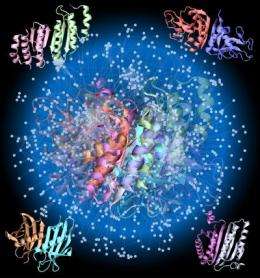
Interactions between proteins are at the heart of cellular processes, and those interactions depend on the interfaces where the direct physical contact occurs. A new study published this week suggests that there may be roughly a thousand structurally-distinct protein-protein interfaces – and that their structures depend largely on the simple physics of the proteins.
Believed to be the first systematic study of the nature of the protein-protein interfaces, the research could help explain the phenomena of "promiscuous" proteins that bind to many other proteins. The results could also have implications for the development of drug compounds designed to affect these protein-protein interactions.
"Proteins and the rules of protein-protein interactions are the result of very simple physical principles," said Jeffrey Skolnick, director of the Center for the Study of Systems Biology at the Georgia Institute of Technology. "In this study, we set out to characterize the nature of the interfaces – the structures of the interfaces – in all known protein structures. We wanted to ask how much of the interface could be explained purely by the structural features of the proteins without involving evolution or intelligent design."
A paper on the research was published Dec. 13 in the early edition of the journal Proceedings of the National Academy of Sciences. The work was sponsored by the National Institutes of Health (NIH).
Skolnick and collaborator Mu Gao studied the structural similarity of protein-protein interfaces involving interactions between dimers, developing an efficient computational method called iAlign to classify the interfaces known to exist among native proteins. They found that even without structural similarity between the individual monomers that form dimeric complexes, roughly 90 percent of the interfaces had a close structural neighbor.
"We found that in the library of protein-protein structures that nature has available, there are about a thousand structurally-distinct interfaces," said Skolnick, who is a Georgia Research Alliance Eminent Scholar in computational systems biology. "You can have very different types of protein structures adopting the same interface, but it was still surprising to see such a small number."
To obtain the kind of bonding measured experimentally requires that interfaces have sufficient surface area, so Skolnick believes most interfaces are roughly planar, much like two Nerf balls pressed together. "If you take this spherical interface and blunt it, that creates a much larger surface interface, so most of the interfaces that we saw are actually planar," he said. "You need to have enough sticky surface area."
To separate the role of the proteins' basic physical structure from the effects of the amino acids that they gain through an evolutionary process, the researchers studied a set of synthetic homopolypeptide proteins created totally in the computer to mimic natural proteins. After conducting docking tests on these "toy proteins" decorated with random amino acids, Skolnick and Gao observed 90 percent of the interfaces that they had previously characterized in the natural proteins.
"This suggests that the interfaces we see are features of the protein structure and the protein physics," Skolnick said. "Proteins seem to be primed by their physical characteristics to enable these higher-order molecular interactions to occur with a significant probability. The capacity is a feature of the structure."
That means the interfaces are independent of the kind of secondary structure that each protein has and uncoupled from the global fold that each protein adopts. "If the interaction between the proteins doesn't depend on the internal geometry of the structure or the secondary type of folding, that allows the possibility of having one protein interface with many interactions," Skolnick said.
The planar nature of the interfaces and their similarity could help explain the promiscuity observed among a number of proteins. If the surfaces were highly specific, it wouldn't be possible for these proteins to interact with so many different proteins.
"If you have a background capacity to interact, then you could imagine that this is the origin of a lot of promiscuous interactions that you see in cells," he said. "The surfaces are essentially complementary, and by accident you happen to have an appropriate constellation of amino acids. The more stable interactions clearly need to have undergone some kind of selection procedure to stabilize them enough to stick."
Skolnick believes that the basic physics of the proteins therefore forms a foundation on which evolution – everything the protein encounters – can act. "We are examining the basic rules of the road that evolution takes advantage of over time," he said.
Understanding these rules helps clarify the complex operation of cellular structures – and potentially give drug designers a new pathway to exploit.
"Promiscuity of interactions appears to be a feature of biological systems, and this bears on drug discovery," Skolnick said. "There are now very few drugs that inhibit protein-protein interactions because of the surface areas that are involved. Knowing the nature of these interfaces and the rules governing them might allow us to figure out how to design an inhibitor better."
Knowledge that protein interfaces are primed for promiscuity helps explains the observations in biology, but open up some new questions. For one, how do cells maintain order if each protein can interact with many other proteins?
"It may be like being at a crowded New Year's Eve party in which everybody is wearing weak flypaper," Skolnick suggested. "How do you reach the person you want to meet when you are sticking to people you don't want to interact with? How do you assemble anything useful when all the parts stick together?"
Provided by Georgia Institute of Technology


