Albino kookaburras found in northern Australia
December 6, 2010

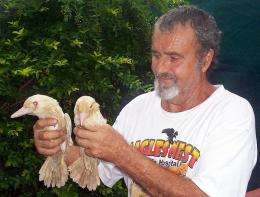
Wildlife expert Harry Kunz holding two rare blue-winged albino kookaburras

Enlarge

An undated handout photo released by the Eagles Nest Wildlife Hospital shows wildlife expert Harry Kunz holding two extremely rare blue-winged albino kookaburras in Ravenshoe, believed to have been swept from their nests in a wild storm, at the wildlife sanctuary.

Australian wildlife workers on Monday said they had discovered a never-before-seen pair of blue-winged albino kookaburras, believed to have been swept from their nests in a wild storm.

The six-week-old birds, renowned for their laughing cry, were found waterlogged at the base of a tree by a cattle farmer near Ravenshoe, in far northern Queensland, said Harry Kunz from the Eagles Nest Wildlife Sanctuary.

The pink-eyed, pink-beaked and starkly white creatures, thought to be sisters, are the first specimens of their kind ever found in Australia, Kunz said. They are still too young to feed themselves or fly.

"Everybody asks me 'are they rare?' They have never been seen because in nature they would not survive a few days out of the nest because their white colour sticks out and every reptile, owl or predator will get them," Kunz told AFP.

"In the whole of Australia I know there is about three white laughing kookaburras but they are not , they have black eyes. For blue wings nobody knows that they exist or can be hatching in this colour."

Wild storms which had recently rocked the area were believed to have swept the unusual chicks from their nests, he added.

Feeding on a diet of small mice, cicadas and moths, the birds were in good health and would be raised at the sanctuary, said Kunz.

"Luckily this farmer found and saved them, they're the real heroes, because probably within the next day they would be dead," he said.

Kunz, founder of the non-profit park, said he was seeking public sponsorship for the birds' care and would offer the rights to name them to the highest bidders.

Usually cream-breasted and bellied with dark brown and blue wings, the kookaburra -- a type of kingfisher -- is an iconic Australian bird which is best known for its call, which sounds uncannily like human laughter.

(c) 2010 AFP


Rank not rated yet
Relevant PhysicsForums posts

More news stories

It's in the genes: Research pinpoints how plants know when to flower

Scientists believe they've pinpointed the last crucial piece of the 80-year-old puzzle of how plants "know" when to flower.

Biology / Biotechnology

created 11 hours ago | popularity 4 / 5 (5) | comments 1 | with audio podcast

Researchers solve structure of human protein critical for silencing genes

In a study published in the journal Cell on May 24, Cold Spring Harbor Laboratory (CSHL) scientists describe the three-dimensional atomic structure of a human protein bound to a piece of RNA that "guides" the pr ...

Biology / Cell & Microbiology

created 11 hours ago | popularity 5 / 5 (5) | comments 0 | with audio podcast

Study uncovers secret to speedy burrowing by razor clams

(Phys.org) -- If you look at a razor burrowing clam sitting in a bucket, you’d never guess that it could burrow itself down into the soil, much less do it with any speed. Razor clams look like fat straws, ...

Biology / Plants & Animals

created 20 hours ago | popularity not rated yet | comments 3 | with audio podcast report

Copy of the genetic makeup travels in a protein suitcase

Scientists from the Institute for Physical and Theoretical Chemistry at the University of Bonn have succeeded for the first time in the real time filming of the transport of an important information carrier in biological ...

Biology / Cell & Microbiology

created 17 hours ago | popularity not rated yet | comments 0 | with audio podcast

'Transformer' protein makes different sized transport pods

These spheres may look almost identical, but subtle differences between them revealed a molecular version of the robots from Transformers. Each sphere is a vesicle, a pod that cells use to transport materials ...

Biology / Cell & Microbiology

created 17 hours ago | popularity not rated yet | comments 0


Of mice and mental models: Neuroscientific implications of risk-optimized behavior in the mouse

(Medical Xpress) -- Regardless of an organism’s biological complexity, every encephalized animal continuously makes under-informed behavioral choices that can have serious consequences. Despite its ubiquity, ...

Dragon arrives at space station in historic 1st (Update 2)

The privately bankrolled Dragon capsule made a historic arrival at the International Space Station on Friday, triumphantly captured by astronauts wielding a giant robot arm.

Landmark calculation clears the way to answering how matter is formed

(Phys.org) -- An international collaboration of scientists, including Thomas Blum, associate professor of physics, is reporting in landmark detail the decay process of a subatomic particle called a kaon – ...

High-speed method to aid search for solar energy storage catalysts

Eons ago, nature solved the problem of converting solar energy to fuels by inventing the process of photosynthesis.

MIT researchers devise new means to synchronize a group of robots (w/ Video)

(Phys.org) -- For several years, roboticists have been working out ways to get a group of robots to perform synchronized activities as demonstrated most often in dance routines. It’s not just about trying ...

Researchers demonstrate possible primitive mechanism of chemical info self-replication

(Phys.org) -- When scientists think about the replication of information in chemistry, they usually have in mind something akin to what happens in living organisms when DNA gets copied: a double-stranded molecule ...