World's fastest camera takes a new look at biosensing
Nov 24, 2010
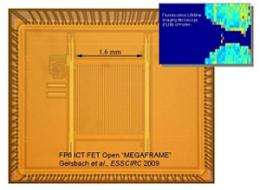
MEGAFRAME 32 x 32 Single Photon Avalanche, Diode (SPAD) array fabricated in 0.13um, STMICRO imaging CMOS technology

A European consortium comprising NPL, ST Microelectronics, the University of Edinburgh, and TU Delft has been involved in the development and application of the Megaframe Imager - an ultrafast camera capable of recording images at the incredible rate of one million frames.

Faster, higher resolution cameras

Since the introduction of solid-state , like those found in digital cameras, the main trend has been towards increasing the resolution (i.e. number of pixels) while miniaturising the chip.

However, the other factor is the number of frames the chip is capable of recording in a given time. Until recently, fast cameras (i.e. those capturing more than the 24 frames per second required for 'normal' video) were only used in niche markets in science and entertainment.

Ultrafast cameras

Now that higher-than-video speeds are achievable, a whole new range of previously unthinkable applications have emerged – such as: cellular / sub-cellular imaging; neural imaging; biochemical sensors; DNA / protein microarray scanning; automotive collision studies; and high-sensitivity astronomical observations.

The Megaframe Imager uses an extremely sensitive single photon avalanche diode (SPAD) device, and bespoke on-chip intelligence and has shown for the first time that it could potentially be a powerful technology in biosensing.

Reporting in the Optical Society of America's new journal Biomedical Optics Express the research team have demonstrated detection of viral DNA binding events using fluoresence lifetime imaging at the very low target concentrations relevant in biosensing applications with acquisition times of less than 30 seconds.

DNA microarrays are important tools for biomolecular detection. Widely used for gene expression profiling, disease screening, mutation and forensic analysis, they also hold much promise for the future development of personalised drugs and point of care testing devices.

Explore further: New tool has potential for brain mapping

More information: Read paper in Biomedical Optics Express: Fluorescence lifetime biosensing with DNA microarrays and a CMOS-SPAD imager

add to favorites email to friend print save as pdf

Related Stories

Video camera that records at the speed of thought

Oct 12, 2009

(PhysOrg.com) -- European researchers who created an ultra-fast, extremely high-resolution video camera have enabled dozens of medical applications, including one scenario that can record 'thought' processes travelling along ...

3D CMOS camera for your mobile?

Oct 14, 2009

(PhysOrg.com) -- European researchers have created a world-leading camera in CMOS that can record photons at a million times a second. Best of all, it will be really cheap to manufacture, offering applications ...

Filming photons, one million times a second

Oct 05, 2009

(PhysOrg.com) -- European researchers have created a CMOS (semiconductor) camera capable of filming individual photons one million times a second. The breakthrough will impact on all the most advanced areas ...

Sony develops new back-illuminated CMOS image sensor

Jun 11, 2008

Sony Corporation today announced the development of a back-illuminated CMOS image sensor (pixel size: 1.75µm square pixels, five effective mega pixels, 60 frames/s) with significantly enhanced imaging characteristics, ...

Recommended for you

New tool has potential for brain mapping

May 16, 2013

A new tool being developed by UT Arlington assistant professor of physics could help scientists map and track the interactions between neurons inside different areas of the brain.

Quantum dot LED approaches theoretical maximum efficiency

May 14, 2013

(Phys.org) —Quantum dot LEDs (QLEDs) are a promising technology for creating large-area displays that could have applications for TVs, cell phones, and digital cameras. So far, however, the highest efficiencies ...

Photonic quantum computers: A brighter future than ever

May 13, 2013

(Phys.org) —Harnessing the unique features of the quantum world promises a dramatic speed-up in information processing as compared to the fastest classical machines. Scientists from the Group of Philip ...

User comments : 0

More news stories

New principle may help explain why nature is quantum

Like small children, scientists are always asking the question 'why?'. One question they've yet to answer is why nature picked quantum physics, in all its weird glory, as a sensible way to behave. Researchers ...

Manipulating Lorentz and Fano spectral line shapes

(Phys.org) —It is widely known that the optical properties of certain materials can be modified by using lasers to control the quantum states of their optical electrons. Lasers that can generate ultra-short ...

Morocco to harness the wind in energy hunt

Morocco is ploughing ahead with a programme to boost wind energy production, particularly in the southern Tarfaya region, where Africa's largest wind farm is set to open in 2014.

Galaxy's Ring of Fire

Johnny Cash may have preferred this galaxy's burning ring of fire to the one he sang about falling into in his popular song. The "starburst ring" seen at center in red and yellow hues is not the product of ...