All viruses 'can be DNA stowaways'
November 19, 2010

All viruses 'can be DNA stowaways'

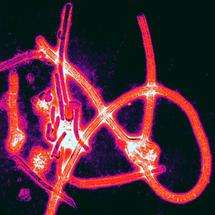
Relatives of Ebola are among the ‘fossil viruses’ researchers have identified. Image: Thomas W Geisbert

(PhysOrg.com) -- 'Fossil viruses' preserved inside the DNA of mammals and insects suggest that all viruses, including relatives of HIV and Ebola, could potentially be ‘stowaways’ transmitted from generation to generation for millions of years, according to new research.

A team from Oxford University and the Aaron Diamond AIDS Research Center built on earlier work at Oxford that discovered the fossilised remains of an ancient HIV-like virus in the genomes of animals including sloths, lemurs and rabbits.

The team’s new research, reported in this week’s PLoS Genetics, shows that many more different types of viruses are endogenous – capable of being transmitted from generation to generation – with ‘fossil viruses’ turning up in the genomes of creatures as different as mosquitoes, wallabies, and humans.

‘Many of these viruses, such as the ancestors of , are far more ancient and spread across many more animal groups than anyone ever suspected,’ said Dr Aris Katzourakis of Oxford University’s Department of Zoology, an author of the report. ‘We’ve demonstrated that viruses have been integrating within animal genomes for at least 100 million years.’

‘We’ve also shown that, in some cases, viral genes have been domesticated by their hosts, and put to use by the hosts for their own purposes, demonstrating that captured viral sequences may have played a larger than expected role in animal evolution.’

Understanding the historical conflict between viruses and animal immune systems could lead to new approaches to combating existing viruses such as and Ebola. It could also help scientists to decide which viruses that cross species are likely to cause dangerous pandemics in the future.

‘These viruses represent the tip of the iceberg of endogenous viral diversity,’ said Dr Katzourakis. ‘We have discovered a large and diverse set of virus sequences preserved in animal genomes, which together include representatives of all known viral groups. This demonstrates a potential for endogenisation for any , and illustrates that viral fossil records may be uncovered for many elusive viral groups.’

Provided by Oxford University search and more info website

4.7 /5 (17 votes)  

Filter


Move the slider to adjust rank threshold, so that you can hide some of the comments.


Display comments: newest first

krundoloss
Nov 19, 2010

Rank: 1.8 / 5 (5)
How the heck can viral DNA hide inside our own? Thats weird, we should definitely figure this out. There could be subtle overpopulation triggers that can make these viral DNA sequences activate. Just a Theory. .
PinkElephant
Nov 20, 2010

Rank: 5 / 5 (4)
@krundoloss,
How the heck can viral DNA hide inside our own?
Retroviruses insert their DNA directly into the nuclear DNA of a cell.

If at some point the viral DNA is damaged or the host cell is a mutant such that the virus can't function well inside it, then the cell can survive the "infection" in good health.

If this cell also happens to be a reproductive germ cell (a sperm or an egg), and subsequently gives rise to offspring, then all of that offspring's cells will carry the disabled viral DNA. Ditto for the offspring of that offspring, and so on.
El_Nose
Nov 20, 2010

Rank: 4.8 / 5 (4)
overpopulation control -- give me a break with the conspiracy theories already... thank you Pink for the simple explanation that most people are aware of.
iwantsomerocks
Nov 20, 2010

Rank: 1 / 5 (2)
this information has been around for decades...these people didn't discover anything new. Endogenous Retroviruses (ERVs) have already been shown to be used in gene promoter elements and mechanisms. These people should give credit where credit is due. I make sure never to support people that 'introduce' the research of others and don't even bother to cite who conducted the research. This is why the science field is so corrupt.
nnoj
Nov 21, 2010

Rank: 5 / 5 (2)
@iwantsomerocks decades ago? the HGP sequenced the first human genome in 2003. lolz thats barely one decade.
iwantsomerocks
Nov 21, 2010

Rank: 1 / 5 (2)
@nnoj 17-18 years = 2 decades in my book..plus we knew about them before the human genome was sequenced. Look up ERVs in at least pubmed. Do your research before you judge people.
PinkElephant
Nov 21, 2010

Rank: 5 / 5 (2)
@iwantsomerocks,

Perhaps you missed this key phrase:
many more different types of viruses are endogenous
That's the novelty of the reported research. And no, they didn't claim to have introduced the concept, either.

Seems like you didn't bother to read the article, short as it is, before commenting. And then you have the gall to admonish people for judging YOU hastily...
210
Nov 21, 2010

Rank: 1 / 5 (1)
Hummm, there is a lot of argument in these comments about "giving credit" and all that, BUT.. the concepts introduced by the presenter are nevertheless intriguing.
We have a chicken and egg scenario here:
The virus(es) do NOT live outside living cells. We have the DNA of the living, but, we do NOT know what life-itself- is. (Life is well DESCRIBED but not identified). We go prehistoric, and see viral forms in truly ancient DNA. Can the argument be made that in the far twilight after first life that there was NOT enough difference between them to actually call them "stowaways" but remnants or uninvited RELATIVES? What do you think?
210
Nov 21, 2010

Rank: 1 / 5 (1)
Further:
Could there have been 'remnants' or 'relatives' whose very presence, whose very existence was so , well, LETHAL, that nature could no longer tolerate them or that wiped out their hosts too fast?
I am seeing viruses as a planetary wide 'mad-rush' to get somewhere OR as test subjects as to what might really work within the range of biospheric conditions.
Could viruses be the reason life is still around? What do you think?
iwantsomerocks
Nov 21, 2010

Rank: 5 / 5 (1)
@Pink Elephant

I read the article, and I understand the novelty of it, and I appreciate them reporting their findings. It just seems like old news. Maybe you think differently. Whatever.

@210

I'm not sure exactly what you're getting at..but I agree that viruses are an essential key in the scheme of life. The ability of many species to use ERVs as promoter elements shows that we can use viruses to our advantage through evolutionary mechanisms which are still very poorly understood. I hope someday soon we will be able to decipher exactly how these elements are able to be inserted, and how we use them in our genome.

http://nar.oxford....full#F4

This is a paper I have cited in previous papers that describes certain preferential insertion target sites and orientations that certain types of ERVs 'like'. Research on this topic is extremely scarce, unfortunately. Enjoy.
210
Nov 21, 2010

Rank: 1 / 5 (2)

@210

I'm not sure exactly what you're getting at..but I agree that viruses are an essential key in the scheme of life. The ability of many species to use ERVs as promoter elements shows that we can use viruses to our advantage through evolutionary mechanisms which are still very poorly understood. I hope someday soon we will be able to decipher exactly how these elements are able to be inserted, and how we use them in our genome.
.
Indeed:
GUIDANCE my friend. To support Megafuna and Flora, the earth had to have had a different general atmosphere - more oxygen than now present and greatly reduced incursion of UV Rays to begin with.
210
Nov 21, 2010

Rank: 1 / 5 (2)
Further:
The dinosaurs died. Pterosaurs replaced by FULLY feathered creatures; wooly mammoths gone and elephants remain, etc, etc, etc...viral, influence, something viral, ubiquitous like the internet, functioned as genetic/DNA goalkeeper. Leaving room for mammalian development on an unprecedented scale but limiting all forms that had existed before. Forms who had once ruled and been possessed by this viral agent - no longer allowed to live!
And in this new biosphere, having seen the old one in totality, it imposed itself on all new and continuing lifeforms. I believe a virus(es) were/are this goalkeeper. A series of infections...what do you think?
drbarry
Nov 21, 2010

Rank: not rated yet
This is a truly interesting finding but through the distorting lens of hindsight I guess not that surprising. During molecular evolution I would think around the time of the transition from an "RNA world" to a "DNA world" small molecules lost the evolutionary race with more successful larger genomes and perhaps decided "if you can't beat 'em join 'em." So recombined rather than tried to defeat. As someone interested in molecular carcinogenesis it seems to me that the broader implication of this finding is that it may be the long sought after connection with viruses and cancer. Cryptic endogenous viruses might act as co-factors in certain cancers but not themselves be carcinogenic. The YES1 gene comes to mind.
210
Nov 21, 2010

Rank: 1 / 5 (2)
This is a truly interesting finding but through the distorting lens of hindsight I guess not that surprising. During molecular evolution I would think around the time of the transition from an "RNA world" to a "DNA world" small molecules lost the evolutionary race with more successful larger genomes and perhaps decided "if you can't beat 'em join 'em." So recombined rather than tried to defeat. As someone interested in molecular carcinogenesis it seems to me that the broader implication of this finding is that it may be the long sought after connection with viruses and cancer.
Cancer my friend? Cancer?...hummm...indeed:
Here read this, a link entitled, "Cancer is probably Man Made"
http://www.medica...4809.php
and,
http://theweek.co...disease. Finally, the ability of the tiny to inhabit the great millions of years ago, and today.
Respectfully, a bit of imagination is required but it is not an astounding leap
Rank 4.7 /5 (17 votes)
Relevant PhysicsForums posts

More news stories

It's in the genes: Research pinpoints how plants know when to flower

Scientists believe they've pinpointed the last crucial piece of the 80-year-old puzzle of how plants "know" when to flower.

Biology / Biotechnology

created 7 hours ago | popularity 4 / 5 (5) | comments 0 | with audio podcast

Researchers solve structure of human protein critical for silencing genes

In a study published in the journal Cell on May 24, Cold Spring Harbor Laboratory (CSHL) scientists describe the three-dimensional atomic structure of a human protein bound to a piece of RNA that "guides" the pr ...

Biology / Cell & Microbiology

created 7 hours ago | popularity 5 / 5 (3) | comments 0 | with audio podcast

Study uncovers secret to speedy burrowing by razor clams

(Phys.org) -- If you look at a razor burrowing clam sitting in a bucket, you’d never guess that it could burrow itself down into the soil, much less do it with any speed. Razor clams look like fat straws, ...

Biology / Plants & Animals

created 16 hours ago | popularity not rated yet | comments 3 | with audio podcast report

Copy of the genetic makeup travels in a protein suitcase

Scientists from the Institute for Physical and Theoretical Chemistry at the University of Bonn have succeeded for the first time in the real time filming of the transport of an important information carrier in biological ...

Biology / Cell & Microbiology

created 13 hours ago | popularity not rated yet | comments 0 | with audio podcast

'Transformer' protein makes different sized transport pods

These spheres may look almost identical, but subtle differences between them revealed a molecular version of the robots from Transformers. Each sphere is a vesicle, a pod that cells use to transport materials ...

Biology / Cell & Microbiology

created 13 hours ago | popularity not rated yet | comments 0


Of mice and mental models: Neuroscientific implications of risk-optimized behavior in the mouse

(Medical Xpress) -- Regardless of an organism’s biological complexity, every encephalized animal continuously makes under-informed behavioral choices that can have serious consequences. Despite its ubiquity, ...

Dragon arrives at space station in historic 1st (Update 2)

The privately bankrolled Dragon capsule made a historic arrival at the International Space Station on Friday, triumphantly captured by astronauts wielding a giant robot arm.

Landmark calculation clears the way to answering how matter is formed

(Phys.org) -- An international collaboration of scientists, including Thomas Blum, associate professor of physics, is reporting in landmark detail the decay process of a subatomic particle called a kaon – ...

High-speed method to aid search for solar energy storage catalysts

Eons ago, nature solved the problem of converting solar energy to fuels by inventing the process of photosynthesis.

MIT researchers devise new means to synchronize a group of robots (w/ Video)

(Phys.org) -- For several years, roboticists have been working out ways to get a group of robots to perform synchronized activities as demonstrated most often in dance routines. It’s not just about trying ...

Researchers demonstrate possible primitive mechanism of chemical info self-replication

(Phys.org) -- When scientists think about the replication of information in chemistry, they usually have in mind something akin to what happens in living organisms when DNA gets copied: a double-stranded molecule ...