Tannins' surprising benefits for soils, forests and farms
November 18, 2010 By Don Comis
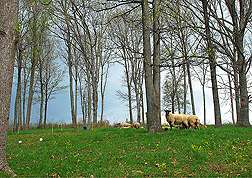
ARS scientists are developing recommendations for using tannins—like those in red wine—to manage agricultural soils, including those where livestock graze in thinned forests. Click the image for more information about it.
The tannins that help make good red wine and bright fall colors also may help make good soil and healthy livestock, according to U.S. Department of Agriculture (USDA) researchers.
Chemist Javier Gonzalez and soil scientist Jonathan Halvorson, both at the Agricultural Research Service (ARS) Appalachian Farming Systems Research Center (AFSRC) in Beaver, W.Va., are leading a tannin research project that's now in its fourth year. Results from the studies by Gonzalez, Halvorson and their colleagues indicate tannins are important components of agroecosystems that can also affect production and environmental quality. ARS is USDA's principal intramural scientific research agency.
The scientists will use their results to develop recommendations for using tannins to manage soils and silvopastures, where livestock graze in thinned forests.
Tannins and other phenolic compounds are common in many plants. These compounds, believed to enter soil from plant roots and decaying leaves, may also be part of "teas" formed as rain and snowmelt run down tree bark and drip off the leaves.
The work is being done jointly with chemist Ann Hagerman's renowned tannin laboratory at Miami University in Oxford, Ohio. The two labs are combining their capabilities to identify important features of tannins that determine soil interactions.
Results to date show the rate and amount of binding to soil varied from one tannin to another. The scientists found that the binding quality of tannins also can be used to immobilize metals such as aluminum, lessening the metals' toxic effects on root growth. Tannin-related phenolics can also free up nutrients such as calcium for crop use.
The scientists are learning more about how forest soil microbes metabolize tannins, leading to a better understanding of the varied ecological functions performed by tannins. The AFSRC scientists also are studying the nutritional and deworming potential of tannin-containing forages for goats.
More information: Read more about this research in the November/December 2010 issue of Agricultural Research magazine. This research was published in Physiologia Plantarum, and in Soil Biology & Biochemistry.
Provided by USDA Agricultural Research Service
-
From lemons to lemonade: Reaction uses carbon dioxide to make carbon-based semiconductor,
28 comments
-
Every black hole contains a new universe: A physicist presents a solution to present-day cosmic mysteries,
217 comments
-
New silicon memory chip developed,
16 comments
-
Thioridazine kills cancer stem cells in human while avoiding toxic side-effects of conventional cancer treatments,
3 comments
-
SpaceX private rocket blasts off for space station (Update),
41 comments
-
More human population = greater mass?
12 hours ago
-
Conversion from aircraft bearing to normal degrees
May 23, 2012
-
Interpretation/Analysis of the Lab results(HEPA filter)
May 22, 2012
-
Has anyone here attended the The Urbino Summer School in Paleoclimatology?
May 22, 2012
-
Earthquakes: Mag 6 N. Italy and Mag 5.6 W. Bulgaria
May 21, 2012
-
determining time frame for most recent geological layers
May 17, 2012
- More from Physics Forums - Earth
More news stories
Dragon arrives at space station in historic 1st (Update 2)
The privately bankrolled Dragon capsule made a historic arrival at the International Space Station on Friday, triumphantly captured by astronauts wielding a giant robot arm.
Space & Earth / Space Exploration
13 hours ago |
5 / 5 (8) |
10
Dragon makes history with space station docking
The private company SpaceX made history Friday with the docking of its Dragon capsule to the International Space Station, the most impressive feat yet in turning routine spaceflight over to the commercial ...
Space & Earth / Space Exploration
6 hours ago |
4.8 / 5 (6) |
0
Aliens don't want to eat us, says former SETI director
Alien life probably isnt interested in having us for dinner, enslaving us or laying eggs in our bellies, according to a recent statement by former SETI director Jill Tarter.
Space & Earth / Space Exploration
14 hours ago |
4.8 / 5 (9) |
23
SKA super telescope to be built in Australia, South Africa (Update 2)
A long-running joust to host a radio telescope that would give mankind its farthest peek into the Universe ended on Friday with a Solomon-like judgement to split the site between Australia and South Africa.
14 hours ago |
5 / 5 (5) |
2
NASA sees Hurricane Bud threaten western Mexico's coast
NASA satellites are providing rainfall, temperature, pressure, visible and infrared data to forecasters as Hurricane Bud is expected to make a quick landfall in western Mexico this weekend before turning back ...
Space & Earth / Earth Sciences
8 hours ago |
not rated yet |
0
Of mice and mental models: Neuroscientific implications of risk-optimized behavior in the mouse
(Medical Xpress) -- Regardless of an organism’s biological complexity, every encephalized animal continuously makes under-informed behavioral choices that can have serious consequences. Despite its ubiquity, ...
Landmark calculation clears the way to answering how matter is formed
(Phys.org) -- An international collaboration of scientists, including Thomas Blum, associate professor of physics, is reporting in landmark detail the decay process of a subatomic particle called a kaon ...
High-speed method to aid search for solar energy storage catalysts
Eons ago, nature solved the problem of converting solar energy to fuels by inventing the process of photosynthesis.
It's in the genes: Research pinpoints how plants know when to flower
Scientists believe they've pinpointed the last crucial piece of the 80-year-old puzzle of how plants "know" when to flower.
Researchers solve structure of human protein critical for silencing genes
In a study published in the journal Cell on May 24, Cold Spring Harbor Laboratory (CSHL) scientists describe the three-dimensional atomic structure of a human protein bound to a piece of RNA that "guides" the pr ...
MIT researchers devise new means to synchronize a group of robots (w/ Video)
(Phys.org) -- For several years, roboticists have been working out ways to get a group of robots to perform synchronized activities as demonstrated most often in dance routines. Its not just about trying ...