Successful launch for NASA's microsatellite FASTSAT
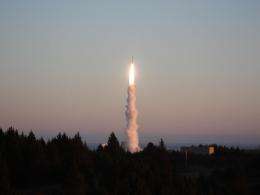
Microsatellite FASTSAT launches from Kodiak, Alaska on Nov. 19, 2010. Image credit: Steven Young/Spaceflight Now
NASA's Fast, Affordable, Science and Technology Satellite, or FASTSAT, launched at 7:25 p.m. CST Friday aboard a Minotaur IV rocket from Kodiak Launch Complex on Kodiak Island, Alaska. FASTSAT is a unique platform that can carry multiple small payloads to low-Earth orbit creating opportunities for researchers to conduct low-cost scientific and technology research on an autonomous satellite in space.
FASTSAT separated from the Minotaur IV rocket approximately 22 minutes after launch, entering low-Earth orbit 406 miles above Earth and immediately began powering up the spacecraft. NASA ground stations are tracking the spacecraft and the spacecraft has been activated. The small satellite command center located at the Huntsville Operations and Science Control Center at NASA's Marshall Space Flight Center in Huntsville, Ala. is continuing commissioning operations of the satellite.
"This milestone is a testament to our FASTSAT team that worked tirelessly to design, build and test a fully functional, low-cost satellite in a year," said Mark Boudreaux, FASTSAT project manager at the Marshall Center. Boudreaux said the team maximized the number of payloads onboard and designed the satellite to support the Evolved Expendable Launch Vehicle Secondary Payload Adaptor (ESPA) ring to increase opportunities for ride sharing with Department of Defense ESPA configurable launch vehicles.
For the first 11 days after launch, the spacecraft and six onboard atmospheric and technology demonstration experiments will go through an on-orbit commissioning phase. Once commissioning is complete, the next 180 days will be focused on science operations. A checkout and performance analysis of each science instrument will be performed and then, one by one, each experiment will turn on to perform its science objectives.
After the science phase is complete, additional characterization of the spacecraft will be performed to test additional flight objectives. These operations will be performed in parallel to test the overall abilities of the spacecraft. This will occur for approximately 100 days. After completion of this phase of the mission, the command will be sent to shut down the spacecraft, which will go into a decommissioning phase.
The microsatellite FASTSAT, weighing just under 400 pounds, will serve as a scientific laboratory containing all the resources needed to carry out scientific and technology research operations for the mission time period. FASTSAT was developed with a simplicity in the design of the spacecraft subsystems that provide power management, onboard storage of experiments data, control of experiments, communications with ground stations, propellantless mechanisms for attitude control and a GPS system for navigation.
FASTSAT launched on the STP-S26 mission -- a joint activity between NASA and the U.S. Department of Defense Space Test Program. The satellite was designed, developed and tested at the Marshall Center in partnership with the Von Braun Center for Science & Innovation and Dynetics Inc. of Huntsville. Dynetics provided key engineering, manufacturing and ground operations support for the new microsatellite. Thirteen Huntsville-area firms, as well as the University of Alabama in Huntsville, also were part of the project team.
Provided by
JPL/NASA
-
From lemons to lemonade: Reaction uses carbon dioxide to make carbon-based semiconductor,
28 comments
-
Every black hole contains a new universe: A physicist presents a solution to present-day cosmic mysteries,
217 comments
-
New silicon memory chip developed,
16 comments
-
Thioridazine kills cancer stem cells in human while avoiding toxic side-effects of conventional cancer treatments,
3 comments
-
SpaceX private rocket blasts off for space station (Update),
41 comments
-
revamping general concept and cosmological principle
9 hours ago
-
Transiting Exoplanet Light Curve
19 hours ago
-
Math behind Theoretical Physics
May 24, 2012
-
Do we know whats at the center of galaxies yet?
May 23, 2012
-
Structure of the Milky Way?
May 20, 2012
-
What would it take to terraform Pluto and Charon?
May 19, 2012
- More from Physics Forums - General Astronomy
More news stories
Dragon arrives at space station in historic 1st (Update 2)
The privately bankrolled Dragon capsule made a historic arrival at the International Space Station on Friday, triumphantly captured by astronauts wielding a giant robot arm.
Space & Earth / Space Exploration
12 hours ago |
5 / 5 (7) |
10
Dragon makes history with space station docking
The private company SpaceX made history Friday with the docking of its Dragon capsule to the International Space Station, the most impressive feat yet in turning routine spaceflight over to the commercial ...
Space & Earth / Space Exploration
5 hours ago |
4.8 / 5 (6) |
0
Aliens don't want to eat us, says former SETI director
Alien life probably isnt interested in having us for dinner, enslaving us or laying eggs in our bellies, according to a recent statement by former SETI director Jill Tarter.
Space & Earth / Space Exploration
14 hours ago |
4.8 / 5 (8) |
22
SKA super telescope to be built in Australia, South Africa (Update 2)
A long-running joust to host a radio telescope that would give mankind its farthest peek into the Universe ended on Friday with a Solomon-like judgement to split the site between Australia and South Africa.
14 hours ago |
5 / 5 (5) |
2
NASA sees Hurricane Bud threaten western Mexico's coast
NASA satellites are providing rainfall, temperature, pressure, visible and infrared data to forecasters as Hurricane Bud is expected to make a quick landfall in western Mexico this weekend before turning back ...
Space & Earth / Earth Sciences
8 hours ago |
not rated yet |
0
Of mice and mental models: Neuroscientific implications of risk-optimized behavior in the mouse
(Medical Xpress) -- Regardless of an organism’s biological complexity, every encephalized animal continuously makes under-informed behavioral choices that can have serious consequences. Despite its ubiquity, ...
It's in the genes: Research pinpoints how plants know when to flower
Scientists believe they've pinpointed the last crucial piece of the 80-year-old puzzle of how plants "know" when to flower.
Landmark calculation clears the way to answering how matter is formed
(Phys.org) -- An international collaboration of scientists, including Thomas Blum, associate professor of physics, is reporting in landmark detail the decay process of a subatomic particle called a kaon ...
High-speed method to aid search for solar energy storage catalysts
Eons ago, nature solved the problem of converting solar energy to fuels by inventing the process of photosynthesis.
Researchers solve structure of human protein critical for silencing genes
In a study published in the journal Cell on May 24, Cold Spring Harbor Laboratory (CSHL) scientists describe the three-dimensional atomic structure of a human protein bound to a piece of RNA that "guides" the pr ...
MIT researchers devise new means to synchronize a group of robots (w/ Video)
(Phys.org) -- For several years, roboticists have been working out ways to get a group of robots to perform synchronized activities as demonstrated most often in dance routines. Its not just about trying ...
Nov 23, 2010
Rank: not rated yet