Sniffer 'hero rats' saving lives in war zones
November 8, 2010 by Otto Bakano
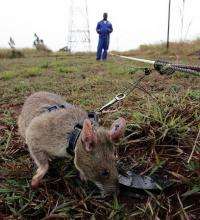
An African rat sniffs out a landmine in Chimoio, Mozambique. Light and with an acute sense of smell, giant African pouched rats have been found to be a highly effective weapon in the struggle to detect mines and a town in Tanzania is now at the forefront of a campaign to train the creatures in ordnance clearance.
A baby rat in a tiny red and black harness twitches its pointed nose incessantly, probing a grassy field where it is being trained by a pioneering Dutch NGO to smell out deadly landmines.
Other rats trained under the same scheme have already helped clear large swathes of land in neighbouring mine-infested Mozambique.
Babette, the two-month-old baby, walks unsteadily across the weedy patch followed by two trainers rolling a bar that teaches her to go back and forth across the patch in straight lines.
Light, with an acute sense of smell and easily motivated by food rewards, giant African pouched rats have been found to be highly effective in mine detection by APOPO, the Dutch non-governmental organisation that launched the training project -- the first of its kind -- in this Tanzanian town.
The rodents are trained to detect the TNT in landmines through Pavlovian conditioning: a click sound to signal a food reward whenever they make the correct detection.
Other rats in the same project undergo a different type of training -- they learn to sniff out tuberculosis in laboratory sputum samples, providing a second-line screening for hospitals in Tanzania where lab testing has 60 percent accuracy.
Training begins at four weeks old when the baby rats are exposed to humans to rid them of their fear of people and new surroundings, after which they are taught to associate a click sound with food.
Once that is achieved, they are then trained to distinguish TNT scent from other smells. When they successfully distinguish it, the click is sounded and they are given a bit of banana, thus reinforcing the link between positive TNT identification and food.
In all, it takes nine months of painstaking on- and off-field training for a rat to be deployed for mine detection.
"This work is not easy," recounts trainer Abdullah Mchomvu, holding a rat cage under his left arm. "You have to be patient. Sometimes I get frustrated, but then again I tell myself these are animals."
But "this work saves lives," he added.
It takes two deminers a day to clear a 200 square-metre (2,150 square-feet) minefield, but if they work with two rats they can sweep it in two hours.
"Detection is the most difficult, dangerous and expensive part of mine action. Since rats are much easier to train than dogs, rats in this environment are much more appropriate," said Bart Weetjens, the founder of APOPO.
"They are very effective. We have very high success rates. So far they have helped re-open almost two million square metres of land" in Mozambique.
In the lab, the rats use their keen noses to positively identify tuberculosis sputum samples.
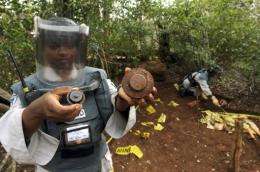
A Sri Lankan mine clearance officer working with the Swiss Foundation for Mine Action shows a diffused anti-personnel mine in scrubland close to Mannar in the former war zone of the island state. It takes two deminers a day to clear a 200 square-metre (2,150 square-feet) minefield, but if they work with two rats they can sweep it in two hours.
Ten samples are slotted into the bottom portion of a long rectangular glass cage containing one trained rat. The animal sniffs each sample and scratches intently over any suspect sample, with a laboratory technician looking on and taking notes.It takes a fully trained rat less that 10 minutes to sniff through 70 samples with high accuracy. Samples found negative for tuberculosis by the hospitals are at times proven positive by the rats and a second lab testing.
"In hospitals we work with, we have increased their detection rate by about 40 percent," said Dian Kuipers, a lab supervisor with APOPO.
Kuipers explained that in September alone they found 69 positive tuberculosis samples that were missed by hospitals and since the programme started three years ago more than 1,500 TB infections initially missed by microscopes have been detected with the help of the rats.
"You have to be pretty sick for the bacteria to be detected" in hospital laboratories, she said.
Tuberculosis is the deadliest opportunistic disease among HIV patients. In Tanzania, less than half of people with active TB are diagnosed before they die and every undetected case cause infections to up to 15 people every year.
However, rats here are seen as vermin that spread disease and destroy harvests.
"Rats absolutely have an image problem. People don't like them and that is one of our biggest struggles," said Weetjens.
"We are trying to change that perception. Rats are very sociable, very intelligent highly likeable creatures."
APOPO calls its sniffers "hero rats" in recognition of the work they perform.
The organisation's website pictures rats that could be straight out of Beatrix Potter: all pink noses and quivering whiskers.
APOPO has even launched an Adopt-a-Rat scheme where individuals and corporations can contribute to the upkeep and the training of a sniffer rat, receiving in exchange an adoption certificate and email updates on the animal's training or career.
Weetjens said the next frontier would be to use the "hero rats" to sniff out narcotics or to search for survivors of disasters such as earthquakes or collapsed buildings.
(c) 2010 AFP
-
From lemons to lemonade: Reaction uses carbon dioxide to make carbon-based semiconductor,
28 comments
-
Thioridazine kills cancer stem cells in human while avoiding toxic side-effects of conventional cancer treatments,
3 comments
-
SpaceX private rocket blasts off for space station (Update),
41 comments
-
Climate scientists say they have solved riddle of rising sea,
30 comments
-
Scotland passes turbine test to harness tidal power,
40 comments
-
Why Do Dogs do Strange things...
11 hours ago
-
What does exophillic and endophillic mean in terms of mosquito and their control?
May 24, 2012
-
Semen stains glows under black lights (uv light)?
May 23, 2012
-
Question on Human Chromosome 2
May 23, 2012
-
How important is composition of TBST in diluting antibodies and Western Blotting?
May 22, 2012
-
Does the medulla monitor blood pH
May 20, 2012
- More from Physics Forums - Biology
More news stories
It's in the genes: Research pinpoints how plants know when to flower
Scientists believe they've pinpointed the last crucial piece of the 80-year-old puzzle of how plants "know" when to flower.
9 hours ago |
4 / 5 (5) |
1
|
Researchers solve structure of human protein critical for silencing genes
In a study published in the journal Cell on May 24, Cold Spring Harbor Laboratory (CSHL) scientists describe the three-dimensional atomic structure of a human protein bound to a piece of RNA that "guides" the pr ...
9 hours ago |
5 / 5 (5) |
0
|
Study uncovers secret to speedy burrowing by razor clams
(Phys.org) -- If you look at a razor burrowing clam sitting in a bucket, youd never guess that it could burrow itself down into the soil, much less do it with any speed. Razor clams look like fat straws, ...
Copy of the genetic makeup travels in a protein suitcase
Scientists from the Institute for Physical and Theoretical Chemistry at the University of Bonn have succeeded for the first time in the real time filming of the transport of an important information carrier in biological ...
15 hours ago |
not rated yet |
0
|
'Transformer' protein makes different sized transport pods
These spheres may look almost identical, but subtle differences between them revealed a molecular version of the robots from Transformers. Each sphere is a vesicle, a pod that cells use to transport materials ...
15 hours ago |
not rated yet |
0
Of mice and mental models: Neuroscientific implications of risk-optimized behavior in the mouse
(Medical Xpress) -- Regardless of an organism’s biological complexity, every encephalized animal continuously makes under-informed behavioral choices that can have serious consequences. Despite its ubiquity, ...
Dragon arrives at space station in historic 1st (Update 2)
The privately bankrolled Dragon capsule made a historic arrival at the International Space Station on Friday, triumphantly captured by astronauts wielding a giant robot arm.
Landmark calculation clears the way to answering how matter is formed
(Phys.org) -- An international collaboration of scientists, including Thomas Blum, associate professor of physics, is reporting in landmark detail the decay process of a subatomic particle called a kaon ...
High-speed method to aid search for solar energy storage catalysts
Eons ago, nature solved the problem of converting solar energy to fuels by inventing the process of photosynthesis.
MIT researchers devise new means to synchronize a group of robots (w/ Video)
(Phys.org) -- For several years, roboticists have been working out ways to get a group of robots to perform synchronized activities as demonstrated most often in dance routines. Its not just about trying ...
Researchers demonstrate possible primitive mechanism of chemical info self-replication
(Phys.org) -- When scientists think about the replication of information in chemistry, they usually have in mind something akin to what happens in living organisms when DNA gets copied: a double-stranded molecule ...

Nov 08, 2010
Rank: not rated yet
Nov 08, 2010
Rank: not rated yet
I can just see it now! FREE THE RATS! A new rallying cry for those groups that prefer rats to live and die short brutal lives in the wild rather than the pampered and well fed lives they do as sniffers.
Don't kid yourself tho about insects. We would soon hear the new song FREE THE BUGS!!! across the land if they substituted insects.