Size of mammals exploded after dinosaur extinction
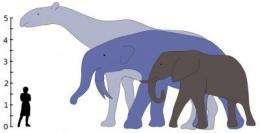
The largest land mammals that ever lived, Indricotherium and Deinotherium, would have towered over the living African elephant. The tallest on diagram, Indricotherium, an extinct rhino relative, lived during the Eocene to the Oligocene Epoch (37 to 23 million years ago) and reached a mass of 15,000 kg, while Deinotherium (an extinct proboscidean, related to modern elephants) was around from the late-Miocene until the early Pleistocene (8.5 to 2.7 million years ago) and weighed as much as 17,000 kg. Credit: Alison Boyer/Yale University
Researchers demonstrate that the extinction of dinosaurs 65 million years ago made way for mammals to get bigger - about a thousand times bigger than they had been. The study, which is published in the prestigious journal Science, is the first to show this new pattern of increased body size of mammals after the exit of the dinosaurs.
"Basically, the dinosaurs disappear and all of a sudden there is nobody else eating the vegetation. That's an open food source and mammals start going for it, and it's more efficient to be an herbivore when you're big," says paper co-author Dr. Jessica Theodor, associate professor in the Department of Biological Sciences at the University of Calgary.
Theodor says as well as confirming the dramatic growth in mammalian size after the dinosaurs, the study shows that the ecosystem is able to reset itself relatively quickly.
"You lose dinosaurs 65 million years ago, and within 25 million years the system is reset to a new maximum for the animals that are there in terms of body size. That's actually a pretty short time frame, geologically speaking," she says. "That's really rapid evolution."
Theodor says mammals grew from a maximum of about 10 kilograms when they were sharing the earth with dinosaurs to a maximum of 17 tonnes afterwards.
"Nobody has ever demonstrated that this pattern is really there. People have talked about it but nobody has ever gone back and done the math," says Theodor one of the 20 researchers from around the world who worked on the study.
"We went through every time period and said OK, for this group of mammals what's the biggest one? And then we estimated its body mass."
In order to document how big mammals grew after the 'competitive release' caused by the extinction of dinosaurs, researchers collected data on the maximum size for major groups of land mammals on each continent, including Perissodactyla, odd-toed ungulates such as horses and rhinos; Proboscidea, which includes elephants, mammoth and mastodon; Xenarthra, the anteaters, tree sloths, and armadillos; as well as a number of other extinct groups.
The results give clues as to what sets the limits on mammal size on land; the amount of space available to each animal and the climate they live in. The colder the climate, the bigger the mammals seem to get, as bigger animals conserve heat better. It also shows that no one group of mammals dominates the largest size class the absolute largest mammal belongs to different groups over time and space.
Provided by
University of Calgary
-
From lemons to lemonade: Reaction uses carbon dioxide to make carbon-based semiconductor,
28 comments
-
Thioridazine kills cancer stem cells in human while avoiding toxic side-effects of conventional cancer treatments,
3 comments
-
SpaceX private rocket blasts off for space station (Update),
41 comments
-
Climate scientists say they have solved riddle of rising sea,
30 comments
-
Scotland passes turbine test to harness tidal power,
40 comments
-
Why Do Dogs do Strange things...
10 hours ago
-
What does exophillic and endophillic mean in terms of mosquito and their control?
May 24, 2012
-
Semen stains glows under black lights (uv light)?
May 23, 2012
-
Question on Human Chromosome 2
May 23, 2012
-
How important is composition of TBST in diluting antibodies and Western Blotting?
May 22, 2012
-
Does the medulla monitor blood pH
May 20, 2012
- More from Physics Forums - Biology
More news stories
Math predicts size of clot-forming cells
UC Davis mathematicians have helped biologists figure out why platelets, the cells that form blood clots, are the size and shape that they are. Because platelets are important both for healing wounds and in strokes and other ...
11 hours ago |
not rated yet |
0
|
Oldest Jewish archaeological evidence on the Iberian Peninsula
German archaeologists of the Friedrich Schiller University Jena found one of the oldest archaeological evidence so far of Jewish Culture on the Iberian Peninsula at an excavation site in the south of Portugal, ...
Other Sciences / Archaeology & Fossils
14 hours ago |
4.3 / 5 (4) |
12
Dinosaur with tiny arms unearthed in Argentina
Argentine experts have discovered the near-complete remains of a new species of Jurassic-era dinosaur that stood on its rear legs and had tiny arms, according to a leading paleontologist.
Other Sciences / Archaeology & Fossils
23 hours ago |
5 / 5 (2) |
0
Earliest musical instruments in Europe 40,000 years ago
The first modern humans in Europe were playing musical instruments and showing artistic creativity as early as 40,000 years ago, according to new research from Oxford and Tübingen universities.
Other Sciences / Archaeology & Fossils
17 hours ago |
5 / 5 (3) |
1
Talking works: UB professor develops method to analyze creative problem solving
(Phys.org) -- Talk -- if it's the right kind -- can increase creativity, leading students to create useful, new ideas that solve problems, a University at Buffalo professor has found by using a statistical tool that he invented.
Other Sciences / Social Sciences
20 hours ago |
not rated yet |
0
Of mice and mental models: Neuroscientific implications of risk-optimized behavior in the mouse
(Medical Xpress) -- Regardless of an organism’s biological complexity, every encephalized animal continuously makes under-informed behavioral choices that can have serious consequences. Despite its ubiquity, ...
Dragon arrives at space station in historic 1st (Update 2)
The privately bankrolled Dragon capsule made a historic arrival at the International Space Station on Friday, triumphantly captured by astronauts wielding a giant robot arm.
Landmark calculation clears the way to answering how matter is formed
(Phys.org) -- An international collaboration of scientists, including Thomas Blum, associate professor of physics, is reporting in landmark detail the decay process of a subatomic particle called a kaon ...
High-speed method to aid search for solar energy storage catalysts
Eons ago, nature solved the problem of converting solar energy to fuels by inventing the process of photosynthesis.
It's in the genes: Research pinpoints how plants know when to flower
Scientists believe they've pinpointed the last crucial piece of the 80-year-old puzzle of how plants "know" when to flower.
Researchers solve structure of human protein critical for silencing genes
In a study published in the journal Cell on May 24, Cold Spring Harbor Laboratory (CSHL) scientists describe the three-dimensional atomic structure of a human protein bound to a piece of RNA that "guides" the pr ...
Nov 25, 2010
Rank: 1.6 / 5 (20)
Nov 26, 2010
Rank: 1 / 5 (3)
...The colder the climate, the bigger the mammals seem to get...
Outsize portions for me from now on!
Nov 26, 2010
Rank: 1 / 5 (1)
Nov 30, 2010
Rank: 1 / 5 (1)
Ethelred