Secrets of sharks' success
Nov 24, 2010
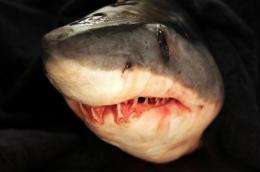
This is a shortfin mako. Credit: P. Motta/Univ. South Florida.

New research from the University of South Florida suggests that one of the evolutionary secrets of the shark's success hides in one of its tiniest traits -- flexible scales on the bodies of these peerless predators that make them better hunters by allowing them to change directions while moving at full speed.

The key to this ability lies in the fact that the scales control water flow separation across the creatures' bodies, says Amy Lang of the University of Alabama who will present work she performed with her colleagues at the University of South Florida today at the American Physical Society's Division of (DFD) annual meeting in Long Beach, CA.

Flow separation is an issue in systems like aircraft design, explains Lang, because it tends to cause vortices that impede speed and stability.

"In nature, if you look at surfaces of animals, you'll see that they are not smooth," she says. "They have patterns. Why? One common application of patterning a surface is to control flow -- think of the dimples of a golf ball that help the ball fly farther. We believe scales on fast-swimming sharks serve a similar purpose of flow separation control."
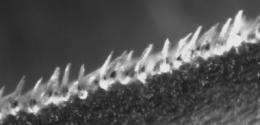
This image is of the mako scales from a sample on the side of the shark. The scales in the foreground have been manually bristled and measure approximately 0.2 mm in length. Credit: P. Motta/Univ. South Florida.

Based on experimental measurements and models of shark scales, Dr. Lang's team discovered that the bases of shortfin mako scales (literally small teeth covering their body) where they attach to the skin are not as wide as the tops of the scales. This tapered shape enables the scales to be easily manipulated to angles of 60 degrees or more, endowing them with movement called "denticle bristling."

Also, these flexible scales are only found on parts of the body where flow separation is most likely to occur, such as behind the gills on the side of the body. Denticle bristling is the probable mechanism leading to flow separation control for the shortfin mako shark.

"As we investigate further, we imagine applications of controlling flow separation in design of aircraft, helicopters, -- anywhere flow separation is an issue," Lang adds.

Explore further: Bubble mattress reduces drag in fluidic chip

More information: The presentation, "Recent Observations on Shortfin Mako Scale Flexibility as a Mechanism for Separation Control" is on Tuesday, November 23, 2010. Abstract: meetings.aps.org/Meeting/DFD10/Event/134387

Provided by American Institute of Physics

3.7 /5 (3 votes)

Related Stories

As fast as a shark in water

Dec 15, 2006

With the help of tiny ridge-like structures in their scales, sharks are able to minimize drag when swimming. A new coating system takes advantage of this “riblet effect” to improve the aerodynamics of vehicles and aircraft.

Enhancing the efficiency of wind turbines

Nov 22, 2010

A milestone in the history of renewable energy occurred in the year 2008 when more new wind-turbine power generation capacity was added in the U.S. than new coal-fired power generation. The costs of producing power with wind ...

Recommended for you

Promising doped zirconia

May 17, 2013

Materials belonging to the family of dilute magnetic oxides (DMOs)—an oxide-based variant of the dilute magnetic semiconductors—are good candidates for spintronics applications. This is the object of ...

Bringing life into focus

May 17, 2013

Spinning-disk confocal microscopy is an optical imaging technique that can be used to generate detailed three-dimensional fluorescence images of living cells and their contents. Although a powerful tool for ...

Nanocrystals grow from liquid interface

May 17, 2013

An international collaboration of scientists has discovered a unique crystalizing behavior at the interface between two immiscible liquids that could aid in sustainable energy development.

User comments : 3

Adjust slider to filter visible comments by rank

Display comments: newest first

Donutz
3 / 5 (2) Nov 24, 2010
I always thought that the secret to sharks' success was their ability to eat anything else in the ocean...
jselin
not rated yet Nov 24, 2010
The success of sharks is primarily due to biting, and activities related to and in support of biting :)
jselin
5 / 5 (1) Nov 24, 2010
Joking aside, why couldn't the title of this article have been something like "Shark scales shown to reduce flow separation, increasing performance" Then, anyone who would really benefit from the science in the article will click through. Instead the teaser/sensationalistic titles obscure the information to those who prioritize their time use.

More news stories

New principle may help explain why nature is quantum

Like small children, scientists are always asking the question 'why?'. One question they've yet to answer is why nature picked quantum physics, in all its weird glory, as a sensible way to behave. Researchers ...

Heat-related deaths in Manhattan projected to rise

Residents of Manhattan will not just sweat harder from rising temperatures in the future, says a new study; many may die. Researchers say deaths linked to warming climate may rise some 20 percent by the 2020s, ...

Kinks and curves at the nanoscale

One of the basic principles of nanotechnology is that when you make things extremely small—one nanometer is about five atoms wide, 100,000 times smaller than the diameter of a human hair—they are going ...