Review: Samsung tablet good, but not good enough
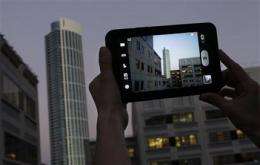
(AP) -- When Apple released the iPad in April, it set a high bar for tablet computers. The first real competitor has arrived in Samsung's Galaxy Tab.
With a screen that measures 7 inches diagonally, two shorter than the iPad, the Tab is good - but not good enough.
The Tab is nearly the same size as Amazon's Kindle e-reader but slightly thicker. It's a bit more portable than the iPad, but has a smaller screen to play with.
For me, at least, this in-between size - bigger and heavier than a smart phone, smaller and lighter than an iPad - made for an in-between experience. It was more engaging than playing around with a phone but less immersive than what I've felt with the iPad.
The Tab, currently available from T-Mobile, Sprint and Verizon Wireless and coming soon from AT&T, costs $400 to $650, depending on whom you buy it from and whether or not you agree to a two-year contract. It runs Google's Android operating system, which is mostly used for smart phones.
The Tab I tested, which worked over Sprint's cellular network and Wi-Fi, had a bright and brilliant screen. That makes it well-suited to surfing the Web, watching videos and reading e-books with Amazon's Kindle app.
But when I bought and downloaded an episode of "Law & Order: SVU" from Samsung Electronics Co.'s online store for TV shows and movies, I found I couldn't quite lose myself in it as I could when watching videos on the iPad. The Tab's screen simply felt more appropriate for media snacking than gorging.
The Tab runs the most recent iteration of Android, version 2.2, which means it can play Flash videos - a trick the iPad and Apple Inc.'s iPhone haven't learned. This came in handy when surfing the Web, as it let me watch videos I usually can't access unless I'm on a computer.
The device has a speedy processor and sensitive touch screen, and it is suited for the typical Android layout of having several hidden home screens that you swipe to see. These home screens can fill up with applications and widgets that let you do such things as check the news or weather.
A number of apps I downloaded from the Android Marketplace looked fine on the Tab's screen, but they don't all magnify to fill up the available space. While the Yelp app and the disturbingly addictive game "Angry Birds" worked well with the larger real estate, others such as Retro Camera were more centered on the screen, surrounded by black emptiness.
Speaking of cameras, that's another feature that the Tab has but the iPad doesn't. There are two on the Tab: a 1.3-megapixel camera on the front and a 3-megapixel camera on the back, both of which can be used for taking photos or video chatting.
I was glad to see the front-facing camera, as one of the iPad's few shortcomings is its lack of a video chat option. The Tab comes with Qik, an app that lets you conduct video chats with others who have Qik or who watch a live video stream on Qik's website. But video chats didn't work so well in my tests. I tried using Qik over Wi-Fi and Sprint's network, but in both cases my friend on the other end looked extremely pixelated.
I thought that having a camera on the back of the Tab would be useful, but it ended up being a throwaway feature - partly because I felt so awkward and silly holding up the clunky Tab to take photos as I wandered around. Thanks, but I'll stick with my smart phone and point-and-shoot camera for now.
The Tab will hold up well to plenty of video chatting or other battery-intensive activities. With Wi-Fi on, I got a little more than six hours of use, including quite a bit of time streaming videos from YouTube. It isn't as good as the 10 hours maximum promised for the iPad with Wi-Fi on, but it's still plenty of play time.
Despite its shortcomings, if you do decide to get a Tab, be prepared to wade through a morass of differing prices and data plans, which vary by carrier. You can get the Tab for as low as $400, but you'll have to sign a two-year wireless service contract (and in some cases you'll have to pay even more to send and receive text messages on it). And if you hate the idea of another monthly commitment or want a no-contract plan, expect to pay much more for the device. Verizon charges $600 for the Tab, and AT&T will charge $650 when it begins selling it on Sunday; neither will require a contract.
Now consider that the cheapest iPad, which has just Wi-Fi for connecting to the Internet, costs $499, and the decision isn't so tough.
My time with the Tab was fun, but it just never got me thinking, "I want this." And if somebody was kind enough to give me one, I'd probably exchange it for an iPad.
©2010 The Associated Press. All rights reserved. This material may not be published, broadcast, rewritten or redistributed.


